
Sports mistakes are painful because they usually happen in public, in slow motion, and with instant replay ready to make everything worse.
A player forgets the clock. A coach calls the wrong play. A runner celebrates too early. A defender touches a live ball for no reason. A manager leaves a pitcher in too long. A team gets too cute near the goal line. A champion relaxes one second before the job is finished.
Then the whole world asks the same question.
What were they thinking?
That’s what separates ordinary failure from legendary sports mistakes. Everyone makes errors. A missed shot, dropped pass, bad pitch, or turnover can happen because sports are hard. But the infamous mistakes feel different. They look preventable. They make fans rewind the play not because the athletic action was so amazing, but because the decision-making seems impossible to understand.
The worst sports mistakes become permanent because they happen at the exact intersection of pressure and confusion. The moment gets too big. The brain gets too loud. Time shrinks. Instincts fail. Someone acts like there will be another chance.
There usually isn’t.
A great play can make a legend.
A terrible mistake can do the same thing, just with fewer endorsement deals.
Why Sports Mistakes Last Forever
Sports mistakes last because regret is easier to replay than ordinary defeat.
A team can lose because the other side was better. Fans eventually accept that, even if they complain first. But a mistake gives the loss a hook. It gives people one moment to blame, one decision to argue about, one image to point at forever.
That’s why these moments hurt so much. They create alternate timelines instantly. What if they had run the ball? What if he hadn’t called timeout? What if he had known the score? What if the manager had gone to the bullpen? What if the player had just fallen on the ball? What if everyone had simply done the obvious thing?
Sports mistakes also become part of how athletes and coaches are remembered. That can be unfair. One bad moment may overshadow years of excellence. But sports memory isn’t built for fairness. It’s built for drama.
And nothing is more dramatic than watching someone hand history the wrong ending.
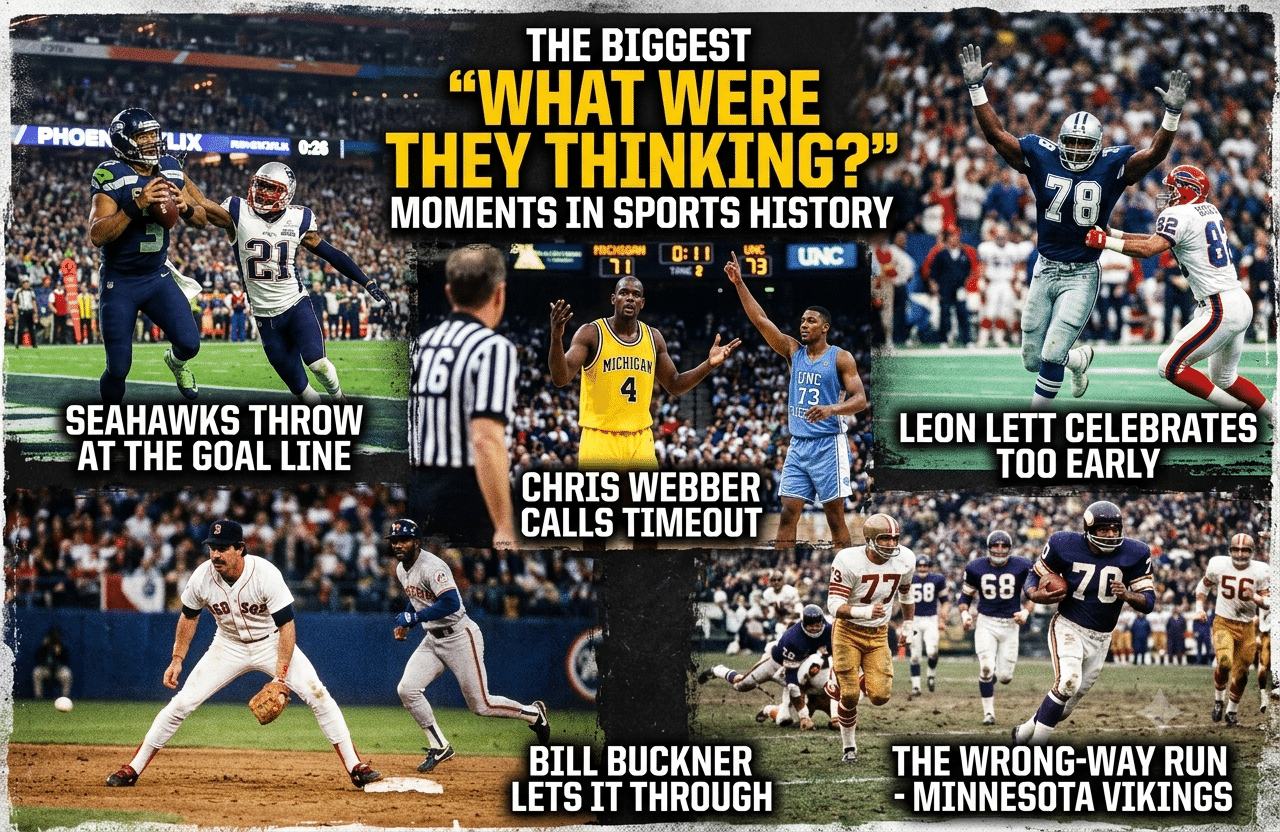
The Seahawks Throw at the Goal Line
The Seattle Seahawks’ goal-line pass in Super Bowl XLIX may be the most debated sports mistake of the modern era.
Seattle trailed the New England Patriots 28-24 in the final minute. The Seahawks had Marshawn Lynch, one of the most powerful running backs in football, and the ball near the goal line. A touchdown would almost certainly win the Super Bowl.
Then Seattle threw the ball.
Russell Wilson’s pass was intercepted by Malcolm Butler, sealing a Patriots victory and turning one play call into football immortality.
The immediate reaction was disbelief. Why not give the ball to Lynch? Why get cute? Why risk a pass in traffic when the team had Beast Mode standing behind the quarterback?
Defenders of the call have pointed out clock, personnel, and situational logic. That’s fine. Football strategy is more complicated than barstool certainty. But emotionally, the play felt impossible to justify because the result was so brutal.
Among sports mistakes, this one stands alone because it combined stakes, timing, and simplicity. Fans didn’t need a coaching clinic to understand the pain.
One yard.
Marshawn Lynch.
Super Bowl on the line.
Interception.
That’s how a decision becomes a scar.
Chris Webber Calls Timeout
Chris Webber’s timeout in the 1993 NCAA Championship Game remains one of college basketball’s most infamous brain freezes.
Michigan’s Fab Five trailed North Carolina late. Webber grabbed a rebound, dribbled upcourt, and became trapped near the sideline. Then he called timeout.
Michigan didn’t have any left.
The result was a technical foul, helping North Carolina seal the championship.
This is one of the most painful sports mistakes because Webber was a brilliant player on one of the most famous teams in college basketball history. The Fab Five had changed the sport’s style, attitude, shorts, and culture. They were young, talented, and magnetic. But that final moment became the image attached to their biggest game.
What makes the mistake so haunting is how human it was. Webber was under enormous pressure, surrounded, rushed, and trying to save a possession. His brain reached for the normal escape hatch.
There wasn’t one.
The timeout became larger than the play itself, a symbol of youth, pressure, and the cruelty of having one mistake replayed forever.
JR Smith Forgets the Score
JR Smith’s mistake in Game 1 of the 2018 NBA Finals was one of the strangest sports mistakes ever because it looked like time briefly stopped making sense.
The Cleveland Cavaliers were tied with the Golden State Warriors in the final seconds of regulation. George Hill missed a free throw. Smith grabbed the offensive rebound near the basket.
Instead of shooting or passing quickly, he dribbled away from the hoop.
LeBron James pointed and screamed. The clock ran out. The game went to overtime. Cleveland lost.
The moment became instantly infamous because it seemed Smith thought the Cavaliers were winning. Whether that was exactly what happened or not, the body language told enough of the story. LeBron’s disbelief became the defining image.
Among sports mistakes, this one stands out because it happened with the world’s best player standing nearby, desperate for one last chance. LeBron had delivered one of the greatest Finals performances ever that night, and the Cavaliers had a rare opportunity to steal Game 1 on the road.
Then confusion ate the moment.
There are turnovers.
There are missed shots.
And then there’s forgetting what the game needs from you.
Leon Lett Celebrates Too Early
Leon Lett gave sports two famous mistakes, but his Super Bowl XXVII blunder remains the classic.
The Dallas Cowboys were destroying the Buffalo Bills. Lett recovered a fumble and headed toward the end zone, ready to add another touchdown to the blowout. As he approached the goal line, he slowed down and began celebrating.
Don Beebe chased him down from behind and knocked the ball loose before Lett scored.
The Cowboys still won easily, so the mistake didn’t cost Dallas the championship. But it became unforgettable because it was such a clean lesson in finishing the play.
Among sports mistakes, Lett’s moment endures because it contained instant moral clarity. Don’t celebrate before the job is done. Don’t assume nobody is chasing. Don’t turn a touchdown into a touchback because you wanted a little style at the finish line.
Lett later had another infamous moment on Thanksgiving when he touched a blocked field goal in the snow, allowing Miami to recover and eventually win.
That’s rough.
Some athletes get one famous mistake.
Lett got a double feature.
Merkle’s Boner
Merkle’s Boner is one of baseball’s earliest legendary sports mistakes, and the name alone has kept it alive for more than a century.
In 1908, New York Giants rookie Fred Merkle was on first base when a game-winning hit appeared to beat the Chicago Cubs. Fans flooded the field, and Merkle, thinking the game was over, didn’t advance to second base.
The Cubs noticed.
They got the ball, forced Merkle out at second, and the run was nullified. The game was eventually replayed, and the Cubs went on to win the National League pennant.
The mistake became infamous, and Merkle carried the label for the rest of his life.
This remains one of the most important sports mistakes because it shows how old baseball’s obsession with technicality and heartbreak really is. Merkle did something many players might’ve done in a chaotic crowd scene, but history decided his name would become shorthand for a blunder.
That’s cruel.
It’s also very baseball.
A sport with that many rules was always going to find creative ways to ruin someone’s life.
Grady Little Leaves Pedro In
The 2003 ALCS gave Boston Red Sox fans another nightmare before the curse finally broke.
In Game 7 against the New York Yankees, Pedro Martinez was pitching with Boston ahead. But as the eighth inning unfolded, Pedro looked tired and the Yankees started to rally. Manager Grady Little went to the mound, talked to him, and left him in.
The Yankees tied the game.
Aaron Boone later won it with a walk-off home run in extra innings.
Leaving Pedro in became one of the most debated sports mistakes in baseball history. Pedro was a legend, but the moment demanded brutal clarity. Managers get paid to make hard decisions before the disaster becomes obvious to everyone else.
Little trusted his ace.
It backfired.
What made the mistake so painful was the setting. Red Sox-Yankees. Game 7. Curse of the Bambino. Boston close enough to taste the World Series. Every pitch felt like history shaking a finger.
The Red Sox got revenge in 2004, but Grady Little’s decision remains part of the old wound.
Sometimes loyalty to greatness becomes its own mistake.
Pete Carroll and the Pain of Overthinking
The Seahawks’ goal-line pass deserves its own place, but it also belongs to a larger category of sports mistakes: overthinking.
Coaches are paid to find edges. They study tendencies, personnel, clock scenarios, matchups, and probabilities. Sometimes the smart answer looks strange. Sometimes the obvious answer is only obvious to people who don’t have to manage the whole situation.
But there are moments when overthinking becomes fatal.
Seattle’s pass wasn’t the only example. Sports history is full of coaches and managers getting too clever, trusting the unexpected option, or trying to outsmart a moment that asked for simplicity.
That’s why fans get so angry. It’s not always that the decision was completely irrational. It’s that the emotional logic of the game demanded something cleaner.
Give it to your best player.
Make the safe play.
Don’t invite catastrophe.
When catastrophe arrives anyway, the explanation never sounds good enough.
The Falcons Stop Running the Ball
The Atlanta Falcons’ collapse in Super Bowl LI wasn’t one mistake. It was a collection of them.
Atlanta led the New England Patriots 28-3. Then the Patriots started crawling back. Even late, the Falcons had chances to bleed clock, protect the ball, and make the comeback almost impossible.
Instead, Atlanta kept giving New England life.
The most criticized sequence came when the Falcons were in field goal range late in the fourth quarter. Rather than playing conservatively to protect the chance at a crucial kick, Atlanta took a sack and then a holding penalty, knocking itself out of range. The Patriots completed the comeback and won in overtime.
Among sports mistakes, the Falcons’ collapse stands out because the whole second half felt like a team slowly losing its grip on reality. No single play explains everything, but the decision-making under pressure became part of the disaster.
The Patriots were brilliant.
The Falcons helped.
That’s what makes it hurt.
Blowing a huge lead is bad enough.
Helping the comeback with your own choices is worse.
Bill Buckner Lets It Through
Bill Buckner’s error in Game 6 of the 1986 World Series became one of baseball’s most famous sports mistakes, even though it unfairly swallowed a much larger collapse.
The Boston Red Sox were one strike away from winning the World Series against the New York Mets. Then the Mets rallied. A wild pitch tied the game. Then Mookie Wilson hit a grounder down the first-base line. The ball went through Buckner’s legs, allowing Ray Knight to score the winning run.
The Mets won Game 6, then Game 7.
Buckner became the face of Boston heartbreak.
That was unfair because the Red Sox had already blown the lead before the error. They also still had another game to win the series. But sports memory loves a single image, and Buckner’s mistake provided it.
Among sports mistakes, this one remains heartbreaking because Buckner was a respected player whose career became reduced to one brutal ground ball. Boston fans later softened toward him, especially after the Red Sox finally won championships.
But the image never fully disappeared.
Some mistakes don’t need to decide everything to haunt everything.
DeSean Jackson Drops the Ball Before the Goal Line
DeSean Jackson has one of the most electrifying highlight reels in NFL history, but one early-career mistake became a permanent warning.
In 2008, while playing for the Philadelphia Eagles, Jackson caught a deep pass against the Dallas Cowboys and raced toward the end zone. Before crossing the goal line, he dropped the ball in celebration.
The ball was ruled not a touchdown.
Philadelphia recovered from the mistake, but the play became infamous because it was so unnecessary. Jackson’s speed and confidence were part of his brilliance, but that moment showed the danger of style arriving one second too early.
Among sports mistakes, this one belongs because it’s the simplest possible lesson.
Cross the line first.
Celebrate second.
It’s amazing how often athletes need to be reminded of that.
Plaxico Burress Spikes the Live Ball
Before Plaxico Burress became a Super Bowl hero with the Giants, he had one of the funniest rookie mistakes in NFL history.
While playing for the Pittsburgh Steelers in 2000, Burress caught a pass, fell to the ground untouched, got up, and spiked the ball as if the play were over. But because he hadn’t been touched down, the ball was still live.
Jacksonville recovered it.
The mistake was embarrassing because it came from misunderstanding the situation, not getting beaten physically. Burress acted like the rules had changed to match his assumption. They had not.
Among sports mistakes, this one is memorable because it’s absurd in a very football-specific way. The NFL has rules that casual fans sometimes misunderstand, but professional players are expected to know when the play is alive.
Burress later built a strong career and caught the winning touchdown in Super Bowl XLII, so he escaped being defined by the blunder.
Still, the lesson remains.
Never spike a live football unless you enjoy becoming a teaching clip.
Nick Anderson’s Missed Free Throws
Nick Anderson’s missed free throws in Game 1 of the 1995 NBA Finals became one of basketball’s most painful pressure moments.
The Orlando Magic led the Houston Rockets late, and Anderson had a chance to help seal the game at the free throw line. He missed four straight free throws. Houston tied the game, won in overtime, and eventually swept the series.
This is one of the great sports mistakes because it wasn’t a brain freeze or a bad decision. It was execution failing at the worst possible time. That makes it almost harder to watch. Anderson knew what to do. He simply couldn’t get the ball to obey.
The misses seemed to affect his confidence afterward, becoming part of his career story in a way that felt cruel. Free throws are supposed to be the simplest shot in basketball, which is exactly why missing them under pressure looks so devastating.
No defender.
No scheme.
Just the player, the rim, and the weight of everything.
The Blazers Pass on Michael Jordan
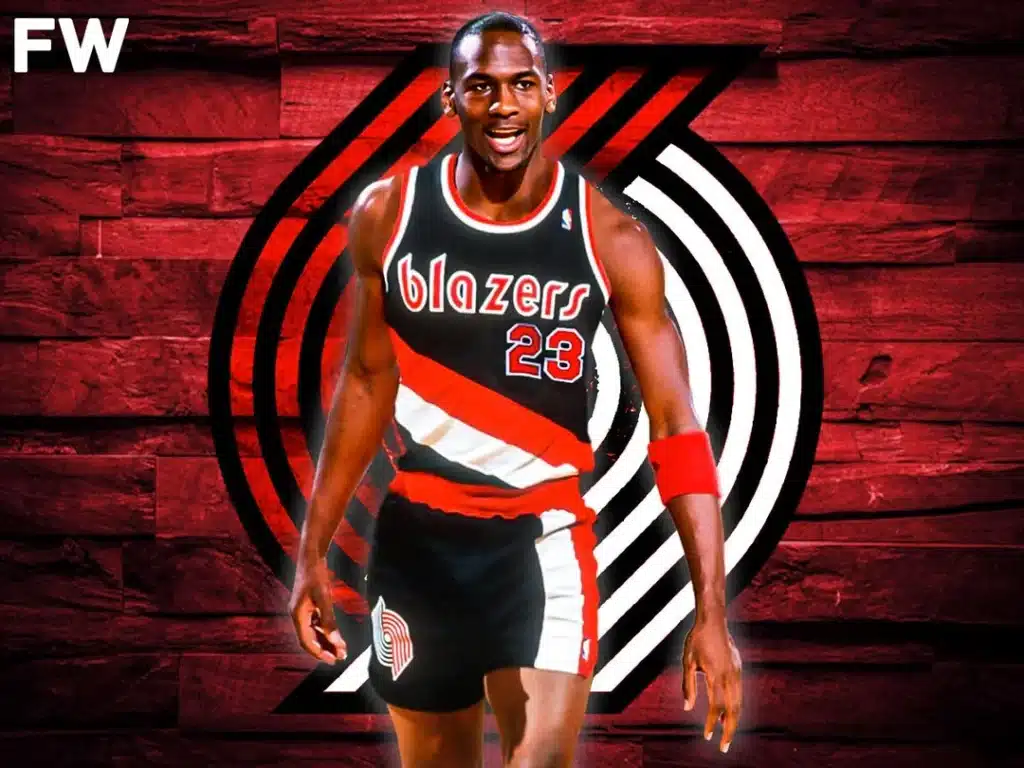
Draft mistakes deserve their own category, but Portland passing on Michael Jordan in 1984 remains the ultimate “what were they thinking?” sports mistake.
The Trail Blazers selected Sam Bowie with the No. 2 pick, one spot before the Chicago Bulls took Jordan. Bowie had size, and Portland already had Clyde Drexler, so the decision had roster logic at the time. But history did not care.
Jordan became the greatest basketball player ever.
Bowie struggled with injuries.
The mistake became a permanent warning against drafting for need over transcendent talent. Of course, hindsight makes everything look simpler. Teams evaluate players with imperfect information, and Bowie had been a highly regarded prospect. But when the missed player becomes Michael Jordan, nuance doesn’t save you.
Among sports mistakes, this one lasts because it changed the NBA’s power structure. Portland didn’t just miss out on a star. It missed the defining athlete of modern basketball.
That’s not a draft whiff.
That’s a historical accident with sneakers.
The Vikings Run Out the Clock Against Themselves
In the 1998 NFC Championship Game, the Minnesota Vikings were one of the best teams in NFL history. Their offense was explosive, their regular season was dominant, and a Super Bowl trip felt almost destined.
Then the Atlanta Falcons refused to follow the script.
Late in regulation, after Gary Anderson’s rare missed field goal helped keep Atlanta alive, the Vikings got the ball back with the score tied and time remaining. Instead of aggressively trying to move into scoring range, Minnesota took a knee and went to overtime.
The Falcons eventually won.
This belongs among sports mistakes because it wasn’t one obvious blunder like a fumble or interception. It was a choice shaped by caution, pressure, and fear of making things worse. Sometimes coaches don’t lose because they’re too reckless. Sometimes they lose because they trust safety too much.
For Vikings fans, the moment remains part of a larger history of postseason pain.
The team had a chance to chase the win.
It chose the wait.
History punished that.
The Wrong-Way Run
Wrong-way plays are some of the most haunting sports mistakes because they turn athletic instinct into comedy.
The most famous example is Jim Marshall of the Minnesota Vikings recovering a fumble in 1964 and running the wrong way into his own end zone. He thought he had scored a touchdown. Instead, he had given the San Francisco 49ers a safety.
Marshall was a great player, which makes the mistake both funnier and more forgiving. It didn’t define his whole career, but it became an unforgettable clip because the visual is so absurd.
Among sports mistakes, wrong-way plays endure because they reveal how disorienting sports can be. Fans watching from above think everything looks obvious. On the field, amid bodies, noise, adrenaline, and chaos, even direction can briefly betray someone.
That’s terrifying if you think about it too long.
Also hilarious.
Sports are generous that way.
Why “Obvious” Isn’t Always Obvious
The cruel thing about sports mistakes is that they usually look clearer from the couch.
Fans watch with angles, replays, score bugs, announcers, slow motion, and no physical consequences. Athletes and coaches live inside speed, fatigue, noise, pressure, and incomplete information. That doesn’t excuse every mistake, but it explains why impossible-looking decisions happen.
A player forgets the score because the brain is overloaded. A coach avoids a risky play because one turnover can end a season. A manager trusts a legend because pulling him feels like betrayal. A defender touches a ball because instinct beats instruction by half a second.
That’s why sports mistakes are so human.
They’re not usually made by people who don’t care.
They’re made by people trapped inside moments that demand perfect clarity while punishing panic.
Still, some mistakes are so bad that empathy only goes so far.
That’s when fans keep asking the question.
What were they thinking?
The Legacy of Sports Mistakes
The legacy of sports mistakes is that they turn one second of confusion into permanent history.
The Seahawks threw instead of handing the ball to Marshawn Lynch. Chris Webber called a timeout Michigan didn’t have. JR Smith forgot what Cleveland needed in the final seconds. Leon Lett celebrated before finishing the play. Fred Merkle didn’t touch second base. Grady Little left Pedro Martinez in too long. Atlanta helped New England complete the 28-3 comeback. Bill Buckner became the face of a Red Sox collapse. DeSean Jackson dropped the ball too early. Plaxico Burress spiked a live ball. Nick Anderson missed four free throws. Portland passed on Michael Jordan. Minnesota played too cautiously. Jim Marshall ran the wrong way.
These moments last because sports are not only about greatness.
They’re about pressure revealing the strangest parts of people.
Sometimes pressure creates a hero.
Sometimes it creates a question nobody stops asking.