
Sports history isn’t only built from what happened.
It’s also haunted by what almost happened.
That’s why sports what if moments are so addictive. They live in the gap between reality and imagination. One injury, one draft pick, one trade that didn’t go through, one retirement, one bad decision, one missed call, one life cut short, and suddenly an entire timeline feels like it split in two.
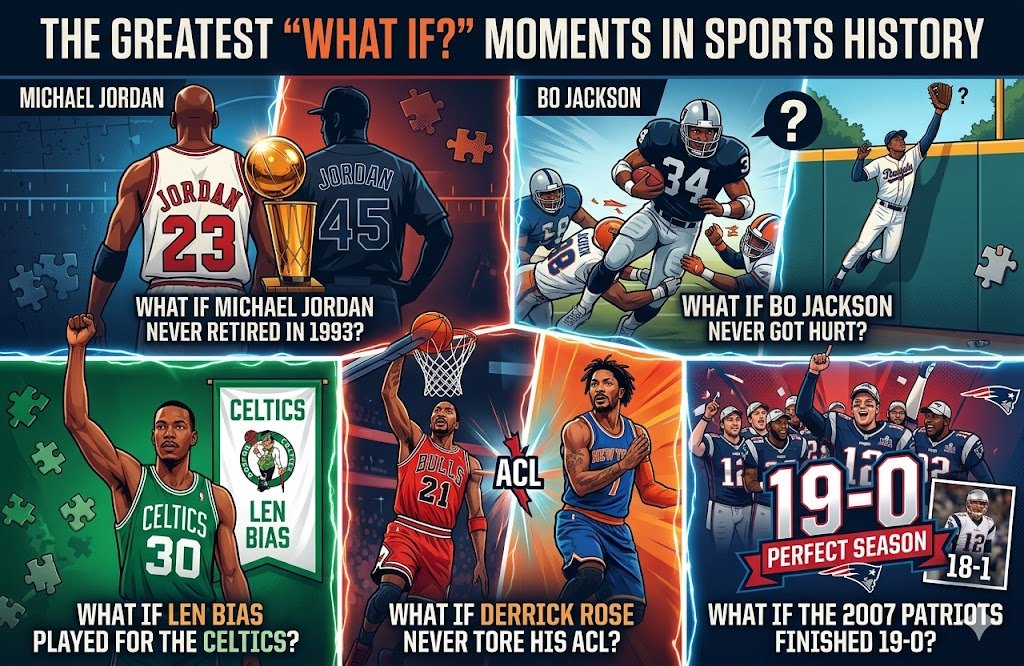
Fans love certainty when their team wins, but they love speculation even more. What if Michael Jordan never retired the first time? What if Bo Jackson stayed healthy? What if Len Bias played for the Celtics? What if Derrick Rose never tore his ACL? What if the 2007 Patriots finished the perfect season? What if Chris Paul became a Laker?
These questions never really die because they can’t be answered. That’s the power of them. A championship has a final score. A what-if has no final score. It keeps moving. It lets fans argue forever.
The greatest sports what if moments aren’t just trivia. They’re alternate histories. They make fans wonder how different leagues, dynasties, legacies, rivalries, and even entire sports cultures might’ve looked if one moment had gone another way.
Why Sports What If Moments Stay With Fans
The reason sports what if moments last is that they protect possibility.
Reality can be brutal. A career ends. A dynasty breaks apart. A prospect never develops. A trade gets blocked. A superstar leaves. A team falls one game short. But the what-if lets fans keep the dream alive in another room.
It’s not always rational. That’s fine. Sports fandom isn’t built on rational thinking. It’s built on memory, loyalty, pain, pride, and the dangerous belief that things were supposed to happen differently.
A great what-if needs more than disappointment. It needs scale. It needs a player, team, or moment big enough to make fans believe history itself could’ve changed.
Some what-ifs are personal tragedies. Some are competitive mysteries. Some are front-office disasters. Some are injury stories. Some are almost absurd because the alternate timeline sounds too dramatic to be real.
But all of them share one thing.
They make fans ask the most dangerous question in sports:
What could’ve been?
What If Michael Jordan Never Retired in 1993?
Michael Jordan’s first retirement remains one of the biggest what-ifs in sports history.
Jordan had just won three straight championships with the Chicago Bulls. He was the best basketball player in the world, the face of the NBA, and one of the most famous athletes alive. Then he walked away from basketball in 1993 and went to play baseball.
The Bulls still stayed competitive without him, but they weren’t the same. Jordan returned late in the 1994-95 season, then led Chicago to another three-peat from 1996 to 1998. That only made the question louder.
What if he’d never left?
Could the Bulls have won eight straight championships? Would Hakeem Olajuwon and the Houston Rockets still have won their two titles? Would Jordan’s legacy be even more untouchable than it already is? Or would exhaustion, roster issues, and league pressure have caught up with Chicago eventually?
That’s what makes this one so irresistible. Jordan already has one of the strongest GOAT cases in sports. But the missing years create a strange empty space in the middle of his prime.
For Bulls fans, it’s a dream.
For Rockets fans, it’s an argument.
For everyone else, it’s one of the greatest sports what if moments because it asks whether the greatest player ever might’ve been even greater.
What If Bo Jackson Never Got Hurt?
Bo Jackson is the ultimate athletic what-if.
He wasn’t just good. He felt unreal. Bo was an MLB All-Star and an NFL star, a two-sport force whose speed, power, and physical presence made him seem like a created player before video games could even do him justice.
Then came the hip injury.
Jackson’s football career ended far too early, and although he returned to baseball, the myth had already changed. Fans weren’t just watching Bo anymore. They were mourning the version of Bo that might’ve existed.
What if he stayed healthy?
Could he have become one of the greatest running backs ever? Could he have built a Hall of Fame case in two sports? Would he have eventually chosen football, baseball, or kept doing the impossible until the sports world had to redefine what athletic greatness meant?
Bo’s what-if feels different because his actual career was already legendary. He gave fans enough proof to believe the ceiling was absurd, then disappeared from football before anyone saw the full version.
Some athletes are remembered for what they did.
Bo is remembered for what he made people think was possible.
What If Len Bias Played for the Celtics?
Len Bias is one of the most tragic what-ifs in American sports.
The Boston Celtics selected Bias with the second overall pick in the 1986 NBA Draft. He was a breathtaking talent, a powerful forward with athleticism, scoring ability, and the kind of physical gifts that made people imagine him as a future superstar. Two days later, he died of a cocaine overdose.
The shock was enormous.
For Boston, Bias was supposed to be the bridge from the Larry Bird era into the future. The Celtics were already an elite team, and adding a player like Bias could’ve extended their dynasty or reshaped the Eastern Conference. Instead, the franchise was left with grief, unanswered questions, and one of the darkest turns in NBA history.
What if Len Bias had lived?
Would the Celtics have battled Michael Jordan’s Bulls differently? Would Larry Bird’s later years have carried less weight? Would Boston have avoided the long decline that followed? Would Bias have become one of the great forwards of his generation?
This isn’t just a basketball question. It’s a human one.
Some sports what if moments are fun to debate. This one hurts because the loss was bigger than the game.
What If Derrick Rose Never Tore His ACL?
Derrick Rose was the youngest MVP in NBA history.
That sentence still feels heavy.
In 2011, Rose looked like the next great superstar guard. He was explosive, fearless, and violent in the air. He attacked the rim like gravity had personally offended him. The Chicago Bulls were back near the top of the Eastern Conference, and Rose seemed ready to become the face of the league’s next era.
Then came the ACL tear in the 2012 playoffs.
Rose returned and played for years, even reinvented himself into a respected veteran, but the MVP version never fully came back. That’s the wound.
What if Rose stayed healthy?
Could the Bulls have challenged LeBron James and the Miami Heat? Could Rose have won more MVPs? Would Chicago have built another championship era? Would the league’s point guard hierarchy look completely different?
Rose’s what-if stays alive because fans saw enough to believe. He wasn’t just potential. He was already there. He’d already reached the mountaintop individually. The question is what might’ve happened if his body had let him stay there.
That’s why this remains one of the most painful sports what if moments of the modern era.
What If the 2007 Patriots Finished 19-0?
The 2007 New England Patriots were one win away from perfection.
They went 16-0 in the regular season. Tom Brady threw 50 touchdown passes. Randy Moss caught 23 touchdowns. The offense looked unstoppable, and the team carried the icy confidence of a dynasty trying to do something historic.
Then came Super Bowl XLII.
The New York Giants shocked them 17-14, helped by one of the most famous plays in NFL history: Eli Manning escaping pressure and David Tyree making the helmet catch.
The Patriots still became one of the greatest dynasties ever. Brady still became the most decorated quarterback in NFL history. Belichick still built a football empire.
But 19-0 would’ve changed everything.
It would’ve made the 2007 Patriots the cleanest answer to the greatest team debate. It would’ve placed them beside, and maybe above, the 1972 Dolphins. It would’ve turned an already hated dynasty into something almost mythological.
Instead, their season became one of the strangest contradictions in sports: one of the best teams ever, remembered most for the one game it lost.
That’s what makes the 2007 Patriots one of the greatest sports what if moments. Perfection was right there.
Then it vanished.
What If Chris Paul Had Been Traded to the Lakers?
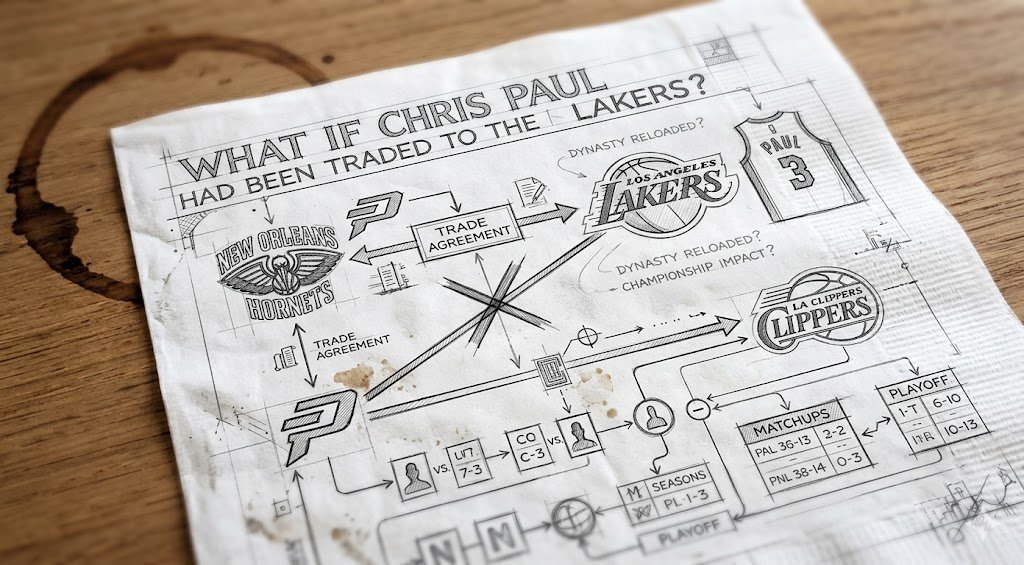
The blocked Chris Paul trade to the Los Angeles Lakers is one of the NBA’s great alternate timelines.
In 2011, Paul was set to join Kobe Bryant in Los Angeles before the league, which owned the New Orleans Hornets at the time, blocked the deal. Paul eventually went to the Los Angeles Clippers instead, changing the direction of both LA franchises.
But the question still lingers.
What if Chris Paul had become a Laker?
Kobe was still elite. Paul was the best pure point guard in the league. Together, they could’ve extended the Lakers’ championship window and completely changed the Western Conference. Maybe Dwight Howard’s later arrival looks different. Maybe Kobe’s workload changes. Maybe the Lakers avoid the collapse that came in the mid-2010s.
Or maybe it doesn’t work. That’s the beauty of the question.
The blocked trade remains one of the great sports what if moments because it involved power, politics, stars, and one of the league’s glamour franchises. It wasn’t just a trade that failed.
It was a future that got vetoed.
What If Kevin Durant Never Joined the Warriors?
Kevin Durant joining the Golden State Warriors in 2016 actually happened, but the what-if asks the reverse.
What if he hadn’t?
The Warriors had just blown a 3-1 lead in the NBA Finals after winning 73 games. The Cavaliers had delivered Cleveland’s first major championship in decades. The league was set up for a fascinating rivalry between LeBron’s Cavs and Curry’s Warriors.
Then Durant joined Golden State and tilted the entire NBA.
Without Durant, do the Warriors recover and win more titles anyway? Do the Cavaliers repeat? Does LeBron’s legacy look different? Does Durant stay in Oklahoma City and eventually win there? Does Russell Westbrook’s career change? Does the league avoid years of fans feeling like the championship was decided in July?
This what-if is interesting because Durant’s move created one of the most talented teams ever, but it also drained suspense from the league for many fans.
The alternate timeline might’ve been messier.
It also might’ve been more fun.
What If Ken Griffey Jr. Stayed Healthy?
Ken Griffey Jr. was baseball joy.
The swing. The smile. The backwards cap. The catches. The effortless cool. In the 1990s, Griffey felt like the clean, electric face of baseball’s future. He had superstar production and superstar charisma.
Then injuries piled up, especially after his move to Cincinnati.
Griffey still hit 630 home runs and made the Hall of Fame. That’s what makes this what-if so wild. Even with all the missed time and physical setbacks, he still had one of the greatest careers ever.
So what if he’d stayed healthy?
Could he have broken Hank Aaron’s home run record before Barry Bonds did? Would he be more central in the GOAT baseball conversation? Would his legacy sit even higher than it already does?
Griffey’s what-if isn’t about failure. It’s about an all-time great who somehow still feels like he had another level stolen by injuries.
That’s rare.
When 630 home runs still leaves people asking what could’ve been, the what-if is massive.
What If the Portland Trail Blazers Drafted Michael Jordan?
The Portland Trail Blazers drafted Sam Bowie second overall in 1984.
Michael Jordan went third to the Chicago Bulls.
That sentence became a permanent scar in NBA draft history.
To be fair, Portland already had Clyde Drexler and needed a big man. Bowie had talent, but injuries derailed his career. Jordan became Jordan. Once that happened, the pick became impossible to defend in sports memory, even if the logic at the time was more complicated than fans like to admit.
What if Portland drafted Jordan?
Do Jordan and Drexler play together? Does Chicago ever become a dynasty? Does Phil Jackson still become Phil Jackson? Does the NBA’s global explosion look different without Jordan in a Bulls uniform? Do the Blazers become the defining team of the late 1980s and 1990s?
This is one of the greatest sports what if moments because it changes almost everything. Some what-ifs affect one team. This one could’ve changed the league’s entire mythology.
Jordan in Portland doesn’t just look strange.
It feels like another universe.
What If Tiger Woods Avoided Injuries and Personal Collapse?
Tiger Woods had one of the most dominant peaks in sports history.
At his best, he didn’t just win golf tournaments. He made everyone else feel like they were playing for second place. He changed television ratings, prize money, fitness expectations, and the cultural profile of golf itself.
Then injuries, surgeries, and personal scandal interrupted what once looked like an inevitable march toward every record.
Tiger still produced one of the greatest comeback moments in sports history by winning the 2019 Masters. But the larger question remains.
What if Tiger’s body had held up? What if the personal collapse never happened? How many majors would he have won? Would Jack Nicklaus’ record have fallen? Would the debate over golf’s greatest player even exist anymore?
Tiger’s what-if is powerful because he already reached heights almost nobody touches. Yet the interruptions were so significant that fans can still imagine a version of his career that’s even more absurd.
That’s the strange burden of genius.
Even greatness can feel incomplete.
Why Sports What If Moments Never End
Sports what-if debates never end because they let fans rewrite pain.
A lost player can become a legend. A failed trade can become a dynasty. An injury can become a missing chapter. A blocked move can become a conspiracy. A draft mistake can become an entire alternate league history.
These stories work because sports are already built on tiny margins. A ball bounces. A knee gives out. A front office panics. A commissioner says no. A young star makes one choice instead of another.
Then the future changes.
Fans know the real timeline. They watched it. They lived with it. But the alternate timeline stays tempting because it doesn’t have to disappoint anyone. It can stay perfect forever.
That’s why sports what if moments are so durable. They’re not just questions.
They’re unfinished dreams.
The Legacy of Sports What If Moments
The legacy of the greatest sports what if moments is that they remind us how fragile sports history really is.
Michael Jordan’s retirement left space in the middle of a dynasty. Bo Jackson’s injury robbed fans of a full athletic miracle. Len Bias’ death changed a franchise and devastated a family. Derrick Rose’s ACL tear altered the path of a superstar. The 2007 Patriots lost perfection by one game. The Chris Paul Lakers trade disappeared before it could exist. Portland passing on Jordan became draft-night folklore.
These stories keep coming back because they sit between fact and imagination. They give fans a way to mourn, argue, dream, and rewrite the record book without touching the official one.
Sports history looks solid after it happens.
But it isn’t.
It’s made of bodies, timing, choices, luck, ambition, injury, money, pressure, and one impossible bounce after another.
That’s why the what-if never goes away.
It’s the ghost version of the game.