
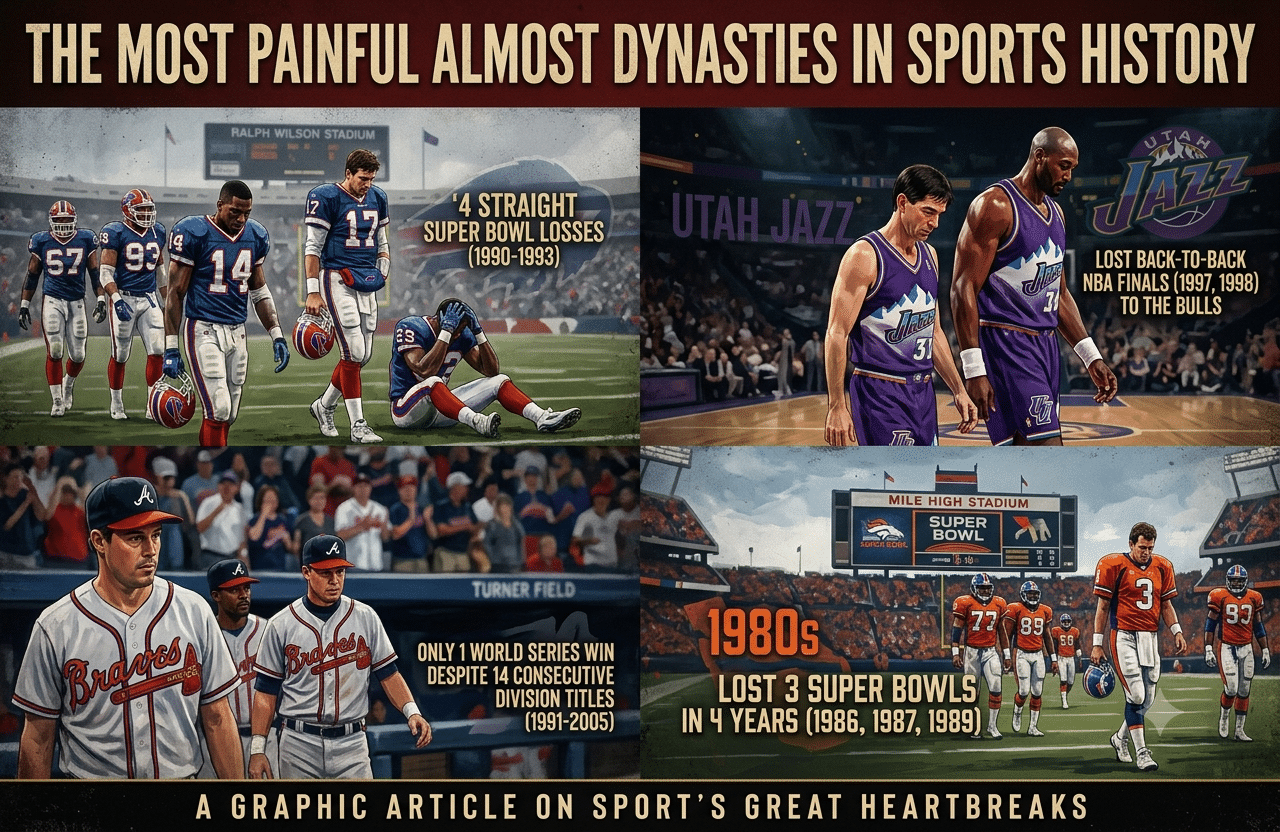
Almost dynasties may be the cruelest teams in sports history.
Bad teams hurt, but at least they tell the truth early. They lose in September. They collapse in January. They draft high. They make fans angry, but they rarely make anyone believe too much.
Almost dynasties are different.
They give fans the full vision first.
The stars are there. The chemistry is there. The coach might be there. The system works. The window opens. The team wins 55 games, 100 games, 13 games, a division title, a conference title, maybe even a pennant or Finals trip. Everyone can see it coming. This is the group. This is the core. This is the start of something.
Then it isn’t.
A missed field goal. A bad matchup. A stronger dynasty in the way. A cheap owner. A brutal injury. A trade too soon. A referee controversy. A locker room fracture. One cold shooting night. One opponent that just won’t go away.
That’s what makes almost dynasties so painful. They don’t fail because fans imagined greatness out of nothing. They fail because greatness was close enough to touch.
A true dynasty gets rings.
An almost dynasty gets documentaries, arguments, and a fanbase that still says, “If only.”
Why Almost Dynasties Hurt So Much
Almost dynasties hurt because they create a memory of the future.
Fans don’t only remember what happened. They remember what should’ve happened. They remember the titles that felt inevitable, the stars who should’ve stayed together, the years that should’ve produced parades, and the league that should’ve belonged to them.
That future never officially existed, but fans can still see it.
Almost dynasties also create resentment toward timing. Sometimes the team was great, but another team was greater. The 1990s Bills ran into NFC powerhouses. The Stockton-Malone Jazz ran into Michael Jordan. The early 2000s Kings ran into the Lakers. The 2010s Thunder ran into injuries, finances, and the Warriors’ rise.
That’s the cruel thing.
Almost doesn’t always mean fraudulent.
Sometimes almost means historically unlucky.
The 1990s Buffalo Bills
The 1990s Buffalo Bills are the ultimate almost dynasty.
Four straight Super Bowl appearances. Four straight losses.
That sentence still feels impossible.
The Bills had Jim Kelly running the K-Gun offense, Thurman Thomas in the backfield, Andre Reed catching passes, Bruce Smith wrecking offenses, Marv Levy coaching, and a roster good enough to dominate the AFC for years. They weren’t flukes. They weren’t one-year wonders. They were a machine.
They just couldn’t finish the final game.
Wide Right against the Giants in Super Bowl XXV became the defining wound. Then came losses to Washington and Dallas, including two straight against a Cowboys team building an actual dynasty.
Among almost dynasties, Buffalo stands alone because the Bills got closer than anyone could reasonably ask. They didn’t lose before the stage. They didn’t disappear after one run. They made the Super Bowl four consecutive times, which is its own kind of greatness.
But sports history is harsh.
Four AFC championships became four reminders of what was missing.
Buffalo didn’t become a dynasty.
It became the most painful proof that getting there isn’t enough.
The Stockton-Malone Utah Jazz
The Utah Jazz of John Stockton and Karl Malone were one of the greatest almost dynasties in NBA history.
They had everything a contender needs: a Hall of Fame point guard, a Hall of Fame power forward, Jerry Sloan’s discipline, pick-and-roll precision, toughness, continuity, and a home crowd that made Salt Lake City miserable for opponents.
What they didn’t have was a solution for Michael Jordan.
The Jazz reached back-to-back NBA Finals in 1997 and 1998. Both times, they lost to the Chicago Bulls. Both times, the series was close enough to make Utah fans feel haunted. Jordan’s Flu Game came against them. His final Bulls shot came against them. Malone’s turnover before that shot remains part of the wound.
This is what makes the Jazz one of the most painful almost dynasties. They weren’t soft. They weren’t fraudulent. They were excellent for years. They just peaked at the same time as the most iconic dynasty in modern basketball.
That timing became their curse.
Stockton and Malone became legends without the one thing fans use too often to settle arguments.
A ring.
The 2000s Sacramento Kings
The early 2000s Sacramento Kings were beautiful, brilliant, and doomed.
They had Chris Webber, Vlade Divac, Peja Stojaković, Mike Bibby, Doug Christie, Bobby Jackson, and one of the most entertaining offenses the NBA had ever seen. The ball moved. The crowd roared. Arco Arena shook with cowbells. The Kings played smart, creative basketball that felt ahead of its time.
Then they ran into the Lakers.
The 2002 Western Conference Finals remains one of the most debated series in NBA history. Sacramento led the defending champion Lakers and looked ready to break through. Game 6 became infamous for controversial officiating. Game 7 went to overtime. The Lakers survived. The Kings never got that close again.
Among almost dynasties, the Kings are especially painful because their window felt stolen by a combination of timing, controversy, and fragility. They weren’t built like the Lakers, with Shaq and Kobe as gravitational superstars. They were built on passing, skill, chemistry, and collective confidence.
That made them lovable.
It also made the heartbreak feel communal.
Sacramento didn’t just lose a series.
It lost the version of basketball that might’ve won.
The Seven Seconds or Less Suns
The Phoenix Suns under Mike D’Antoni were one of basketball’s great almost dynasties because they helped change the sport without winning the title.
Steve Nash ran the show with genius, Amar’e Stoudemire attacked the rim, Shawn Marion filled every gap, and the Suns played fast, spaced the floor, shot threes, and treated tempo like a weapon. At their best, they made traditional basketball look outdated.
The problem was that the league hadn’t fully caught up yet.
Phoenix kept running into bigger, slower, more physical playoff opponents, especially the San Antonio Spurs. The 2007 playoff series against San Antonio became a defining heartbreak after suspensions hurt the Suns following a late-game altercation. To this day, Suns fans can argue themselves sick over what might’ve happened with a full roster.
Among almost dynasties, the Suns stand out because their legacy is philosophical. They didn’t win the championship, but they helped point the NBA toward the future. Pace, space, shooting, small-ball ideas, and offensive freedom became central to modern basketball later.
That’s the strange cruelty.
The Suns were right.
They were just early.
The 2010s Oklahoma City Thunder
The Oklahoma City Thunder should’ve become a dynasty.
That’s what makes their story so painful.
Kevin Durant, Russell Westbrook, James Harden, and Serge Ibaka were on the same young roster. That sounds like someone built a team in a video game and forgot to turn fairness back on. They reached the 2012 NBA Finals and looked like the future of the league.
Then the future broke apart.
Harden was traded to Houston. Injuries hit. Playoff losses piled up. Durant eventually left for Golden State after the Thunder blew a 3-1 lead to the Warriors in the 2016 Western Conference Finals. Westbrook stayed, won an MVP, and became a solo force, but the dynasty window had already closed.
Among almost dynasties, the Thunder may be the most maddening because the talent was obvious before everyone fully understood how historic it was. Three future MVPs on one team. One Finals trip. Zero championships together.
That’s not just a missed window.
That’s a whole skyscraper left unfinished.
Fans can argue about money, ownership, patience, fit, coaching, injuries, and egos. All of it matters.
The simplest truth still hurts most.
They had them.
Then they didn’t.
The 1990s Atlanta Braves
The Atlanta Braves are a complicated case because they did win a championship.
That 1995 World Series title matters. It means they aren’t a ringless almost dynasty. But considering how dominant the Braves were across the 1990s and early 2000s, one title can still feel strangely small compared with what the era promised.
The Braves had Greg Maddux, Tom Glavine, John Smoltz, Chipper Jones, Bobby Cox, and a remarkable run of division dominance. Their pitching was historic. Their consistency was absurd. They were always there, always dangerous, always part of October.
But the postseason payoff never matched the regular-season machine.
They lost World Series to the Twins, Blue Jays, and Yankees. They lost playoff series that felt winnable. They became known as a team that could dominate the long season but not always deliver the final blow.
Among almost dynasties, the Braves are painful because they were so close to being remembered like the Yankees of their era. Instead, they’re remembered as one of baseball’s greatest sustained winners with one ring to show for a mountain of excellence.
That’s still greatness.
It’s just not the full empire it could’ve been.
The 1990s Cleveland Indians
The 1990s Cleveland Indians had one of baseball’s most terrifying lineups and one of the sport’s most painful unfinished stories.
Albert Belle, Manny Ramirez, Jim Thome, Kenny Lofton, Carlos Baerga, Sandy Alomar Jr., Omar Vizquel — Cleveland had stars, power, speed, defense, and a fanbase desperate for a title. Jacobs Field was electric. The team felt like a monster.
They reached the World Series in 1995 and 1997.
They lost both.
The 1997 loss to the Florida Marlins in Game 7 was especially brutal. Cleveland was close to ending a long championship drought, only to watch the title slip away in extra innings.
Among almost dynasties, Cleveland stands out because the offense felt championship-worthy for years. The team didn’t just have a good season. It had a window where Cleveland baseball looked ready to own the American League.
Instead, the Yankees dynasty rose. The Marlins stole 1997. The core eventually scattered.
Cleveland fans know this pattern too well.
Hope arrives loud.
Heartbreak stays longer.
The Early 2000s Oakland Athletics
The Moneyball Oakland A’s became famous for challenging baseball’s rich teams with intelligence, efficiency, and stubbornness.
Billy Beane’s front office found undervalued players, emphasized on-base percentage, and built competitive teams despite a limited payroll. The A’s had stars and near-stars, including Jason Giambi, Miguel Tejada, Eric Chavez, Tim Hudson, Mark Mulder, and Barry Zito. They won 103 games in 2002 and helped change how baseball thought about roster construction.
But October kept ending badly.
The A’s lost multiple heartbreaking Division Series and never reached the World Series during that era. The Moneyball story became culturally massive, but the team’s own postseason ceiling stayed frustratingly low.
Among almost dynasties, Oakland is fascinating because its influence was bigger than its trophy case. The A’s helped reshape baseball thinking, but other teams with more money eventually adopted similar ideas and used them with deeper resources.
That’s the cruelest part.
Oakland found the edge.
Then richer teams bought the better version.
The 1980s Denver Broncos
John Elway’s Denver Broncos were one of the NFL’s most painful almost-dynasties before the franchise finally broke through.
Elway carried Denver to three Super Bowls in the 1980s, but each ended in a loss. The Broncos fell to the Giants, Washington, and the 49ers, often in games that turned ugly. Elway’s brilliance got them to the stage, but the roster around him wasn’t always strong enough to finish the job against NFC powerhouses.
This makes the Broncos one of football’s classic almost dynasties. They had the franchise quarterback. They had dramatic playoff moments. They had the fanbase, the identity, and the repeated chances.
They didn’t have the rings yet.
The story eventually changed when Elway won back-to-back Super Bowls in the late 1990s with Terrell Davis and a stronger supporting cast. That redemption softened the earlier heartbreak, but it didn’t erase it.
The 1980s Broncos are a reminder that even an all-time quarterback can spend years dragging a team close enough to suffer.
Sometimes greatness needs help.
Elway eventually got it.
Just not soon enough for those teams.
The Ewing Knicks
The Patrick Ewing-era New York Knicks were built for war.
They were physical, defensive, bruising, and impossible to ignore. Ewing was the franchise center, Pat Riley and later Jeff Van Gundy gave them identity, and Madison Square Garden turned every playoff game into a street fight with better lighting.
The Knicks were very good for a long time.
They just never won the title.
Michael Jordan’s Bulls blocked them repeatedly. When Jordan first retired, New York reached the 1994 NBA Finals, only to lose to Hakeem Olajuwon and the Houston Rockets in seven games. Later Knicks teams kept fighting, but the championship never came.
Among almost dynasties, the Ewing Knicks are painful because they represented New York with such force. They weren’t elegant. They weren’t universally loved. But they were real. Hard fouls, low scores, elbows, fights, hatred, defense — they gave the city a team that matched its self-image.
A title would’ve made them immortal.
Without it, they became one of the defining almost teams of the 1990s.
The Garden still remembers the noise.
It also remembers what never arrived.
The Portland Trail Blazers of the Early 1990s
The early 1990s Portland Trail Blazers were good enough to win a championship.
Clyde Drexler led a deep, athletic, balanced team that reached the NBA Finals in 1990 and 1992 and also posted excellent regular seasons. Portland had size, speed, defense, and experience. For a few years, the Blazers looked like one of the league’s most complete teams.
They lost to the Detroit Pistons in 1990.
They lost to Michael Jordan’s Bulls in 1992.
That’s rough company.
Among almost dynasties, Portland’s pain comes from being excellent at the wrong time. Drexler was a superstar. The roster was strong. The franchise had a real window. But the NBA was moving through the end of Detroit’s reign and the rise of Chicago’s.
There wasn’t much oxygen left.
Drexler eventually won a title with Houston, which helped his personal legacy. But Portland’s window closed without the championship that would’ve changed how those teams are remembered.
Sometimes an almost dynasty doesn’t fail because it lacks greatness.
It fails because the league has already chosen its next ruler.
The Early 2000s Philadelphia Eagles
The Donovan McNabb and Andy Reid Eagles were one of the NFL’s most consistent almost dynasties.
Philadelphia reached four straight NFC Championship Games from the 2001 through 2004 seasons and made the Super Bowl after the 2004 season. The team had McNabb, Brian Westbrook, a strong defense, smart coaching, and a fanbase desperate for a title.
They kept getting close.
Then close turned cruel.
The Eagles lost three straight conference championship games before finally breaking through to the Super Bowl, where they lost to Tom Brady and the New England Patriots. That era produced years of winning, but not the parade Philadelphia wanted.
Among almost dynasties, the Eagles are painful because the consistency was real. They weren’t a fluke contender. They were always in the mix, always dangerous, always one step from the final validation.
Philadelphia eventually got its Super Bowl with a different team in 2017.
That helped the city.
But for the McNabb-Reid era, the absence still lingers.
They built the window.
They just couldn’t climb all the way through it.
The 1980s Milwaukee Brewers
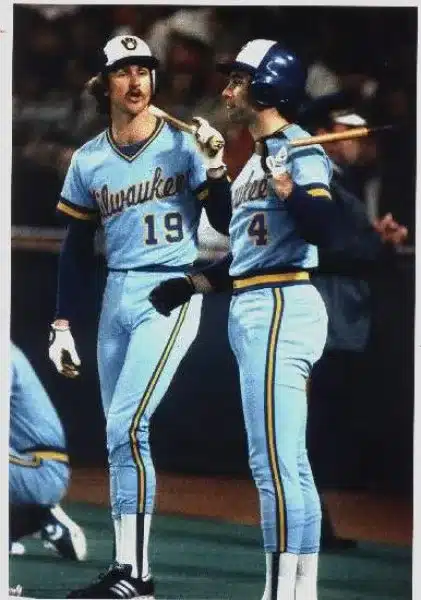
The early 1980s Milwaukee Brewers, especially the 1982 team known as “Harvey’s Wallbangers,” had one of baseball’s great near-miss windows.
Led by Robin Yount, Paul Molitor, Cecil Cooper, Gorman Thomas, and a powerful lineup, the Brewers reached the 1982 World Series against the St. Louis Cardinals. Milwaukee had personality, offense, and a fanbase ready for the franchise’s first championship.
They lost in seven games.
The Brewers remained competitive, but that World Series became the peak. The dynasty never came. The title never came.
Among almost dynasties, Milwaukee belongs because smaller-market heartbreak hits differently. Not every franchise gets repeated chances. When the window opens, fans know it may not stay open long. The 1982 Brewers were good enough, memorable enough, and beloved enough to become a permanent part of the city’s sports identity.
But almost was all they got.
Sometimes almost dynasties don’t last a decade.
Sometimes they last just long enough for everyone to fall in love.
Why Almost Dynasties Fall Apart
Almost dynasties fall apart because championship windows are fragile.
Fans talk about windows like they’re stable structures. They aren’t. They’re more like weather. A team may have two or three real chances before contracts, injuries, age, egos, ownership, coaching changes, and bad luck start pulling everything apart.
Sometimes the stars leave.
Sometimes the rival is too strong.
Sometimes the front office gets scared.
Sometimes the sport changes.
Sometimes a team is ahead of its time, and by the time everyone understands it, the roster is gone.
That’s what makes almost dynasties so tragic. They prove how hard it is to win even once, let alone rule an era. Being great isn’t enough. Being healthy isn’t enough. Being innovative isn’t enough. Being beloved isn’t enough.
A dynasty needs greatness plus timing.
Almost dynasties usually have one without the other.
The Legacy of Almost Dynasties
The legacy of almost dynasties is that they keep sports fans arguing with ghosts.
The 1990s Bills went to four straight Super Bowls and lost them all. The Stockton-Malone Jazz ran into Michael Jordan at the worst possible time. The early 2000s Kings played beautiful basketball and still couldn’t get past the Lakers. The Seven Seconds or Less Suns helped invent the future but never won the present. The Thunder had Durant, Westbrook, Harden, and Ibaka, then watched the window collapse. The Braves won once, but left fans wondering how one of baseball’s greatest runs didn’t produce more. Cleveland’s 1990s baseball teams had the bats, the stars, and the heartbreak. The Moneyball A’s changed the sport without conquering October. The Ewing Knicks fought through the Jordan era and came up empty. The McNabb-Reid Eagles kept knocking until the door finally closed.
Almost dynasties matter because they show how thin the line is between history and heartbreak.
One bounce.
One trade.
One injury.
One bad inning.
One rival born at the wrong time.
A dynasty gets banners.
An almost dynasty gets memory, pain, and the forever argument that it should’ve been more.