
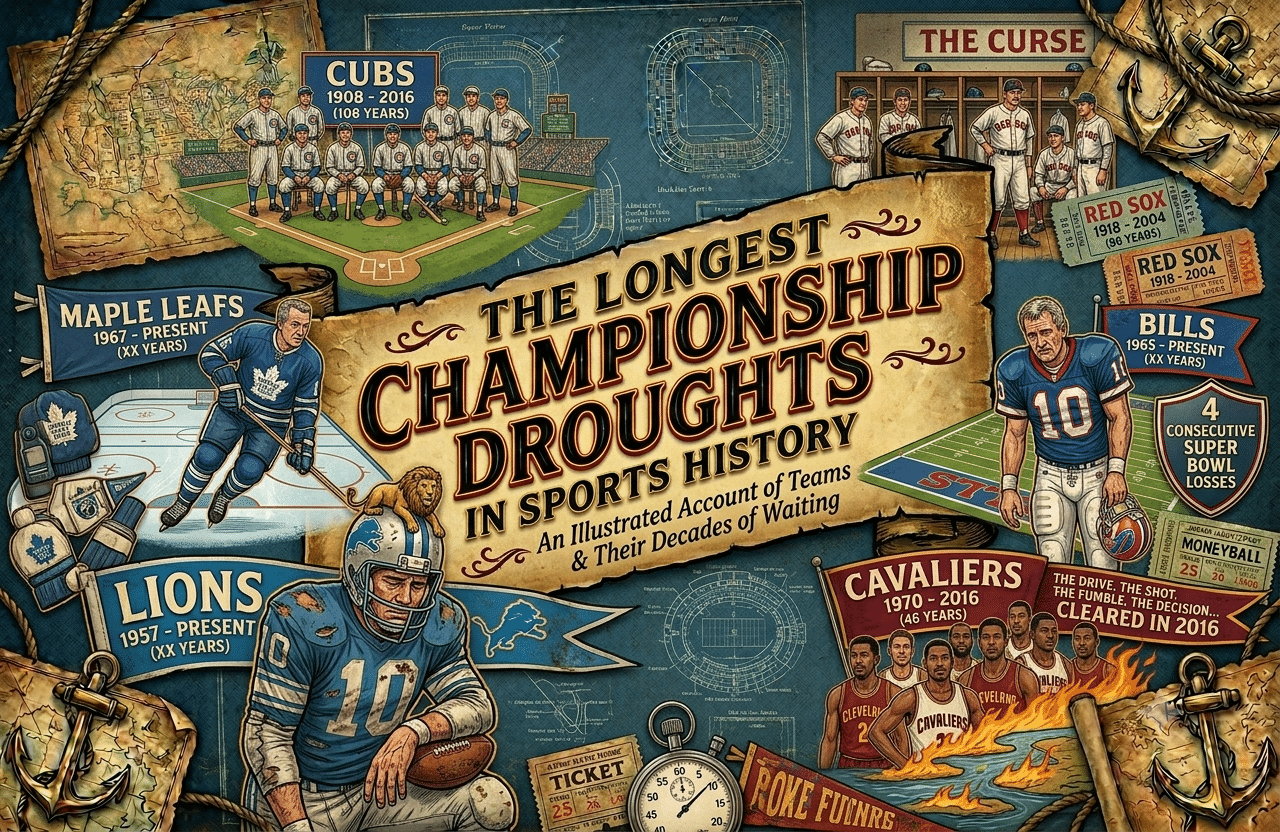
Championship droughts are where hope goes to get tested.
Every fanbase says it suffers. That’s part of being a fan. A bad season feels personal. A blown lead feels criminal. A missed playoff run feels like proof the universe has a grudge.
But some fanbases don’t just suffer for a season.
They suffer for generations.
That’s what makes championship droughts different. They stretch beyond one roster, one coach, one bad front office, or one painful loss. They become inherited. Parents pass them to kids. Grandparents tell stories about the last title like they’re describing a different country. Fans learn early that belief comes with danger.
The cruelest part is that droughts don’t always mean constant failure. Sometimes the team gets close. Sometimes it has stars. Sometimes it wins divisions, makes deep playoff runs, builds hope, and looks ready to end the whole nightmare.
Then something happens.
A curse. A collapse. An injury. A bad call. A missed kick. A cold bat. A hot goalie. A front office mistake. A dynasty standing in the way. A city holding its breath too soon.
The longest championship droughts in sports history aren’t just about losing.
They’re about waiting so long that waiting becomes part of the team’s identity.
Why Championship Droughts Matter
Championship droughts matter because they reveal the deepest kind of fandom.
Winning fans are easy to understand. They show up for parades, buy jerseys, talk trash, and expect more. Long-suffering fans are different. They keep showing up when the evidence says they shouldn’t. They defend teams that keep hurting them. They remember obscure players from losing seasons. They build rituals around disappointment.
That kind of loyalty is irrational.
It’s also beautiful.
A championship means more after a drought because the title doesn’t belong only to the current roster. It belongs to everyone who waited. Every fan who watched bad teams. Every family member who died before seeing the parade. Every kid who grew up hearing “maybe next year” and became an adult saying the same thing.
When a drought ends, it doesn’t feel like a normal championship.
It feels like a haunting stopped.
Chicago Cubs
The Chicago Cubs had the most famous championship drought in American sports.
Before 2016, the Cubs hadn’t won a World Series since 1908. That number became less a statistic and more a curse. Generations of fans lived and died without seeing the team win it all. Wrigley Field stayed beautiful, loyal, and wounded. The Cubs became lovable losers, which sounds charming until you remember losing hurts.
The mythology around the drought grew huge. The Curse of the Billy Goat. Steve Bartman. 1969. 1984. 2003. Every near-miss added another layer to the story. The Cubs didn’t merely fail to win. They failed in ways that felt designed by a cruel playwright.
Then 2016 happened.
The Cubs won 103 games, survived October pressure, and reached the World Series against Cleveland, another franchise carrying its own drought. Game 7 became almost too dramatic: rain delay, extra innings, blown lead, comeback, panic, release.
When the Cubs finally won, it felt like more than baseball.
It felt like time breaking open.
Among championship droughts, the Cubs’ 108-year wait remains the standard because the ending had everything: history, fear, drama, and the relief of a century finally exhaling.
Boston Red Sox
The Boston Red Sox drought lasted 86 years, and somehow it became one of baseball’s greatest stories.
Before 2004, the Red Sox hadn’t won a World Series since 1918. The “Curse of the Bambino” became the explanation, the joke, and the wound. Babe Ruth had been sold to the Yankees, and Boston spent decades watching New York become baseball royalty while Red Sox fans learned creative ways to suffer.
The drought had iconic heartbreaks. Bucky Dent. Bill Buckner. Aaron Boone. The Yankees weren’t just a rival. They were the monster at the end of every Boston nightmare.
Then the 2004 Red Sox did something impossible.
They fell behind the Yankees 3-0 in the ALCS, then won four straight. No MLB team had ever come back from that deficit in a postseason series. Boston didn’t just break the curse. It broke it by humiliating the Yankees first.
Then the Red Sox swept the Cardinals in the World Series.
That’s why this is one of the most unforgettable championship droughts ever. The ending was too perfect for fiction. Boston’s pain didn’t fade quietly. It exploded into one of the greatest comeback stories in sports history.
For Red Sox fans, 2004 wasn’t just a title.
It was liberation.
Cleveland Cavaliers
Cleveland’s professional sports pain became a national storyline before LeBron James finally delivered.
The city had suffered through decades without a major championship. The Browns had “The Drive” and “The Fumble.” Cleveland baseball had near-misses. The Cavaliers had been close enough to dream but never close enough to celebrate.
Then LeBron returned to Cleveland and carried the weight of an entire region with him.
The 2016 NBA Finals looked lost when the Cavaliers fell behind the Golden State Warriors 3-1. Golden State had won 73 games. Stephen Curry was the unanimous MVP. The Warriors looked like a historically great team ready to finish the story.
Instead, Cleveland won three straight.
LeBron’s block. Kyrie Irving’s shot. Kevin Love’s defense. Game 7 became Cleveland scripture.
The Cavaliers ended the city’s 52-year major championship drought, and the parade felt like something deeper than basketball. It was a city finally getting to put down a burden it had carried for too long.
Among championship droughts, Cleveland’s ended with one of the most cinematic finishes ever.
Down 3-1.
Against a 73-win team.
For a city that had heard every joke.
That’s not just a championship.
That’s revenge on history.
Toronto Maple Leafs
The Toronto Maple Leafs’ drought is one of hockey’s most painful because the franchise is so famous, so wealthy, and so central to the sport’s culture.
The Maple Leafs haven’t won the Stanley Cup since 1967. That’s hard enough. But the pressure in Toronto makes the drought feel even heavier. This isn’t a small-market team quietly wandering through mediocrity. This is one of the NHL’s flagship franchises, playing in a city where hockey attention can feel suffocating.
Every promising Leafs team carries ghosts.
Fans don’t just watch the current roster. They watch decades of failure standing behind it. Every playoff lead gets nervous. Every elimination feels like part of a larger curse. Every star arrives with the same question: are you the one who finally ends it?
That’s what makes the Leafs one of the defining championship droughts in sports. The drought isn’t hidden. It lives under bright lights. Every postseason failure gets national attention in Canada and endless dissection from fans, media, and rivals.
Toronto doesn’t just want a Cup.
Toronto needs the old joke to die.
Until that happens, the drought remains one of sports’ loudest open wounds.
Buffalo Bills
The Buffalo Bills’ championship pain is unique because they came so close so many times in a row.
The Bills went to four straight Super Bowls from the 1990 to 1993 seasons.
They lost all four.
That’s almost impossible to process. Reaching one Super Bowl is hard. Reaching four straight is historic. Losing all four turned achievement into torment. The first loss, “Wide Right” against the Giants, became the image that still haunts the franchise. The next three losses only deepened the wound.
Buffalo fans are some of the most loyal in sports, and that loyalty makes the drought more powerful. The Bills aren’t a casual team for casual people. They’re tied to cold weather, tailgates, regional pride, and a fanbase that keeps showing up with wild devotion.
The Bills have never won a Super Bowl.
That absence hangs over every great season.
Among championship droughts, Buffalo’s stands out because it wasn’t built only on losing. It was built on repeated almost-greatness. The team was good enough to get there again and again.
Just never good enough to finish.
That’s a special kind of cruelty.
Cleveland Browns
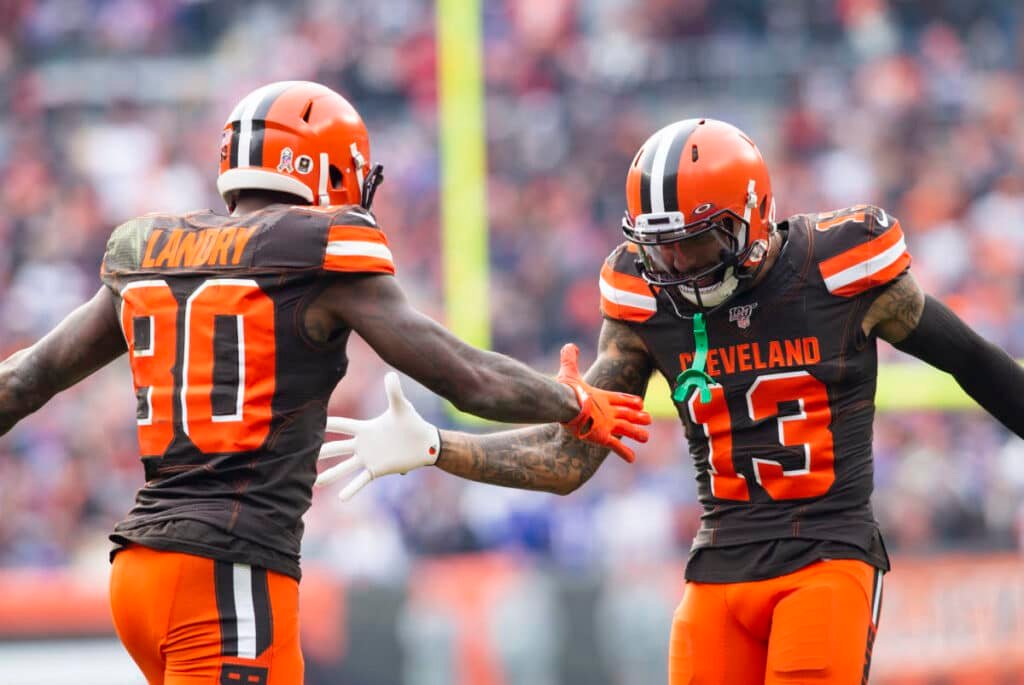
The Cleveland Browns’ drought is less about one missed trophy and more about decades of organizational trauma.
The Browns last won an NFL championship in 1964, before the Super Bowl era. Since then, the franchise has suffered through painful playoff losses, long stretches of bad football, quarterback chaos, ownership frustration, and even the team’s relocation to Baltimore after the 1995 season.
That relocation made the pain deeper.
Cleveland didn’t just lose games. It lost its team. The Browns name, colors, and history eventually returned with the expansion franchise in 1999, but the emotional damage stayed. Meanwhile, the relocated Ravens won Super Bowls in Baltimore, which only made Cleveland’s suffering more bitter.
The Browns belong among the most painful championship droughts because their fans have had to endure almost every possible version of sports disappointment: losing, instability, false hope, national jokes, and the strange cruelty of watching another city celebrate with the bones of their old franchise.
Yet Browns fans remain.
That’s the thing.
Some droughts destroy interest.
Cleveland’s somehow became proof of loyalty.
New York Knicks
The New York Knicks haven’t won an NBA championship since 1973, and the drought feels especially loud because it belongs to New York.
Madison Square Garden is basketball’s most famous arena. The Knicks have history, money, celebrity fans, and one of the biggest markets in sports. That should make winning easier.
It hasn’t.
The Knicks have had moments: Patrick Ewing’s era, the 1994 Finals run, the 1999 Finals run, the brief Linsanity explosion, and more recent signs of life. But the championship hasn’t come back.
That’s what makes the Knicks one of the great championship droughts. The franchise sits at the center of basketball culture but has spent decades without reaching the top. Every revival gets magnified. Every collapse gets mocked. Every star rumor becomes a civic event.
Knicks fans don’t lack passion.
They lack the parade.
And in New York, everything is louder: the hope, the anger, the jokes, the belief that the Garden should be home to more than nostalgia.
A Knicks title would shake the NBA.
That’s why the drought feels so large.
Detroit Lions
The Detroit Lions’ championship drought is one of the NFL’s oldest and most painful.
The Lions last won a league championship in 1957, long before the Super Bowl became America’s biggest sports event. Since then, Detroit fans have lived through decades of disappointment, bad teams, wasted talent, and strange heartbreak.
Barry Sanders gave the franchise one of the greatest running backs ever, but not a Super Bowl. Calvin Johnson gave it one of the greatest receivers ever, but not a Super Bowl. That’s part of the pain. The Lions didn’t have nothing. They had greatness and still couldn’t build enough around it.
For years, the franchise became a punchline. Thanksgiving games often showcased misery to a national audience. The Lions felt stuck in a loop of rebuilds, injuries, questionable decisions, and fan exhaustion.
That’s why their drought belongs high on any list of championship droughts. It’s not just the years. It’s the sense that the franchise has repeatedly failed extraordinary players and fiercely loyal fans.
Detroit fans have waited through almost everything.
If the Lions ever win the Super Bowl, the celebration may register on seismographs.
Minnesota Vikings
The Minnesota Vikings have one of the most agonizing championship droughts because they’ve often been too good to dismiss.
The Vikings have been to four Super Bowls and lost all four. They’ve had legendary players, great defenses, explosive offenses, and several seasons that felt like they could finally end the wait. Instead, Minnesota’s history is filled with sharp heartbreak.
The 1998 team went 15-1 and looked like a Super Bowl favorite before losing the NFC Championship Game to the Falcons. The 2009 team with Brett Favre came painfully close before losing to the Saints in overtime. Missed kicks, turnovers, and postseason cruelty have become part of Vikings lore.
Minnesota fans know the terrible difference between being bad and being haunted.
Bad teams don’t expect anything.
Haunted teams make you believe first.
The Vikings haven’t won a Super Bowl, and that absence hangs over every promising season. Among championship droughts, theirs hurts because the franchise has had enough talent to imagine multiple endings.
None of them arrived.
Seattle Mariners
The Seattle Mariners carry one of baseball’s strangest droughts.
They’ve never reached the World Series.
Not won it.
Reached it.
That’s brutal for a franchise that has had Ken Griffey Jr., Randy Johnson, Edgar Martinez, Ichiro Suzuki, Félix Hernández, and other beloved stars. The Mariners have given fans greatness, personality, and unforgettable moments, but never the final stage.
The 1995 playoff run helped save baseball in Seattle and created one of the franchise’s defining memories. The 2001 Mariners won 116 games, tying the regular-season record, then fell short in October. That season remains one of the great “how did they not win it all?” stories in baseball.
The Mariners belong among championship droughts because their pain includes both absence and wasted possibility. Fans can’t say the franchise never had elite talent. It did. That almost makes the drought worse.
Seattle knows baseball magic.
It just hasn’t seen baseball’s final round.
Arizona Cardinals
The Arizona Cardinals have one of the longest championship droughts in NFL history.
The franchise last won a championship in 1947, when it was still in Chicago. Since then, the team has moved, struggled, rebuilt, and spent long stretches as one of football’s least successful organizations.
The closest modern moment came in Super Bowl XLIII, when Kurt Warner and Larry Fitzgerald led the Cardinals within minutes of a title. Fitzgerald’s late touchdown against the Steelers looked like it might become the defining play in franchise history. Then Ben Roethlisberger found Santonio Holmes in the corner of the end zone, and Arizona’s dream vanished.
That’s what makes this drought so painful. The Cardinals don’t have endless near-misses like some franchises. They have long periods of irrelevance interrupted by one brilliant almost.
Larry Fitzgerald deserved a ring. So did that run.
But sports doesn’t hand out titles for emotional fairness.
Among championship droughts, the Cardinals’ wait feels ancient, quiet, and heavy.
The Chicago White Sox End an 88-Year Wait
The other side of Chicago had its own enormous drought.
The White Sox won the World Series in 1917, then became connected to one of baseball’s darkest scandals when several players from the 1919 team were accused of conspiring to throw the World Series. The Black Sox scandal gave the franchise a shadow that lasted far longer than the careers of anyone involved.
By 2005, the White Sox had gone 88 years without another championship.
Then Ozzie Guillén’s team turned October into a sprint.
Chicago swept the defending champion Red Sox in the Division Series, defeated the Angels in five games, and swept the Houston Astros in the World Series. The White Sox finished the postseason 11-1 and won 16 of their final 17 games when the end of the regular season is included.
The championship didn’t receive the same endless national mythology that surrounded Boston in 2004 or the Cubs in 2016. That doesn’t make the release smaller.
South Side fans had waited nearly nine decades.
Their team ended the drought by leaving almost no room for one final collapse.
The Philadelphia Phillies Finally Win in 1980

The Philadelphia Phillies were founded in 1883 and spent nearly a century without winning a World Series.
There were pennants, stars, promising teams, and repeated failures. By 1980, the organization understood the window around Mike Schmidt, Steve Carlton, Pete Rose, Greg Luzinski, Garry Maddox, Larry Bowa, and Tug McGraw couldn’t remain open forever.
The Phillies survived an exhausting National League Championship Series against Houston, with four of the five games going to extra innings. They then defeated the Kansas City Royals in six games to win the first World Series title in franchise history.
The ending produced one of baseball’s great celebration images. McGraw struck out Willie Wilson, leapt into the air, and Philadelphia finally had the championship its oldest professional franchise had spent generations chasing.
The Phillies’ wait wasn’t surrounded by one famous curse.
It didn’t need one.
Ninety-seven seasons of trying created enough pressure without supernatural help.
The New York Rangers End the “1940” Chant
For decades, rival hockey fans could torment the New York Rangers with one number.
That was the last year the Rangers had won the Stanley Cup. As the drought stretched across five decades, the number became a chant, an insult, and a reminder that one of hockey’s most famous franchises couldn’t finish the job.
The 1993-94 Rangers entered the postseason as the Presidents’ Trophy winner, but the path still became brutal. New York survived a seven-game Eastern Conference Final against the New Jersey Devils, then faced the Vancouver Canucks in another seven-game series.
The Rangers won Game 7 at Madison Square Garden, 3-2, ending a 54-year championship drought. Captain Mark Messier scored what became the Cup-winning goal, Brian Leetch won the Conn Smythe Trophy, and the Garden erupted when the final seconds disappeared.
The emotional word attached to the night was relief.
That makes sense.
When a drought lasts 54 years, winning doesn’t initially feel like ordinary joy.
It feels like putting down something the whole city had been carrying.
Why Droughts Become Part of Team Identity
Championship droughts become part of team identity because fans need a way to explain repeated pain.
At some point, losing stops feeling random. It becomes a story. A curse. A joke. A civic wound. Fans create language around it because plain disappointment isn’t enough.
The Cubs had the billy goat. The Red Sox had the Bambino. Cleveland had decades of heartbreak. The Bills had Wide Right. The Browns had relocation and quarterback chaos. The Maple Leafs have 1967 hanging over everything. The Lions have generations of waiting.
These stories help fans survive.
They also make the ending bigger when it finally comes.
A drought turns a championship into a resurrection.
The Legacy of Championship Droughts
The legacy of championship droughts is that they prove how stubborn sports love can be.
Cubs fans waited 108 years. Red Sox fans waited 86. Cleveland waited 52 years for a major title. Maple Leafs fans are still waiting. Bills fans are still waiting for a Super Bowl. Browns fans are still waiting for the Super Bowl era to love them back. Knicks fans are still waiting for the Garden to host another championship parade. Lions fans are still waiting for the final breakthrough. Mariners fans are still waiting for a World Series appearance.
These droughts hurt because fans care long after caring stops making sense.
That’s the secret.
Fandom isn’t logical. It’s inherited, chosen, defended, regretted, and renewed. Every season starts with the same dangerous thought: maybe this is the year.
Most years aren’t.
But when the year finally comes, all the waiting becomes part of the celebration.
That’s why championship droughts matter.
They turn winning from joy into release.