
Fan moments are proof that sports don’t belong only to the people playing.
The athletes make the plays. The coaches make the calls. The owners sign the checks. The leagues sell the product. But fans give sports its emotional weather. They turn games into rituals, stadiums into pressure cookers, losses into civic wounds, and championships into public release.
A crowd can make a normal game feel dangerous. A city can turn a parade into a generational event. A fanbase can become famous for loyalty, chaos, suffering, costumes, chants, tailgates, or the strange ability to believe long after belief stopped making sense.
That’s why fan moments matter.
Sometimes fans become part of the game’s memory. Sometimes they help create an atmosphere so intense that the players talk about it years later. Sometimes they celebrate so wildly that the celebration becomes news. Sometimes they suffer so publicly that the pain becomes part of sports history.
And sometimes one fan reaches for a foul ball and accidentally becomes a symbol for an entire century of heartbreak.
Sports are about competition.
But fandom is about attachment.
That attachment can be beautiful, irrational, funny, embarrassing, loyal, cruel, and completely impossible to explain to anyone who hasn’t inherited a team like a family illness.
The most memorable fan moments are the ones where the crowd stops being background noise and becomes the story.
Why Fan Moments Matter
Fan moments matter because they reveal what sports actually do to people.
A scoreboard can explain who won. It can’t explain why strangers hug in the street. It can’t explain why grown adults cry over laundry colors. It can’t explain why a city stays loyal through decades of losing, why a stadium sings the same song every week, or why one championship parade can feel like a funeral and a wedding happening at the same time.
Fans turn sports into memory. They make teams matter beyond the roster. A franchise can move, rebuild, collapse, win, lose, change uniforms, trade stars, and fire coaches, but the fans are the ones who carry the emotional continuity.
They remember.
That’s both the gift and the curse.
A great fan moment can lift a team. A painful one can haunt a city. Either way, fans make sports feel larger than entertainment.
They make it personal.
Steve Bartman and the Cubs’ Long Nightmare
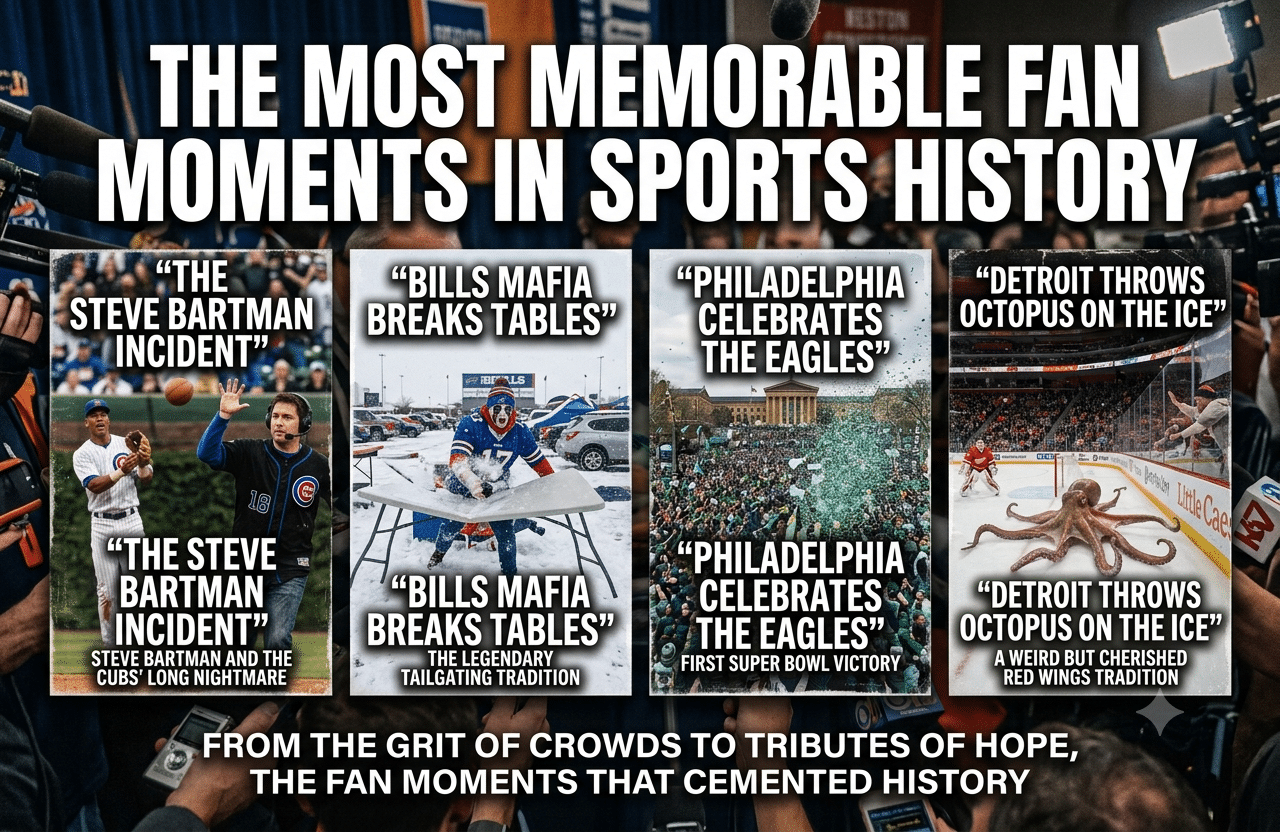
No fan moment is more infamous than Steve Bartman reaching for a foul ball during Game 6 of the 2003 NLCS.
The Chicago Cubs were five outs away from reaching the World Series. Wrigley Field was vibrating with hope and dread. The Cubs hadn’t won a World Series since 1908, and generations of fans had carried the weight of that drought.
Then the foul ball drifted toward the stands.
Bartman, wearing headphones and a Cubs cap, reached for it as left fielder Moises Alou tried to make the catch. The ball fell away. Alou reacted angrily. The stadium’s mood shifted. The Florida Marlins rallied. The Cubs lost Game 6, then lost Game 7.
Bartman became the face of the collapse, which was deeply unfair. The Cubs still had chances to escape the inning. The team made mistakes. The pitching and defense unraveled. One fan didn’t lose the series.
But sports suffering needs a symbol, and Bartman became one.
Among fan moments, this one remains painful because it shows how cruel fandom can become when hope breaks. Bartman wasn’t a villain. He was a fan sitting in the wrong seat at the worst possible second.
The Cubs finally won the World Series in 2016, and the organization later gave Bartman a championship ring.
That was grace arriving 13 years late.
Cleveland’s 2016 Championship Parade
When the Cleveland Cavaliers won the 2016 NBA Finals, the celebration was bigger than basketball.
Cleveland had waited 52 years for a major professional sports championship. The city had endured “The Drive,” “The Fumble,” “The Shot,” blown leads, bad luck, national jokes, and decades of being treated like sports misery had a mailing address.
Then LeBron James, Kyrie Irving, Kevin Love, and the Cavaliers came back from a 3-1 deficit against the 73-win Golden State Warriors.
The parade that followed felt like a city exhaling for the first time in half a century.
More than a million fans packed downtown Cleveland. People cried, screamed, climbed, danced, and celebrated like the championship had released something old and heavy from the city’s chest.
This belongs among the greatest fan moments because it showed what a title can mean after generations of waiting. It wasn’t just joy. It was relief. It was revenge against every joke. It was proof that the city’s loyalty hadn’t been foolish after all.
Some parades celebrate a team.
Cleveland’s celebrated survival.
Bills Mafia Breaks Tables
Bills Mafia became one of the most famous fanbases in American sports by turning loyalty, cold weather, tailgates, and complete physical disregard into a brand.
Buffalo Bills fans have jumped through folding tables, covered themselves in ketchup and mustard, tailgated in brutal weather, donated to charities connected to opposing players, and built a national reputation for being both chaotic and deeply loyal.
That combination matters.
Bills fans have suffered. The franchise lost four straight Super Bowls in the early 1990s, went through a long playoff drought, and gave its fanbase years of heartbreak. Yet the fans stayed intense. They didn’t disappear. They turned suffering into identity.
Among fan moments, Bills Mafia’s table-jumping culture stands out because it’s ridiculous, dangerous, and somehow affectionate. It’s easy to mock until you realize the madness is tied to devotion. These aren’t casual fans. They’re people who made loyalty physical.
A fanbase doesn’t become famous because it wins.
It becomes famous because it keeps showing up.
Buffalo has mastered that.
Sometimes through plywood.
Philadelphia Celebrates the Eagles’ First Super Bowl
When the Philadelphia Eagles won Super Bowl LII, the city’s celebration felt exactly like Philadelphia: loud, emotional, chaotic, funny, and slightly dangerous to public infrastructure.
The Eagles had never won a Super Bowl. Their fans had lived through decades of heartbreak, near-misses, quarterback debates, playoff pain, and national stereotypes about Philly sports anger. Then Nick Foles, an underdog backup quarterback, led them past Tom Brady and the New England Patriots.
The city erupted.
Fans filled the streets. Light poles got climbed. The parade became a civic catharsis. Jason Kelce’s famous speech in a Mummers costume turned the celebration into something even more Philadelphia than anyone could’ve scripted.
This is one of the great fan moments because it captured the personality of a city and fanbase that had waited too long and cared too loudly to celebrate politely.
Philadelphia fans are often framed as harsh, but that harshness comes from caring with no emotional seatbelt. When the Eagles finally won, all that intensity flipped into joy.
A softer city might’ve smiled.
Philly screamed in costume.
Red Sox Fans After 2004
When the Boston Red Sox won the 2004 World Series, generations of fans felt a curse dissolve.
The team hadn’t won since 1918. The Curse of the Bambino had become baseball’s most famous drought story. Red Sox fans had lived through Bucky Dent, Bill Buckner, Aaron Boone, and decades of Yankees superiority that felt almost designed to punish them.
Then Boston came back from down 3-0 against the Yankees in the ALCS.
Then the Red Sox swept the St. Louis Cardinals in the World Series.
The fan reaction was enormous because the title didn’t feel like a normal championship. It felt like a haunting ending. Fans visited cemeteries, leaving Red Sox gear, pennants, flowers, and notes at the graves of relatives who hadn’t lived long enough to see it.
Those cemetery images are among the most powerful fan moments in sports because they show how fandom passes through families. A championship can arrive too late for some people and still feel like it belongs to them.
The Red Sox didn’t just win for the living.
Fans made sure the dead heard about it too.
Saints Fans After Hurricane Katrina

The New Orleans Saints’ return to the Superdome after Hurricane Katrina produced one of the most emotional fan moments in NFL history.
The city had been devastated. The Superdome itself had become a symbol of suffering, survival, and governmental failure during the storm’s aftermath. When the Saints returned home in 2006 for a Monday night game against the Atlanta Falcons, the game carried more than football meaning.
Then Steve Gleason blocked a punt early in the game, and the stadium exploded.
The moment became a symbol of New Orleans’ resilience. Saints fans weren’t just cheering a play. They were reclaiming a space, a sound, and a piece of normal life after trauma.
This belongs among the most important fan moments because it shows how sports can become part of civic healing. A football game can’t rebuild homes or undo loss. But it can give a city a shared place to scream, cry, remember, and feel alive together.
The Saints won that night.
For New Orleans, the return itself was bigger.
Detroit Throws Octopus on the Ice
Detroit Red Wings fans throwing octopuses onto the ice is one of hockey’s strangest and most beloved traditions.
The tradition dates back to the era when a team needed eight playoff wins to capture the Stanley Cup. An octopus, with eight arms, became the symbol. Over time, the ritual became part of Red Wings playoff identity.
It’s weird.
That’s the point.
Sports traditions don’t always need to make clean sense to outsiders. They need to mean something to the people inside them. For Detroit fans, the octopus became a sign of playoff hope, local pride, and hockey weirdness carried through generations.
Among fan moments, the octopus toss stands out because it’s so specific. This isn’t a generic cheer that could belong anywhere. It belongs to Detroit hockey.
That specificity is what makes fan traditions powerful.
A great fanbase doesn’t only clap at the right times.
It develops customs that make everyone else ask, “Why are they doing that?”
Then keeps doing it anyway.
Seattle’s 12th Man
Seattle Seahawks fans made crowd noise into a weapon.
The 12th Man became central to the Seahawks’ identity, especially during the team’s rise under Pete Carroll, Russell Wilson, and the Legion of Boom defense. CenturyLink Field, later Lumen Field, developed a reputation as one of the loudest stadiums in the NFL.
Opposing offenses struggled with communication. False starts piled up. Fans took pride in being more than spectators. They were part of the defense.
That’s why the 12th Man belongs among memorable fan moments and traditions. It turned crowd noise into competitive identity. Every team says its fans matter. Seattle fans could point to actual disruption.
The best fan moments aren’t always one-time events. Sometimes they’re repeated pressure. A stadium becomes famous because the crowd does its job every week.
Seattle didn’t just cheer.
Seattle interfered.
Legally, which makes it even better.
Toronto Raptors Fans and Jurassic Park
Toronto Raptors fans turned “Jurassic Park” into one of the NBA’s best modern fan traditions.
Outside Scotiabank Arena, fans gathered in huge numbers to watch playoff games on big screens, creating a public basketball party that became especially powerful during the Raptors’ 2019 championship run.
That title meant enormous things for Toronto and Canada. The Raptors were the country’s only NBA team, and their success felt national. Fans across Canada gathered in public spaces, bars, homes, and viewing parties, turning the playoff run into a shared event far beyond the arena.
Jurassic Park became the visual center of that energy.
Among fan moments, this one matters because it shows how a team can create community outside the building. Tickets are expensive. Arenas are limited. But fandom spills into streets when the moment gets big enough.
When Kawhi Leonard’s shot bounced in against the 76ers, and when the Raptors eventually won the title, those outdoor crowds became part of the memory.
The fans weren’t inside the arena.
They were still inside the story.
Mississippi State Fans and Cowbells
Mississippi State’s cowbell tradition is one of college football’s loudest and most distinctive fan rituals.
The sound is unmistakable. Metallic, relentless, and deeply annoying to opponents, which is part of the appeal. Mississippi State fans don’t just cheer. They create a specific noise tied to their school’s identity.
Like many great fan traditions, cowbells are both beloved and controversial. Opposing fans may hate them. Broadcasts may pick them up constantly. Rules have had to address them. But inside Mississippi State culture, the cowbell is part of belonging.
Among fan moments and traditions, this one stands out because it proves sound can become a fanbase’s signature. The cowbell says Mississippi State before anyone sees a logo.
That’s powerful branding created by fans, not a marketing department.
A school can design a uniform.
Fans create the noise.
Cubs Fans Outside Wrigley in 2016
When the Cubs won the 2016 World Series, the celebration wasn’t limited to Cleveland, where Game 7 was played.
Back in Chicago, fans flooded the area around Wrigley Field. They gathered outside the ballpark, hugged strangers, cried, sang, climbed, took photos, and tried to process something their families had waited 108 years to see.
Wrigley Field wasn’t hosting the game that night, but it was still the emotional center of the franchise.
That’s what made the scene so powerful.
Among fan moments, Cubs fans outside Wrigley belong because the place mattered as much as the result. Wrigley had held decades of hope, jokes, curses, summer afternoons, bad teams, great players, and “maybe next year.” When next year finally arrived, fans needed to be near the old building.
The Cubs won the title on the road.
Chicago came home anyway.
The Black Hole in Oakland
The Raiders’ Black Hole was one of the NFL’s most intimidating fan sections.
Located in the end zone at Oakland Coliseum, the Black Hole was filled with fans in costumes, spikes, face paint, skulls, silver and black gear, and an attitude that matched the Raiders’ outlaw identity. It looked less like a seating section and more like a warning.
The Black Hole mattered because it made the Raiders’ brand physical. Silver and black already symbolized rebellion and menace. The fans gave that symbolism bodies, voices, and props.
Among fan moments and traditions, the Black Hole stands out because it created one of the strongest visuals in football fandom. Even casual viewers understood immediately: this place isn’t friendly.
When the Raiders moved to Las Vegas, the loss of Oakland’s specific energy became part of the relocation pain. The franchise kept the colors and logo, but the Black Hole in Oakland had a rawness that couldn’t simply be packed up and recreated.
Some fan sections are loud.
The Black Hole had lore.
Kansas City’s Sea of Red
Kansas City Chiefs fans turned Arrowhead Stadium into one of the loudest and most visually striking environments in football.
The sea of red, the tomahawk chop, the noise, the tailgating, the cold-weather playoff scenes — all of it made Arrowhead feel like a stadium with its own personality. During the Patrick Mahomes era, that energy became attached to championship football, but the fanbase had been passionate long before the Super Bowl wins returned.
That’s what makes Kansas City’s fan culture important. The loyalty didn’t begin with dominance. The winning gave it a bigger stage.
Among fan moments, Arrowhead’s noise and red crowd identity matter because they show how atmosphere can become part of a franchise’s advantage. Opponents don’t just play the Chiefs. They play the building.
A great home crowd makes routine plays feel larger and pressure moments feel heavier.
Kansas City fans know their job.
They do it loudly.
When Fans Become Too Much
Not every fan moment is beautiful.
Sometimes fans cross lines. They throw things. Harass players. Threaten families. Turn athletes into targets. Blame individuals for team failures. Hide cruelty behind passion. The same emotional force that makes fandom powerful can become ugly fast.
Steve Bartman’s treatment remains the clearest warning. A fanbase in pain turned one ordinary person into a public villain. That wasn’t passion. That was projection.
Sports fans love to say they’re part of the team, but that emotional closeness comes with responsibility. Caring deeply doesn’t give anyone permission to become inhuman.
The best fan moments show loyalty, creativity, humor, sound, memory, and joy.
The worst show what happens when identity gets too tangled with a scoreboard.
A real fanbase should know the difference.
Why Fan Moments Last
Fan moments last because they show sports from the seats instead of the field.
Most sports history focuses on winners and losers. Fans give the story texture. A parade tells us what the championship meant. A tradition tells us how a community sees itself. A chant tells us what a fanbase values. A public heartbreak tells us how deeply the loss landed.
Fans also create continuity. Players leave. Coaches get fired. Stadiums change names. Leagues expand. Uniforms get redesigned. But the people in the stands carry memory forward.
That’s why fan moments can become as emotional as game moments.
The crowd is where sports becomes culture.
The Legacy of Fan Moments
The legacy of fan moments is that they prove sports history isn’t only written by athletes.
Steve Bartman became a tragic symbol of Cubs suffering and fan cruelty. Cleveland’s 2016 parade turned a championship into civic release. Bills Mafia made loyalty look like controlled demolition. Philadelphia’s Super Bowl celebration gave a city its long-awaited scream. Red Sox fans visiting graves after 2004 showed how fandom passes through generations. Saints fans returning to the Superdome after Katrina turned football into healing. Detroit’s octopus tradition made hockey weird in the best way. Seattle’s 12th Man turned noise into identity. Toronto’s Jurassic Park made a whole country feel connected to one NBA run. The Black Hole gave the Raiders a fan section with menace and mythology.
Fans matter because they give sports its emotional scale.
Without fans, a championship is a result.
With fans, it becomes a parade, a song, a scar, a story, a family memory, a citywide release, or an old man crying because the team his father loved finally won.
That’s not background noise.
That’s the point.