
Lost sports venues occupy a strange place in memory.
The building disappears, but fans continue describing it in the present tense. They remember which entrance their family used, where the cheap seats were, how the concourse smelled, which support column blocked half the field, and exactly how the crowd sounded when the home team made the play everyone had been waiting for.
Modern stadiums are usually more comfortable. They offer wider concourses, better sightlines, larger scoreboards, cleaner restrooms, premium clubs, reliable plumbing, and food options that have progressed beyond a suspicious hot dog placed beneath a heat lamp during the previous administration.
Yet comfort doesn’t automatically create attachment.
The most iconic sports venues became beloved through repetition. Generations attended games beneath the same roof, walked through the same gates, and watched new players inherit the ground where old legends had competed. The venue became the physical connection between seasons that otherwise had little in common.
When those buildings were demolished, cities didn’t merely lose aging structures. They lost containers for public memory.
The rubble could be removed.
The stories remained considerably more stubborn.
Why Lost Sports Venues Still Matter
Sports history is often presented through athletes, coaches, championships, and records, but the setting shapes how those stories are remembered.
Bobby Orr’s flying goal belongs to Boston Garden. Joe Montana’s final drive against Dallas belongs to Candlestick Park. The Miracle Mets belong to Shea Stadium. Babe Ruth, Lou Gehrig, Joe DiMaggio, Mickey Mantle, and Derek Jeter appear connected across generations because they shared Yankee Stadium.
A venue can become part of a team’s competitive identity as well. Tight seating places the crowd almost on top of the action. Strange dimensions create tactical advantages. Harsh weather, awkward shadows, artificial turf, bad ice, and questionable ventilation make visiting teams uncomfortable while home fans treat the same defects as sacred tradition.
That is the peculiar loyalty surrounding lost sports venues. Fans may have spent decades complaining about the building while it existed, then become deeply offended when someone actually removed it.
Humans are consistent only in their refusal to be consistent.
The Original Yankee Stadium
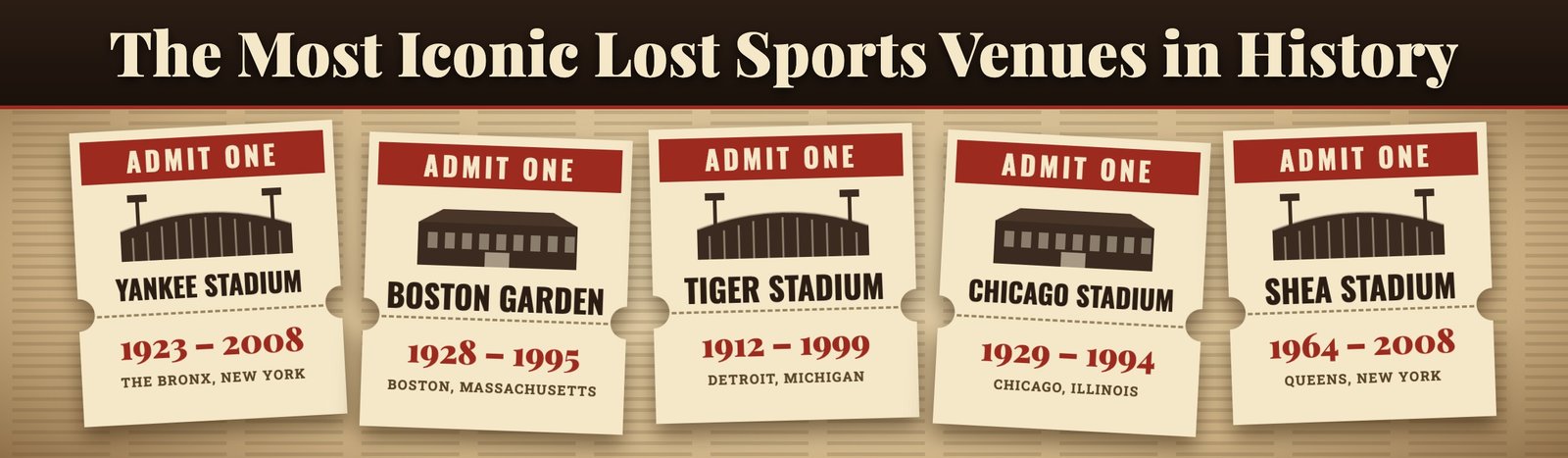
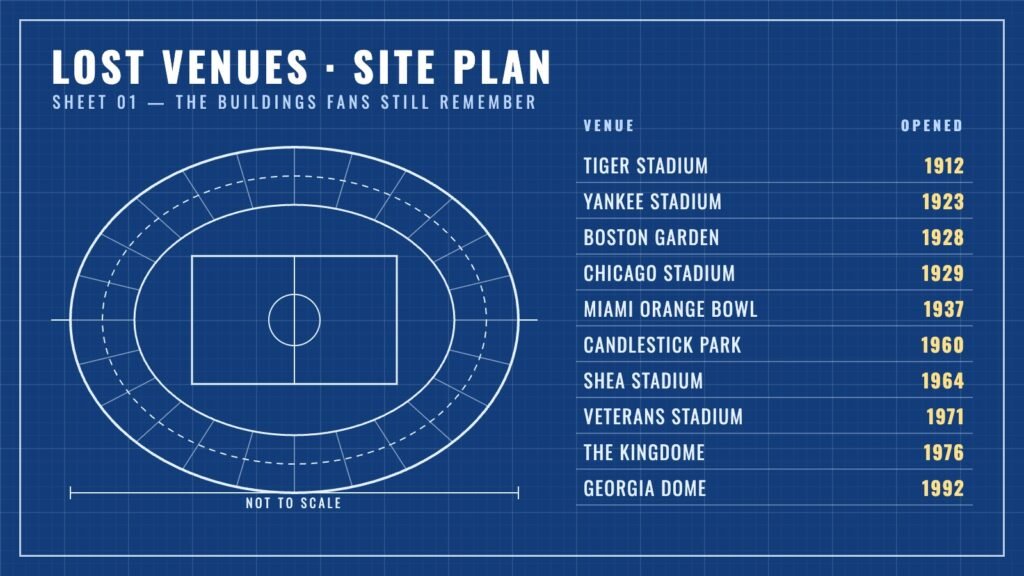
The original Yankee Stadium opened in 1923 and quickly became known as the House That Ruth Built.
Babe Ruth’s home-run popularity helped justify the enormous ballpark, but the stadium eventually became the stage for far more than one player. Lou Gehrig delivered his farewell there. Joe DiMaggio patrolled center field. Mickey Mantle sent baseballs toward its façade. Reggie Jackson became Mr. October, and Derek Jeter helped build another championship era before the Yankees played their final season in the old building in 2008.
The structure underwent a major renovation during the 1970s, forcing the Yankees to play the 1974 and 1975 seasons at Shea Stadium before reopening their Bronx home in 1976. Even after that substantial reconstruction, fans continued treating it as the same historic ground where the franchise’s earliest dynasty had formed.
The Yankees moved across the street into a new stadium in 2009, and demolition of the old building was completed in 2010. The site became part of the redeveloped Macombs Dam Park, with Heritage Field preserving the approximate locations of the old diamond and elements of the famous roofline frieze.
The replacement copied many visual features of the old stadium, but architecture can reproduce only so much. The new park could inherit the façade, Monument Park, and pinstripes.
It couldn’t inherit the exact ground where Ruth stood.
Boston Garden
Boston Garden opened in 1928 and served as the home of the Bruins and Celtics for nearly seven decades.
It was uncomfortable, cramped, hot, obstructed, and loud enough to make those defects feel like strategic advantages. The crowd sat close to the court and rink, creating the impression that spectators weren’t surrounding the game so much as leaning directly into it.
The Celtics filled the rafters with championship banners during the Bill Russell and Larry Bird eras. The Bruins created their own mythology beneath the same low roof, with Bobby Orr, Phil Esposito, Ray Bourque, and generations of players performing inside one of hockey’s most intimidating buildings. The Bruins later described the old Garden as one of sports’ great home-ice advantages because of its intimate surface and crowd placement.
The Garden closed in 1995 after a final period of farewell events, including a Bruins-Canadiens exhibition known as the Last Hurrah. It remained vacant beside its replacement for three years before being demolished in 1998.
The new arena provided the amenities the Garden never could. It did not reproduce the old building’s sensory chaos, which included heat, bad sightlines, crowded corridors, wooden seats, and whatever mysterious substance had permanently attached itself to the floors.
Fans had complained about those things for years.
Once the building was gone, they became atmosphere.
Tiger Stadium
Tiger Stadium stood at the corner of Michigan and Trumbull, one of baseball’s most emotionally resonant addresses.
The Tigers played there from 1912 through 1999, sharing the site’s opening year with Fenway Park. The stadium hosted World Series games in 1934, 1935, 1940, 1945, 1968, and 1984, along with generations of Detroit stars including Ty Cobb, Hank Greenberg, Al Kaline, Willie Horton, Lou Whitaker, Alan Trammell, and Kirk Gibson.
The ballpark’s right-field upper deck hung dramatically over the field, making home runs appear to disappear beneath a crowded wall of spectators. Steel supports created obstructed views, and the stadium lacked many amenities modern clubs considered essential. Yet its closeness and architectural irregularities gave games an intimacy that cleaner facilities frequently fail to reproduce.
The Tigers played their final game there on September 27, 1999, defeating Kansas City as Robert Fick hit a late grand slam off the right-field roof. The stadium then sat largely vacant while preservation groups, city officials, and developers argued over its future. Demolition began in 2008 and was completed in 2009 after attempts to save part of the grandstand failed.
Baseball eventually returned to the site through a youth facility now known as the Corner Ballpark. That outcome preserved the field’s purpose even after the old decks disappeared.
Tiger Stadium no longer surrounds Michigan and Trumbull.
The corner still remembers what belonged there.
Candlestick Park
Candlestick Park opened in 1960 on the edge of San Francisco Bay and spent more than five decades developing a reputation for cold wind, swirling conditions, strange football weather, and moments large enough to overpower every complaint about the building.
The San Francisco Giants played there through the 1999 season. Willie Mays, Willie McCovey, Juan Marichal, and Barry Bonds all appeared at the park, while the 1989 World Series between the Giants and Athletics was interrupted by the Loma Prieta earthquake shortly before Game 3. The Giants’ departure ended the baseball chapter, but the 49ers continued making Candlestick central to Bay Area sports.
The 49ers played 43 seasons at the stadium and won five Super Bowls while calling it home. Joe Montana found Dwight Clark for The Catch there. Steve Young, Jerry Rice, Ronnie Lott, and generations of championship players made the concrete bowl inseparable from one of the NFL’s greatest dynasties.
The 49ers played their final season at Candlestick in 2013. Paul McCartney performed the final public event in August 2014, fittingly closing the building’s life with a connection to the Beatles’ last paid concert, held at the same stadium in 1966. Demolition proceeded through 2015, with the last major upper-deck section coming down that June.
Candlestick was rarely described as comfortable.
It was described as home.
Those are not the same thing, and sports fans generally prefer the second.
Shea Stadium
Shea Stadium opened in 1964 as the new home of the New York Mets and Jets, immediately becoming one of the city’s most recognizable public venues.
The Mets created the building’s defining memories. Cleon Jones caught the final out of the 1969 World Series there. The stadium hosted the frantic ending of Game 6 in the 1986 World Series, when Boston came within one strike of a championship before the Mets completed one of baseball’s most famous rallies.
Shea’s history extended far beyond the Mets. The Beatles’ 1965 appearance helped establish the commercial possibilities of large outdoor stadium concerts. Pope John Paul II held Mass there in 1979, and the building hosted soccer, boxing, wrestling, college football, and major concerts. In 1975, Shea became the temporary home of the Mets, Yankees, Jets, and Giants, placing all four New York baseball and football teams inside one stadium during the same year.
The Mets played their final game at Shea on September 28, 2008, followed by a farewell ceremony in which Tom Seaver threw a ceremonial final pitch to Mike Piazza. Demolition lasted several months, with the final section removed on February 18, 2009. Citi Field’s parking area now covers much of the site, although markers identify the former locations of the bases, mound, and home plate.
Shea was rarely considered beautiful.
That hardly mattered to the people who watched impossible Mets seasons become real inside it.
Veterans Stadium
Veterans Stadium opened in South Philadelphia in 1971 as the shared home of the Eagles and Phillies.
The circular multipurpose design represented modern stadium planning at the time, although its artificial turf, concrete surroundings, and lack of intimacy eventually became easy targets. Players complained about the surface. Fans complained about almost everything else while continuing to fill the building and transform it into one of American sports’ most hostile home environments.
The Eagles played there from 1971 through the end of the 2002 season. One of the stadium’s defining football moments came in the 1980 NFC Championship Game, when Wilbert Montgomery’s 42-yard touchdown helped Philadelphia defeat Dallas and reach its first Super Bowl.
The Phillies created their own championship history at the Vet. Tug McGraw struck out Kansas City’s Willie Wilson there in 1980, completing the first World Series championship in the franchise’s long history. The 1993 Phillies also turned the building into the chaotic home of one of baseball’s most beloved and unlikely pennant winners.
After both teams moved into separate new stadiums, Veterans Stadium was imploded in March 2004. Former Eagles players and fans gathered around the old site for one last look before the concrete bowl disappeared.
The Vet was not graceful.
Philadelphia never requested grace.
The building looked, sounded, and occasionally behaved like the fanbase occupying it.
Chicago Stadium
Chicago Stadium opened in 1929 and became known as the Madhouse on Madison.
At the time of its construction, it was one of the world’s largest indoor arenas. Its famous Barton organ contained more than 3,600 pipes and could generate enough sound to compete with a building already known for overwhelming noise. The Blackhawks played there for 65 seasons, while the Bulls made it their home from 1967 through 1994.
The arena hosted 10 Stanley Cup Finals and three NBA Finals, placing the building at the center of Chicago hockey and basketball history. Bobby Hull, Stan Mikita, Tony Esposito, and Denis Savard defined Blackhawks eras there. Michael Jordan’s earliest Bulls seasons unfolded beneath its roof before the franchise’s dynasty moved across Madison Street into the United Center.
Chicago Stadium’s size, acoustics, organ, and tightly packed seating created an atmosphere modern arenas rarely attempt to replicate. The building could feel ceremonial during the national anthem and ferocious once play began, giving the nickname Madhouse more credibility than most marketing phrases receive.
The arena closed after the 1993-94 Bulls and Blackhawks seasons and was demolished in February 1995. Its former site became parking for the United Center.
The teams moved a few hundred feet.
The atmosphere did not make the trip quite so neatly.
The Kingdome
The Kingdome opened in Seattle in 1976 as a concrete multipurpose stadium capable of housing nearly every event a city could reasonably attempt beneath one roof.
The Seahawks, Mariners, and Sounders all used it, while the SuperSonics also played selected seasons and major games there. The building hosted football, baseball, basketball, soccer, concerts, rodeos, motor sports, trade shows, and other events, drawing more than 72 million visitors during its life. Its concrete roof covered nearly eight acres and was once described as the largest of its kind in the world.
The stadium was not elegant, but it gave Seattle’s emerging major-league identity a shared home. Steve Largent built his Seahawks legacy there. The Mariners’ 1995 Refuse to Lose run helped save major-league baseball in Seattle, turning a building often criticized for its sterile design into the setting for one of the city’s most emotional sports seasons.
The Kingdome also became known for structural and maintenance problems, including falling ceiling tiles that forced repairs during the 1994 baseball season. By the end of the decade, Seattle had committed to separate modern facilities for baseball and football.
The final game was a Seahawks playoff loss to Miami in January 2000. The Kingdome was imploded on March 26, 2000, exactly 24 years after the building’s public dedication.
The dome disappeared in seconds.
Seattle sports had taken decades to grow inside it.
The Miami Orange Bowl
The Miami Orange Bowl was more than the name of a postseason college football game.
It was a stadium that carried Miami football history across generations, opening in the 1930s and serving as the longtime home of the University of Miami. The Dolphins also played there from their inaugural 1966 season through 1986, compiling a 120-43-3 record when regular-season and playoff games were combined.
The Dolphins’ perfect 1972 championship season passed through the Orange Bowl, as did the team’s subsequent Super Bowl runs under Don Shula. The stadium also hosted five Super Bowls, the annual Orange Bowl game, Olympic soccer, championship boxing, and numerous historic college football matchups.
For Miami Hurricanes fans, the building represented a particularly intimidating home environment. The program produced national championships, famous rivalries, and a long home winning streak there, with the stadium’s aging concrete and packed stands giving major games an atmosphere far removed from the polished venue that later replaced it.
The University of Miami played its final Orange Bowl game in November 2007. A farewell celebration followed in January 2008, and demolition took place between March and May of that year.
LoanDepot Park, the home of the Miami Marlins, now occupies the site.
The baseball stadium is modern, enclosed, and climate-controlled.
The Orange Bowl was none of those things, which is partly why people still talk about it.
The Georgia Dome
The Georgia Dome was younger than most lost sports venues on this list, but its compressed history contained an extraordinary range of major events.
The Atlanta Falcons began playing there in 1992 and remained for 25 seasons. The building hosted Super Bowls, NCAA men’s Final Fours, SEC championship games, major concerts, and events during the 1996 Atlanta Olympics. According to the Falcons, it was the only venue to host the Olympics, a Super Bowl, and the men’s Final Four.
The Falcons reached the franchise’s first Super Bowl while playing there during the 1998 season. Later Atlanta teams built around Matt Ryan, Julio Jones, and Tony Gonzalez turned the Dome into one of the NFL’s loudest indoor settings, particularly when the team’s fast offense gave the crowd a reason to remain engaged.
The building’s replacement, Mercedes-Benz Stadium, rose directly beside it, producing the strange sight of one enormous venue waiting while another prepared for demolition. The Georgia Dome was imploded on November 20, 2017, only months after hosting its final events.
Twenty-five years is not especially old by stadium standards.
That was part of the message.
Modern venues don’t always disappear because they’ve ceased functioning. Sometimes they disappear because a newer building offers more premium inventory, sponsorship opportunities, technology, and revenue.
History occasionally loses to better luxury suites.
Why New Stadiums Cannot Fully Replace Old Ones
Replacement stadiums are usually better buildings.
They have improved accessibility, safer infrastructure, modern locker rooms, larger concourses, better food, clearer sightlines, and enough video screens to ensure nobody is ever forced to look directly at the field for too long.
What they lack initially is memory.
A new stadium cannot open with 50 years of family stories already embedded in its walls. It has no legendary seat until something happens near it. It has no haunted tunnel, championship corner, famous outfield spot, or section where a grandparent sat during the game everyone still discusses.
Those things accumulate slowly.
That is why fans can appreciate a new venue while still mourning the old one. The buildings are not competing solely on comfort. One contains superior facilities. The other contains childhood.
Architecture struggles against that opponent.
What Should Be Preserved When Sports Venues Disappear?
Cities and teams have become better at preserving physical pieces of demolished venues.
Home plate may be marked at the former site. Seats are sold or transferred to museums. Scoreboards, signs, bricks, turnstiles, banners, façades, and pieces of turf are distributed to collectors. New buildings imitate old rooflines, arches, dimensions, or concourse details.
These gestures matter because they provide continuity, but preservation should extend beyond valuable memorabilia. Oral histories, public archives, fan photographs, broadcast recordings, stadium-worker stories, neighborhood accounts, and affordable access to historical materials can preserve the venue more completely than selling its most recognizable objects to private collectors.
The stadium’s history did not belong only to the athletes and wealthy season-ticket holders.
It also belonged to ushers, vendors, groundskeepers, transit workers, nearby businesses, children in the upper deck, and fans who could afford to enter only a few times.
A building becomes iconic through collective memory.
Its preservation should be collective too.
The Legacy of Lost Sports Venues
The legacy of lost sports venues is that demolition cannot fully remove a place once generations have built meaning inside it.
The original Yankee Stadium gave baseball its most powerful cathedral before becoming Heritage Field. Boston Garden held Celtics banners and Bruins battles inside a cramped building fans still describe with affection. Tiger Stadium carried 88 seasons of Detroit baseball at Michigan and Trumbull. Candlestick Park gave Willie Mays, Joe Montana, and Jerry Rice the same windswept stage. Shea Stadium contained the Miracle Mets, 1986 chaos, the Jets, the Beatles, and nearly every variety of New York spectacle. Veterans Stadium became Philadelphia’s concrete home for championships, hostility, and artificial-turf suffering. Chicago Stadium turned noise into a competitive weapon. The Kingdome gave Seattle’s major-league ambitions one enormous roof. The Orange Bowl made Miami football feel dangerous. The Georgia Dome packed several decades of major events into a surprisingly short life.
These venues mattered because sports are not experienced only through results.
They’re experienced through place.
The route to the stadium.
The first view of the field.
The sound beneath the roof.
The seat someone’s father chose.
The gate where friends agreed to meet.
The section where a championship became real.
Modern buildings can be brighter, cleaner, safer, and more profitable.
The lost sports venues remain powerful because nobody is comparing them only as buildings.
Fans are comparing the new stadium with the place where part of their life happened.
Concrete rarely wins that argument.
Memory does.