
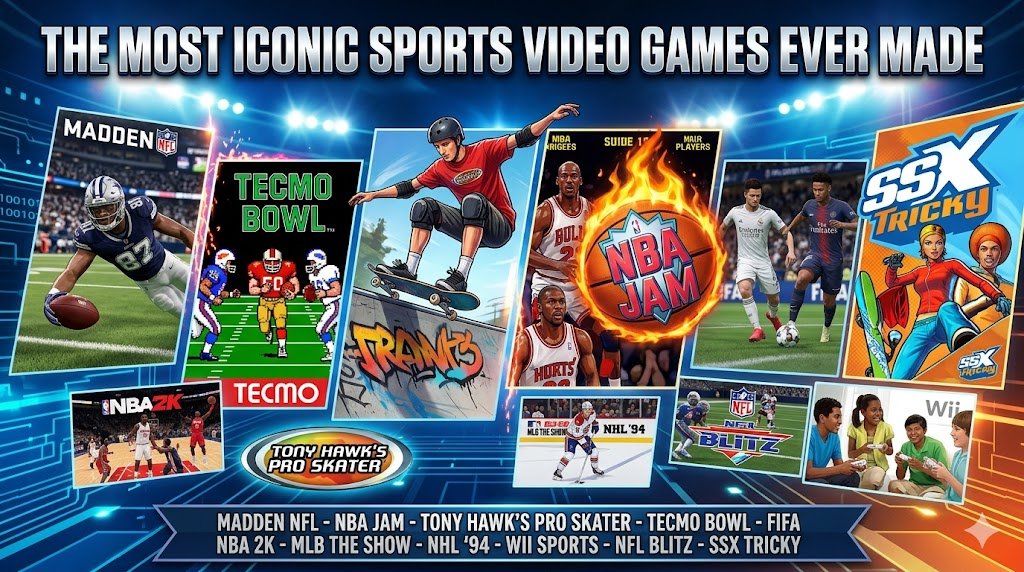
Sports video games changed how fans experienced sports.
They didn’t replace the real thing. They made it playable.
A kid who couldn’t dunk could still fly in NBA Jam. A fan who’d never call an NFL play could build a dynasty in Madden. Someone who didn’t own a skateboard could grind rails in Tony Hawk’s Pro Skater. A soccer fan could take a club from another continent and make it feel like home through FIFA. A baseball fan could learn lineups, swings, stadiums, and stats through a controller before ever opening a scorebook.
That’s the power of sports video games. They turn fandom into participation. Watching is emotional, but playing is personal. Suddenly, fans aren’t just yelling at the coach. They are the coach. They aren’t just criticizing the quarterback. They’re throwing the interception themselves and blaming the controller like generations before them.
The best sports video games became bigger than entertainment. They became childhood memories, dorm-room arguments, arcade rituals, franchise addictions, soundtrack discoveries, and digital versions of sports history.
Some were realistic.
Some were completely ridiculous.
The greatest ones understood that sports aren’t only about accuracy. They’re about feeling. Speed. Pressure. Rivalry. Style. Momentum. Humiliation. Revenge. One more game before bed that somehow turns into 2 a.m.
That’s when a sports game becomes iconic.
Why Sports Video Games Matter
Sports video games matter because they made fans feel closer to the games they loved.
A great sports game teaches you the sport without making it feel like homework. Madden helped fans understand football formations, play-calling, and roster building. FIFA introduced casual players to international clubs and players. NBA 2K made basketball strategy, player ratings, and career modes part of everyday fan conversation.
Video games also preserved eras. Old rosters, old uniforms, old stadiums, old players, old theme music — all of it gets frozen inside games. Fans can remember a season not just by who won, but by which player was unstoppable on the sticks.
Sports video games gave fans a different kind of memory.
Not just, “I watched that.”
But, “I played with that team.”
Madden NFL
Madden is the king of football video games.
For decades, Madden NFL has been the game that turned football fans into armchair offensive coordinators. It taught people formations, coverages, audibles, hot routes, blitzes, and clock management, even if half of them still ran four verticals every play and called it strategy.
The series became iconic because it blended realism, accessibility, and the personality of John Madden himself. Madden’s voice, enthusiasm, and football teaching style gave the early games a warmth that later sports titles often struggled to match.
Madden also became a cultural calendar. New ratings mattered. Cover athletes mattered. Franchise mode mattered. Roster updates mattered. Fans argued over whether their team was underrated before they’d even played a full game.
And then there was the Madden curse.
For years, fans believed landing on the cover invited injury, decline, or bad luck. Whether the curse was real didn’t matter. It became part of the game’s mythology.
Among sports video games, Madden stands above most because it didn’t just reflect football culture.
It shaped it.
NBA Jam
NBA Jam understood that basketball didn’t have to be realistic to be perfect.
Two-on-two. No fouls. Flaming basketballs. Monster dunks. Wild blocks. Secret characters. Announcers screaming lines that became part of gaming history.
“He’s on fire!”
“Boomshakalaka!”
That was enough.
NBA Jam became one of the most iconic sports video games because it captured basketball’s arcade soul. It wasn’t trying to simulate a real NBA game. It was trying to make every possession feel like a highlight from another planet.
The players jumped impossibly high. The dunks looked illegal. The pace never slowed. The game made casual fans and serious NBA fans equally happy because it removed everything complicated and kept only the fun parts.
That’s harder than it sounds.
A realistic basketball game can get bogged down in systems. NBA Jam had one job: make people yell.
It succeeded.
Tony Hawk’s Pro Skater
Tony Hawk’s Pro Skater didn’t just become a great sports game.
It changed youth culture.
The game brought skateboarding into millions of homes and made it feel accessible, stylish, rebellious, and addictive. Players learned trick names, discovered skate spots, memorized levels, and absorbed a soundtrack that became almost as famous as the gameplay.
That soundtrack mattered. Punk, ska, hip-hop, rock — the music made the game feel like an identity, not just a sport. For a lot of kids, Tony Hawk’s Pro Skater wasn’t simply their introduction to skateboarding. It was their introduction to an entire style of culture.
The controls were smooth. The combo system was brilliant. The levels were memorable. The game rewarded creativity, risk, and flow. It made players chase impossible lines for hours.
Among sports video games, Tony Hawk’s Pro Skater is special because it helped push an action sport into the mainstream without sanding off all its edge.
It made skateboarding playable.
Then it made it cool.
Tecmo Bowl
Tecmo Bowl is old-school football chaos at its finest.
By modern standards, it’s simple. By memory standards, it’s untouchable.
The game became legendary because it was fast, fun, and completely dominated by certain players, especially Bo Jackson. Digital Bo became one of the most overpowered athletes in sports gaming history. If someone had the Raiders and knew what they were doing, friendship could be tested.
That’s part of the charm.
Tecmo Bowl didn’t need perfect realism. It had speed, personality, and the kind of gameplay people could understand immediately. It belongs to an era when sports video games were less about simulation and more about pure competition.
The game also helped create the early language of sports gaming bragging rights. Beating someone in Tecmo Bowl wasn’t just winning. It was evidence. It gave fans a way to turn football arguments into direct combat on the couch.
Some games age because graphics move on.
Tecmo Bowl aged into legend.
FIFA
FIFA became one of the most important sports video game franchises in the world because soccer is one of the few sports that truly belongs to the whole planet.
The series gave fans access to clubs, leagues, players, kits, stadiums, and international teams they might never see regularly on television. For many American fans especially, FIFA became a gateway into global soccer. You could learn about Barcelona, Manchester United, Real Madrid, Bayern Munich, Juventus, Chelsea, and national teams by playing with them first.
That’s a huge cultural role.
FIFA also became a social game. Dorm rooms, apartments, parties, online matches, late-night tournaments — the game was easy enough for casual players to enjoy and deep enough for serious fans to obsess over.
The beauty of FIFA was that it turned global soccer into something immediate. Pick a team. Pick a rival. Start yelling.
Among sports video games, FIFA matters because it expanded fandom across borders. Someone could fall in love with a club because of a video game, then become a real fan for life.
That’s power.
NBA 2K
NBA 2K became more than a basketball game.
It became part of basketball culture.
The series grew into the dominant NBA simulation by combining realistic gameplay, presentation, player ratings, career modes, online play, and a deep connection to modern basketball fandom. Players didn’t just buy NBA 2K to play games. They bought it to live inside basketball.
MyCareer changed everything. Fans could create a player, build a career, chase endorsements, enter the league, and imagine themselves inside the NBA machine. MyTeam gave collectors and competitors another obsession. Online play turned casual confidence into public humiliation fast.
NBA 2K also made ratings a major part of player identity. Real NBA players care about their ratings. Fans argue over them. Media covers them. That means the video game became part of the league’s conversation.
That’s what makes NBA 2K one of the most important sports video games ever. It didn’t just simulate the NBA.
It joined the NBA’s ecosystem.
MLB The Show
MLB The Show became the gold standard for modern baseball video games.
Baseball is hard to translate into gaming because it’s slow, tense, technical, and built on tiny moments. A great baseball game has to make pitching, hitting, fielding, roster building, and player development feel meaningful without becoming boring.
MLB The Show pulled that off.
The series became beloved for its presentation, realism, Road to the Show mode, franchise depth, and respect for baseball atmosphere. It made fans feel the rhythm of the sport: the pitcher-batter duel, the late-inning pressure, the satisfaction of squaring up a pitch, the frustration of chasing something in the dirt.
Road to the Show especially gave players a baseball fantasy that felt personal. Create a prospect. Grind through the minors. Get called up. Chase records. Become a legend.
Among sports video games, MLB The Show matters because it respects baseball’s pace instead of apologizing for it.
It made patience playable.
NHL ’94
NHL ’94 is still treated like sacred text by many hockey gaming fans.
The gameplay was fast, smooth, and easy to love. The controls felt right. The action had just enough realism and just enough arcade energy. One-timers became a weapon. Couch rivalries became serious. Hockey fans found a game that captured the speed and flow of the sport better than anything before it.
NHL ’94 also benefited from timing. It arrived when 16-bit sports games were becoming central to home gaming culture, and it created memories that stuck for decades.
Some modern hockey games have more features, better graphics, deeper modes, and more realistic physics. That doesn’t automatically make them more loved.
NHL ’94 is one of the greatest sports video games because it nailed the feeling.
That’s the thing nostalgia often protects. Not the pixels. Not the rosters. The feeling.
Hockey felt fast.
Winning felt loud.
Losing felt personal.
Wii Sports
Wii Sports may be the most universally played sports game ever.
It wasn’t deep. It wasn’t a simulation. It didn’t have real athletes, franchise modes, licensed teams, or advanced mechanics. It didn’t need them.
Wii Sports worked because anyone could play it.
Bowling, tennis, baseball, boxing, golf — the motion controls made the game instantly understandable. Kids played it. Parents played it. Grandparents played it. People who never cared about video games suddenly found themselves standing in living rooms trying to bowl a perfect game.
That kind of accessibility is rare.
Wii Sports belongs among iconic sports video games because it expanded who felt welcome playing. It turned gaming into a living-room activity across generations. It made sports games physical in a new way and helped sell the Wii as a phenomenon.
Not every classic needs complexity.
Sometimes the genius is getting everyone to pick up the controller.
Or in this case, swing it carefully before breaking a lamp.
NFL Blitz
NFL Blitz was football with the rules loosened and the violence turned into cartoon electricity.
Late hits? Basically encouraged. Massive tackles? Constant. Fast-paced action? Always. NFL Blitz took the structure of football and stripped it down to arcade aggression.
That made it unforgettable.
Like NBA Jam, NFL Blitz understood that exaggeration could reveal the fun inside a sport. It wasn’t trying to be Madden. It wasn’t teaching playbooks or realistic strategy. It was about speed, impact, trash talk, and making your friend angry enough to demand a rematch.
The game became a staple of arcades and home consoles because it was immediately fun. You didn’t need to understand football deeply to enjoy it. You just needed to enjoy chaos.
Among sports video games, NFL Blitz matters because it gave football fans a different fantasy. Not realism. Not coaching.
Carnage.
Sometimes that’s the better game.
SSX Tricky
SSX Tricky turned snowboarding into style, speed, and pure early-2000s attitude.
The game was colorful, exaggerated, and full of personality. The courses were wild. The tricks were massive. The soundtrack and voice work gave it a tone that felt more like an extreme sports party than a traditional competition.
That was the appeal.
SSX Tricky didn’t ask players to master realistic snowboarding. It asked them to fly, spin, boost, and embarrass gravity. The game rewarded rhythm and spectacle. It made winning feel good, but it made looking good feel just as important.
Among sports video games, SSX Tricky deserves love because it captured an era when extreme sports games were exploding. It wasn’t as culturally massive as Tony Hawk, but it had a loyal fanbase and a style all its own.
Some games are remembered because they were realistic.
SSX Tricky is remembered because it was fun enough to feel illegal.
MVP Baseball 2005
MVP Baseball 2005 is one of those games fans still bring up with real emotion.
That tells you something.
The game had smooth gameplay, satisfying pitching and hitting mechanics, strong presentation, and a franchise mode that baseball fans could lose hours inside. It felt balanced in a way sports games don’t always manage. Fun, deep, accessible, and just realistic enough.
For many fans, MVP Baseball 2005 remains the baseball game they compare everything else to.
That kind of attachment doesn’t happen by accident. It usually means a game arrived at the right time, got the right mechanics, and gave players the right feeling of control.
Baseball video games can become repetitive if the core mechanics aren’t satisfying. MVP Baseball 2005 made the basics feel good. Pitching felt strategic. Hitting felt rewarding. Building a team felt addictive.
It’s one of the most beloved sports video games because fans still talk about it like an old friend.
Why Sports Video Games Become Classics
Sports video games become classics when they give fans something real sports can’t.
Control.
In real life, fans can’t make the trade, call the play, take the shot, throw the pass, or build the lineup. In a game, they can. That fantasy is powerful. It lets fans test their opinions, create alternate histories, and turn sports knowledge into action.
The best games also understand tone. Madden feels like football strategy. NBA Jam feels like arcade basketball joy. FIFA feels global. Tony Hawk feels like youth culture. Wii Sports feels like family chaos. MLB The Show feels like baseball patience.
A classic sports game doesn’t always need to be perfect.
It needs to feel like the sport’s spirit made playable.
The Legacy of Sports Video Games
The legacy of sports video games is that they forever changed the culture of fandom.
Madden taught fans football strategy and made ratings part of NFL conversation. NBA Jam turned basketball into arcade mythology. Tony Hawk’s Pro Skater pushed skateboarding culture into living rooms. Tecmo Bowl made Bo Jackson a digital god. FIFA helped grow global soccer fandom. NBA 2K became part of basketball culture itself. MLB The Show gave baseball fans a modern home. NHL ’94 preserved hockey gaming magic. Wii Sports brought everyone into the room. NFL Blitz made football chaos unforgettable.
These games matter because they didn’t just entertain fans.
They made fans participate.
They let people rewrite seasons, revive old teams, create new stars, settle arguments, and build memories with friends who still swear they only lost because the game cheated.
That’s the beautiful lie at the heart of sports gaming.
The controller was fine.
You just threw a bad pass.