
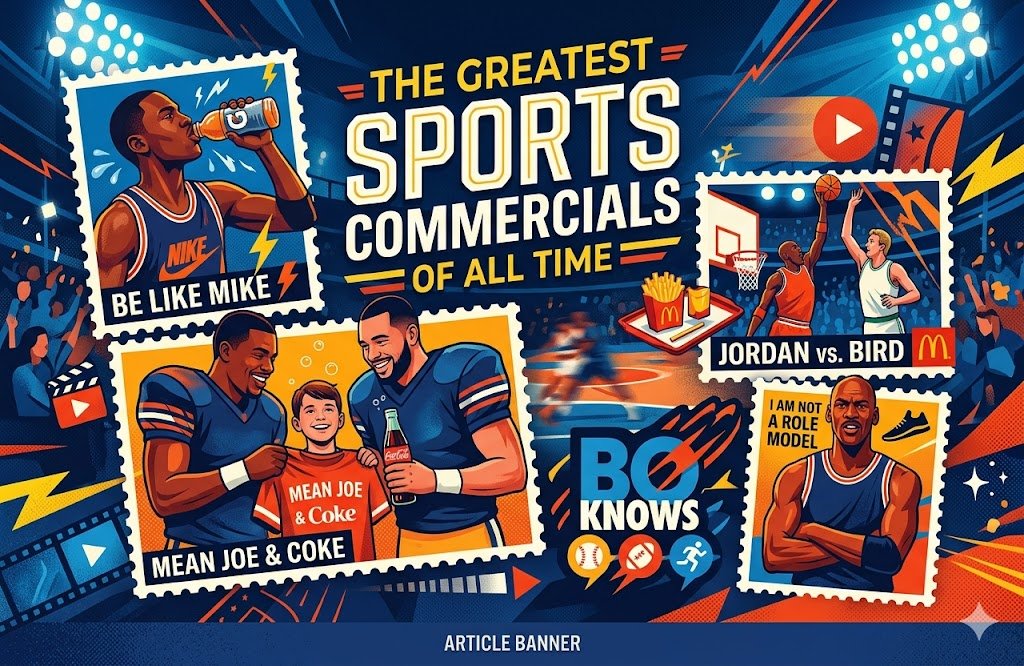
Sports commercials can do something regular ads can’t.
They don’t just sell a product. They sell a feeling.
A great sports ad can make a shoe feel like ambition. A bottle of Gatorade feel like greatness. A fast-food jingle feel like childhood. A sneaker campaign feel like an entire generation learning how to talk about confidence, hustle, swagger, and destiny.
That’s why the best sports commercials last long after the products change, the athletes retire, and the original TV spots stop airing. Fans don’t remember them like ads. They remember them like cultural moments.
“Be Like Mike.”
“Bo Knows.”
“Nothing but net.”
Mean Joe Greene tossing the jersey.
The Nike voiceover that made running feel spiritual.
These weren’t just marketing lines. They became part of sports language.
The greatest sports commercials worked because they understood something simple: fans don’t only admire athletes for what they do. Fans admire what athletes make them feel they could become. Faster. Cooler. Tougher. More fearless. More disciplined. More alive.
A great sports commercial takes that fantasy and makes it 30 seconds long.
Why Sports Commercials Matter
Sports commercials matter because they helped turn athletes into brands.
Before social media, before athlete podcasts, before Instagram training clips and TikTok edits, commercials were one of the main ways fans saw athletes outside the game. A commercial could change how the public understood a player’s personality. It could make a serious athlete funny, a young star global, or a dominant player feel almost mythic.
Commercials also gave fans images to copy. Kids didn’t just want the shoes. They wanted the move, the pose, the attitude, the sweat, the soundtrack, the belief that something from greatness could be purchased, worn, or drunk.
That’s advertising, yes.
But it’s also sports culture.
The best sports commercials didn’t feel separate from the games. They became part of how fans remembered them.
“Be Like Mike” — Gatorade
“Be Like Mike” may be the most famous sports commercial campaign ever.
The idea was simple and perfect. Michael Jordan wasn’t just great. He was the athlete everyone wanted to become. The Gatorade commercial turned that desire into a song, a slogan, and a childhood commandment.
“Be Like Mike” worked because it didn’t overcomplicate Jordan’s appeal. It showed him smiling, playing, competing, and looking impossibly effortless. The ad didn’t need to explain his greatness. Fans already knew. It just translated admiration into a catchy emotional hook.
That’s what made it one of the greatest sports commercials of all time.
The commercial wasn’t selling hydration in a technical way. It was selling closeness to greatness. Drink this, and maybe you’re one step nearer to the feeling Jordan gives people.
That’s a powerful fantasy.
For kids in the 1990s, “Be Like Mike” wasn’t just an ad.
It was a wish.
“Bo Knows” — Nike
“Bo Knows” worked because Bo Jackson felt unreal.
He was a two-sport star, powerful enough for football and explosive enough for baseball. That alone made him perfect for mythmaking. Nike took that athletic absurdity and turned it into one of the most memorable campaigns in sports advertising history.
The joke was that Bo knew everything.
Bo knows baseball. Bo knows football. Bo knows basketball. Bo knows tennis. Bo knows cycling. The campaign leaned into the impossible idea that Jackson’s athletic talent was so broad it could spill into any sport.
It was funny, catchy, and perfectly matched to the athlete.
That’s why “Bo Knows” remains one of the best sports commercials ever. It didn’t try to make Bo look relatable. It made him look superhuman, then made the superhuman part playful.
The campaign also showed how a nickname, slogan, and athlete could merge into one brand identity. People didn’t just talk about Bo Jackson.
They talked in the language of the ad.
Bo knows.
Everyone else remembered.
Mean Joe Greene and Coca-Cola
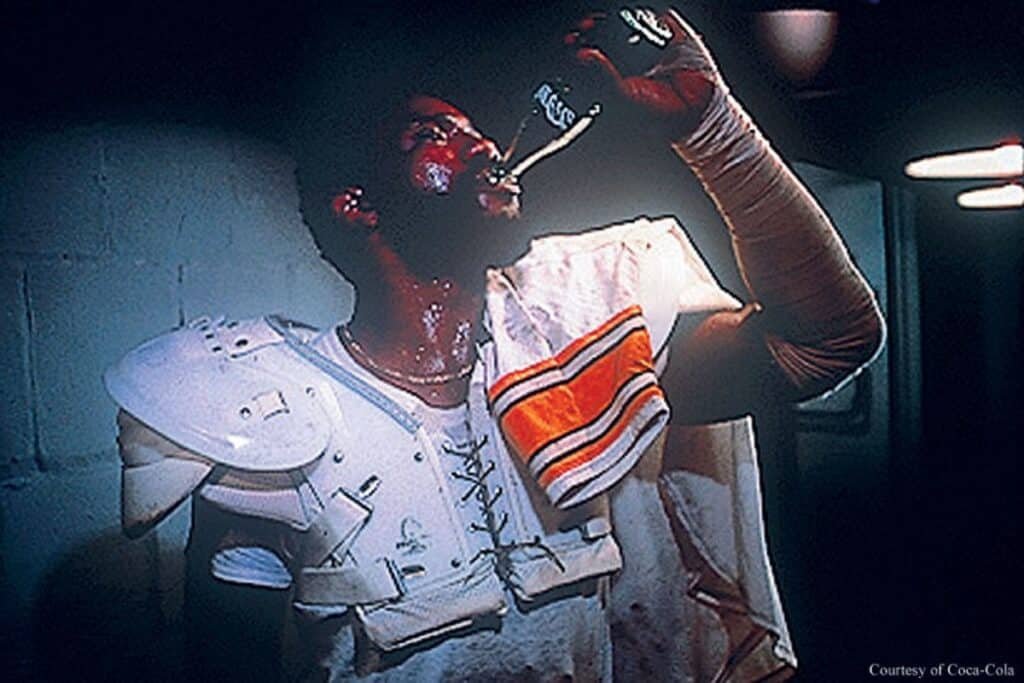
The Mean Joe Greene Coca-Cola commercial is one of the most beloved sports ads ever because it used toughness and tenderness at the same time.
The setup was simple. Mean Joe Greene, one of the fiercest defensive players in football, limps toward the locker room. A young fan offers him a Coke. Greene drinks it, softens, and tosses the kid his jersey.
That’s it.
No complicated concept. No flashy editing. No giant production. Just a feared athlete, a kind kid, and a small exchange that made Greene feel human without making him less intimidating.
The commercial worked because it created contrast. Mean Joe was supposed to be scary. The ad let fans see warmth under the armor. That made the moment memorable.
Among classic sports commercials, this one stands out because it wasn’t about speed, dominance, or winning. It was about connection.
The product mattered less than the feeling.
And that’s usually how great advertising wins.
Jordan vs. Bird — McDonald’s
The Michael Jordan and Larry Bird McDonald’s commercial gave fans one of the best playground fantasies ever: two legends calling impossible shots for a Big Mac.
“Off the floor, off the scoreboard, off the backboard, no rim.”
The whole thing felt like every kid’s backyard shooting contest, just upgraded with two of the biggest basketball stars alive. Jordan and Bird didn’t need dramatic acting. Their rivalry, personalities, and competitive energy carried the ad.
It worked because it made legends feel familiar. Everyone has played some version of that game. Calling ridiculous shots. Raising the difficulty. Refusing to lose. The commercial turned that universal basketball ritual into a national ad.
That’s why it remains one of the most memorable sports commercials ever. It had humor, star power, simplicity, and a line fans could repeat.
A great commercial doesn’t always need a serious message.
Sometimes it just needs two legends fighting over lunch.
Nike’s “Just Do It”
Nike’s “Just Do It” campaign became bigger than any one sport.
That’s what makes it so powerful.
The slogan is short, almost blunt. It doesn’t explain. It orders. Stop waiting. Stop making excuses. Move. Train. Run. Compete. Begin. That directness made it perfect for sports advertising because it could apply to elite athletes and ordinary people at the same time.
Over the years, Nike used “Just Do It” across countless sports, athletes, and stories. Some ads were inspirational. Some were intense. Some were controversial. Some were simple. But the slogan tied them together under one emotional idea: action matters.
Among sports commercials, “Just Do It” stands as one of the most influential campaigns because it changed how brands talked to athletes and fans. It didn’t just sell gear. It sold identity.
Wearing Nike wasn’t just about shoes.
It was about becoming the kind of person who does the thing.
That’s branding at its strongest.
“Write the Future” — Nike
Nike’s “Write the Future” commercial for soccer felt less like an ad and more like a short film about pressure.
The concept was brilliant. One moment on the pitch could change everything. A pass, tackle, goal, or mistake could alter careers, nations, headlines, and fan memory. The ad exaggerated those futures in dramatic, funny, and cinematic ways.
That’s exactly how soccer feels during a World Cup.
The stakes are enormous. One mistake can haunt a country. One goal can turn a player into a national hero. Nike understood that and built an ad around the emotional violence of possibility.
“Write the Future” became one of the most iconic sports commercials because it captured the global scale of soccer. It wasn’t just about winning a game. It was about what winning or losing does to identity, fame, pride, and memory.
The commercial didn’t need to explain why the sport mattered.
It showed what the world does when it does.
“I Am Not a Role Model” — Charles Barkley
Charles Barkley’s “I Am Not a Role Model” Nike commercial remains one of the boldest sports commercials ever made.
The message was uncomfortable on purpose. Barkley looked into the camera and rejected the idea that athletes should automatically be treated as role models. He told parents that just because he could dunk a basketball didn’t mean he should raise their kids.
That was not a soft ad.
It sparked debate because it challenged a major assumption in sports culture. Fans often want athletes to be heroes, examples, moral teachers, entertainers, winners, and flawless public figures all at once. Barkley pushed back.
Whether people agreed with him or not, the ad worked because it sounded like Barkley. Honest. Blunt. Slightly confrontational. Impossible to ignore.
Among sports commercials, this one matters because it did more than sell sneakers.
It started an argument.
And some ads become legendary because they’re brave enough to make people uncomfortable.
“The Cage” — Nike Soccer
Nike’s “The Cage” commercial was pure early-2000s soccer cool.
The ad featured some of the world’s greatest players competing in a secret three-on-three tournament inside a cage, with Eric Cantona overseeing the chaos. It had speed, skill, music, style, and the feeling of a video game turned into real life.
For young soccer fans, it was unforgettable.
The commercial worked because it stripped soccer down to flair. Tricks. Touches. Quick goals. Personality. It wasn’t about tactics or national teams. It was about joy, creativity, and the fantasy of seeing elite players battle in a hidden underground tournament.
That’s why it remains one of the great sports commercials. It understood that fans don’t only love official matches. They love the imagined spaces too: street courts, cages, playgrounds, gyms, alleys, and anywhere athletes can show off without rules getting in the way.
“The Cage” didn’t sell soccer as tradition.
It sold it as style.
“The Showdown” — Larry Bird and Michael Jordan
The McDonald’s Jordan-Bird ad became so famous because it understood athlete chemistry.
Jordan and Bird were opposites in many ways: flash versus deadpan, Chicago versus Boston, flight versus precision. But both were ruthless competitors, and that made the commercial believable even when the shots became ridiculous.
The real joke was that neither man would quit. That was true to their public images. Fans could believe that Jordan and Bird would keep escalating forever just to avoid losing a sandwich.
That’s why the ad lasted.
Great sports commercials often exaggerate the truth. They take something fans already believe about an athlete and stretch it until it becomes comedy, myth, or inspiration.
Jordan and Bird were competitive enough to make a silly premise feel real.
That’s advertising magic.
“Thank You, Mom” — Olympics
The Olympic “Thank You, Mom” campaign became one of the most emotional sports commercial ideas ever.
Instead of focusing only on athletes, it focused on the parents behind them. Early mornings. Practices. Falls. Tears. Travel. Encouragement. Sacrifice. The ad connected Olympic greatness to family labor, especially mothers who helped carry the dream long before the world was watching.
That emotional angle worked because the Olympics already invite human storytelling. Fans don’t just watch events. They watch life stories condensed into seconds, routines, races, and medal ceremonies.
The campaign made viewers think about what athletic success costs outside the arena.
Among sports commercials, “Thank You, Mom” stands out because it understood that sports greatness is rarely individual. Behind the podium is a whole support system.
The ad didn’t sell dominance.
It sold gratitude.
And gratitude can hit harder than hype.
“Failure” — Michael Jordan
Michael Jordan’s “Failure” commercial is one of the most quoted sports ads because it flipped the usual greatness story.
Instead of listing only wins, the ad focused on misses. Missed shots. Lost games. Failed moments. Then Jordan says he succeeded because he failed again and again.
That message worked because it came from Michael Jordan. If a normal person says failure leads to success, it can sound like a poster in a school hallway. When Jordan says it, the words carry the weight of six championships, game-winners, and the most competitive image in basketball history.
The commercial made greatness feel earned instead of magical.
That’s why it remains one of the best sports commercials ever. It gave fans a version of Jordan that wasn’t just flying or winning. It showed the discipline under the mythology.
A great sports ad doesn’t always make an athlete look untouchable.
Sometimes it makes them look human enough to believe in.
Why Sports Commercials Become Legendary
Sports commercials become legendary when they capture the truth of an athlete, not just the product.
“Be Like Mike” worked because everyone wanted to be like Jordan. “Bo Knows” worked because Bo really did feel impossible. Mean Joe Greene worked because toughness hiding kindness felt emotionally real. “I Am Not a Role Model” worked because Barkley was the only person who could deliver it that way.
The product matters, but the athlete matters more.
Fans can tell when an ad feels fake. They can also tell when a campaign understands exactly why an athlete fascinates people. That’s where the best commercials live: between marketing and myth.
They don’t invent greatness.
They package it so well that people remember the package too.
The Legacy of Sports Commercials
The legacy of sports commercials is that they helped shape how fans remember athletes.
Michael Jordan didn’t need Gatorade or Nike to become great, but those ads helped turn his greatness into a language. Bo Jackson’s career was shortened, but “Bo Knows” kept his myth alive. Mean Joe Greene’s Coke ad softened a football monster into a beloved figure. Jordan and Bird made fast food feel like a playground classic. Nike turned slogans into sports philosophy. Olympic ads reminded fans that families are part of the medal too.
The greatest sports commercials weren’t just selling drinks, shoes, burgers, or gear.
They were selling dreams.
A dream of flying.
A dream of winning.
A dream of being tougher than doubt.
A dream of mattering enough that the whole world remembers your name.
That’s why the best ads still work decades later.
They weren’t just commercials.
They were sports memories with a sponsor.