
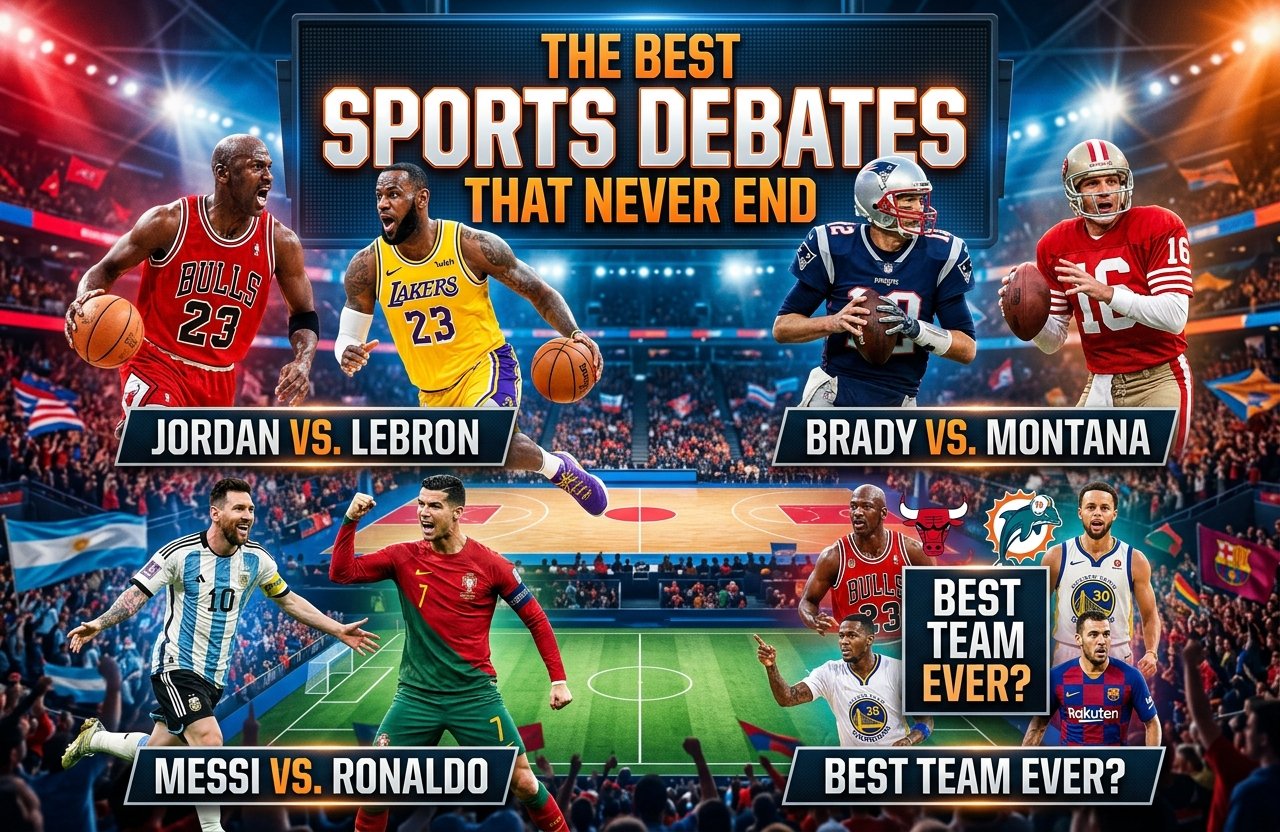
Sports debates are proof that fans don’t actually want closure.
They say they do. They say they want the argument settled. They want one stat, one ring count, one head-to-head matchup, one documentary, one playoff run, one final ranking that ends the conversation forever.
Then someone gives them an answer.
And they immediately start arguing with it.
That’s the beauty of sports debates. They survive because sports are not clean math. Greatness changes depending on what someone values. Rings matter until they don’t. Stats matter until they need context. Peak matters until longevity enters the room. Eye test matters until nostalgia starts lying. Era matters until someone uses it as an excuse. Style matters until winning shuts everyone up.
The best sports debates are not really about facts.
They’re about values.
What do you care about most? Winning? Dominance? Skill? Longevity? Influence? Difficulty? Clutch moments? Aesthetic beauty? Cultural impact? Pure numbers? Fear factor? The answer changes the ranking before the argument even starts.
That’s why these debates never die.
Sports gives fans enough evidence to build completely different churches.
Then it leaves them all in the same bar.
Why Sports Debates Never End
Sports debates never end because fans are usually arguing from different rulebooks.
One fan says Michael Jordan is the GOAT because he went 6-0 in the NBA Finals and defined basketball’s global imagination. Another says LeBron James belongs at the top because of longevity, all-around dominance, and historic production across two decades. Both sides have real evidence. Both sides also have emotional investments they pretend are objective.
That’s how most sports debates work.
The same evidence can be used differently. Losing in the Finals can mean a player wasn’t perfect, or it can mean he carried teams farther than they belonged. Playing in a tougher era can be proof of greatness, or a convenient shield. Advanced stats can clarify a debate, or flatten things fans actually watched.
And memory makes everything worse.
Fans don’t remember the past accurately. They remember how it felt. That feeling becomes evidence.
Good luck defeating that with a spreadsheet.
Michael Jordan vs. LeBron James
No modern basketball argument is bigger than Michael Jordan vs. LeBron James.
Jordan has the perfect myth. Six championships. Six Finals MVPs. No Finals losses. Scoring titles. Defensive greatness. Iconic moments. The Bulls dynasty. The shoes. The commercials. The final shot. The feeling that he turned basketball into a global religion and then left with the last word.
LeBron has the impossible résumé. More longevity. More all-around production. More years as an elite force. Multiple teams. Multiple eras. Historic scoring, passing, rebounding, playoff durability, and the 2016 comeback against a 73-win Warriors team.
That’s why this is the king of sports debates.
The argument changes depending on what greatness means. If greatness means peak mythology and championship perfection, Jordan is almost impossible to move. If greatness means sustained excellence, adaptability, and total basketball value over time, LeBron’s case gets stronger every year.
The funniest part is that both sides act like the other side has no argument.
That’s nonsense.
Both arguments are strong.
That’s why everyone is still yelling.
Tom Brady vs. Joe Montana
The Tom Brady vs. Joe Montana debate used to feel more balanced.
Then Brady kept winning.
Montana had the perfect older quarterback résumé: four Super Bowl wins, no Super Bowl losses, iconic postseason performances, Bill Walsh’s 49ers machine, and a calm elegance that made pressure look optional.
Brady turned the debate into a numbers avalanche. Seven Super Bowl wins. Ten Super Bowl appearances. Longevity beyond reason. Multiple versions of the Patriots dynasty. A late-career championship in Tampa Bay. Comebacks. Records. Playoff dominance. The sense that the NFL spent 20 years trying to end his story and failed repeatedly.
Among sports debates, this one still survives because Montana’s supporters can argue perfection, era, aesthetics, and the fact that he never lost on the biggest stage. Brady’s supporters can point to a career so long and decorated that arguing against him feels like arguing against gravity.
Brady probably made the broad GOAT case harder to deny.
But Montana’s myth remains beautiful.
Sports fans love beauty almost as much as they love winning.
Almost.
Messi vs. Ronaldo
Lionel Messi vs. Cristiano Ronaldo is one of the greatest global sports debates because it’s really an argument about what soccer greatness should look like.
Messi represents genius that seems natural, quiet, and almost unfairly fluid. He dribbles like the ball has chosen him. He passes like he sees hidden doors. He scores without needing to look like he’s forcing the moment. His game feels like art pretending to be efficiency.
Ronaldo represents construction, power, ambition, reinvention, and obsession. He became a machine of goals, fitness, branding, clutch Champions League moments, and self-belief. His greatness feels built brick by brick through will.
That contrast made the debate irresistible.
Among sports debates, Messi vs. Ronaldo lasted because fans weren’t only comparing goals and trophies. They were comparing personalities, styles, philosophies, and emotional preferences. Do you prefer the artist or the conqueror? The genius or the worker? The creator or the finisher?
The World Cup strengthened Messi’s case for many fans, but Ronaldo’s supporters still have their arguments.
And honestly, the debate was a gift.
Soccer got two different versions of greatness at the same time.
Fans argued because they were spoiled.
Rings vs. Stats
Rings vs. stats may be the most annoying and necessary of all sports debates.
Championships matter. Of course they do. Winning is the point. Athletes are judged by how they perform when the stakes are highest. Rings give fans a clean shortcut for legacy.
But rings are also team achievements.
That’s where the problem starts.
A superstar can play brilliantly and lose because the roster is weaker, the coach is worse, the opponent is better, or one teammate forgets how clocks work. Another player can win a ring as part of a dominant team without being the main reason. Rings matter, but they don’t explain everything.
Stats bring another kind of evidence. They help measure production, efficiency, impact, and consistency. But stats can also be inflated by era, role, pace, usage, rules, or systems. Numbers need interpretation.
That’s why this remains one of the central sports debates.
Rings without context are lazy.
Stats without stakes are incomplete.
The best legacy arguments need both.
Fans still choose whichever one helps their favorite player.
Obviously.
Peak vs. Longevity
Peak vs. longevity is one of the best sports debates because it asks a brutal question.
Would you rather have the athlete who was the best for a shorter stretch, or the athlete who stayed great forever?
Peak is intoxicating. A player at their absolute best can feel untouchable. Prime Shaq. Peak Pedro Martinez. 1980s Mike Tyson. 1991-93 Michael Jordan. 2007 Tom Brady. 2016 Steph Curry. Peak gives fans the highest version of possibility.
Longevity is harder to romanticize but maybe more impressive. Staying elite across years, injuries, rule changes, teammates, opponents, and age requires a different kind of greatness. LeBron, Brady, Serena, Kareem, Jerry Rice, Gordie Howe — their careers became monuments to durability and adaptation.
Among sports debates, this one never ends because fans value fireworks differently than architecture.
Peak is the explosion.
Longevity is the cathedral.
The best of the best have both, which is why they become impossible to argue about cleanly.
But when athletes have one more than the other, fans start sharpening knives.
Best Team Ever
The best team ever debate is beautifully chaotic.
Is it the 1995-96 Chicago Bulls? The 2016-17 Warriors? The 1972 Dolphins? The 1985 Bears? The 2007 Patriots even though they didn’t finish? The 1998 Yankees? The 1976-77 Montreal Canadiens? The 1927 Yankees? The 1992 Dream Team if national teams count?
Every answer starts a fight.
This is one of the great sports debates because team greatness depends on dominance, competition, playoff performance, talent, chemistry, innovation, and historical impact. Some teams had the best record. Some had the best postseason. Some changed how the sport was played. Some were so culturally famous that their aura outgrew the schedule.
The debate gets even messier across eras. Modern teams have better training, scouting, nutrition, analytics, and global talent pools. Older teams dominated their own time with less technology and different rules. How do you compare them fairly?
You don’t.
You argue forever.
That’s the point.
Greatest Dynasty
The greatest dynasty debate is slightly different from the best team debate.
A team can have one perfect season.
A dynasty owns time.
The 1990s Bulls. The Brady-Belichick Patriots. The Yankees across multiple eras. The Russell Celtics. The Showtime Lakers. The 1980s Oilers. The UConn women’s basketball dynasty. The Alabama football machine under Nick Saban. The Warriors’ modern run. The Canadiens’ old hockey empire.
Each dynasty has a different case.
Some won the most titles. Some ruled in the toughest era. Some changed the sport’s economics or style. Some became villains. Some became cultural symbols. Some lasted longer than seemed reasonable.
Among sports debates, dynasties are fun because fans have to decide whether dominance means total rings, consecutive rings, length of control, quality of opponents, or emotional fear. A dynasty can be statistically great and still not feel as intimidating as another one.
The best dynasty isn’t always the one with the most banners.
Sometimes it’s the one everyone else measured themselves against.
Best Player Without a Ring
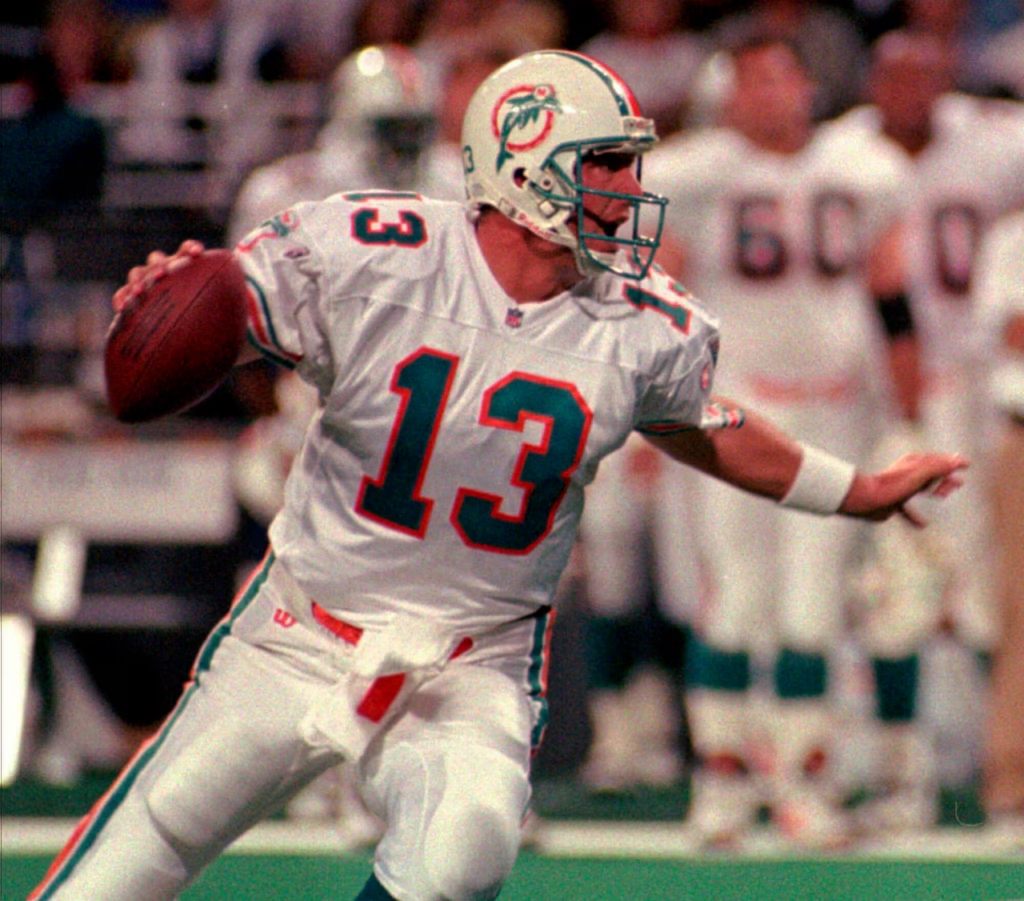
The best player without a championship debate is basically sports sadness with rankings.
Dan Marino. Charles Barkley. Karl Malone. John Stockton. Patrick Ewing. Barry Bonds. Ken Griffey Jr. Ted Williams. Tony Gwynn. Allen Iverson. Fran Tarkenton. Marcel Dionne. Eric Lindros. The list changes by sport, and every name carries a different kind of ache.
This is one of the classic sports debates because it exposes how unfair legacy conversations can be. A player can be individually brilliant, historically important, and beloved, then get penalized because the team never finished the job.
But the ring absence matters too.
Championships are where greatness gets tested in a different light. Fans want to know who rose, who fell, who carried, who disappeared, and who never had enough help.
That’s why the argument never fully resolves.
A ringless player can be better than many champions.
But the empty space still follows them.
Sports can be cruel, and fans keep volunteering to make it crueler.
Most Clutch Athlete
The clutch debate is where facts and feelings fight in a locked room.
Fans love clutch athletes because they make pressure feel romantic. Michael Jordan. Tom Brady. Kobe Bryant. Derek Jeter. David Ortiz. Joe Montana. Reggie Miller. Serena Williams. Tiger Woods. Mariano Rivera. Patrick Mahomes. These names carry a late-game charge.
But measuring clutch is tricky.
Is it game-winners? Playoff stats? Finals moments? Elimination games? Reputation? Fear? Memory? A player can miss plenty of big shots and still be remembered for the makes. Another can perform consistently under pressure without one iconic highlight and get left out of the mythology.
Among sports debates, clutch arguments survive because fans remember emotional spikes more than full data sets. The one shot, one drive, one save, one at-bat, one putt — those moments become identity.
Clutch is real.
Clutch is also exaggerated.
That’s why everyone keeps arguing.
Best Era of Basketball
Every generation thinks its basketball era was the real one.
Older fans say the 1980s and 1990s were tougher, more physical, more competitive, and less friendly. They remember hand-checking, hard fouls, post play, rivalries, and stars who supposedly hated each other more.
Modern fans point to skill, spacing, shooting, global talent, defensive complexity, pace, and the fact that today’s big men can dribble, pass, shoot, and defend in ways older eras rarely demanded.
This is one of the most emotional sports debates because it’s secretly about aging.
Fans often defend the era that shaped them. The players they watched as kids become the standard. Everything after looks soft, weird, too analytical, or too obsessed with threes. Everything before looks slow, inefficient, or less skilled.
The truth is that each era had different demands.
Great players adapt to their time.
Fans rarely do.
That’s why the argument survives.
Best Era of Football
Football era debates might be even harder because the sport has changed so dramatically.
Older NFL fans value toughness, running games, defense, and quarterbacks surviving hits that would draw flags today. Modern fans point to passing efficiency, offensive complexity, athletic defenders, spread concepts, and the difficulty of playing quarterback in a league where every mistake is dissected instantly.
Rules changed everything.
That complicates every comparison. Quarterback numbers exploded in modern eras because the league emphasized passing and player safety. Defensive players from earlier eras had freedoms that would now be penalized. Receivers today face different coverage, but also more sophisticated athletes.
Among sports debates, football eras are messy because the game is almost different enough to be a cousin of itself.
Would an old defense survive modern rules?
Would a modern quarterback survive old hits?
Would anyone survive a debate show discussing this for three hours?
Unclear.
College Football Playoff Arguments
Few sports debates are as reliable as college football playoff arguments.
Four teams. Twelve teams. Strength of schedule. Conference champions. Eye test. Best team vs. most deserving team. Undefeated smaller schools. SEC bias. Brand bias. Bad losses. Quality wins. Committee logic. Computer rankings. Human rankings. Chaos.
College football was basically designed in a lab to make fans furious.
The problem is that college football has too many teams, uneven schedules, regional loyalties, and a short season. Teams don’t all play comparable opponents. Conferences rise and fall. Injuries change rosters. One loss can mean everything or nothing depending on the logo.
That’s why this remains one of the loudest sports debates.
The playoff can expand and still not eliminate the argument. It just moves the cutoff line. Someone will always be first team out. Someone will always feel robbed. Someone will always say the committee got scared.
College football fans don’t trust systems.
Usually for good reason.
Analytics vs. Eye Test
Analytics vs. eye test is one of the defining modern sports debates.
Analytics help fans and teams understand efficiency, value, tendencies, probabilities, and hidden contributions. They’ve changed baseball, basketball, football, hockey, and soccer. Ignoring data now feels foolish.
But the eye test still matters.
Sports are played by humans, not spreadsheets. Body language, matchup feel, defensive attention, pressure, leadership, fear, and rhythm don’t always show cleanly in one number. Some fans use “eye test” as an excuse to ignore evidence. Some analysts use numbers as an excuse to ignore context.
That’s why the debate is useful.
Analytics can correct lazy memory.
The eye test can correct lazy interpretation.
Among sports debates, this one won’t end because both sides are right when they’re not being annoying.
The best analysis uses numbers and eyes.
The worst fans pick one and act superior.
Offense vs. Defense
Does offense win championships, or defense?
Yes.
That’s the annoying answer.
Defense has the old slogan. Defense travels. Defense survives bad shooting nights. Defense pressures stars, creates mistakes, and can define playoff series. The 1985 Bears, 2000 Ravens, 2004 Pistons, and many great hockey teams built their identities on suffocation.
But modern sports keep rewarding offense. Rules often favor scoring. Fans love points. Elite offensive creators can bend entire leagues. Patrick Mahomes, Steph Curry, Lionel Messi, Wayne Gretzky, and other offensive geniuses force opponents to change everything.
Among sports debates, offense vs. defense survives because sports evolve in cycles. A dominant offense changes the game. Then defenses adjust. Then offenses adjust again. The argument never ends because the answer depends on era, rules, roster, and matchup.
Defense may win championships.
But someone still has to score.
Minor detail.
Individual Greatness vs. Team Success
This is one of the deepest sports debates because it gets to the heart of legacy.
How much should an individual athlete be judged by team success?
In basketball, one superstar can shape everything, so rings weigh heavily. In baseball, even the greatest hitter gets only a few at-bats per game, so team success is less individually controllable. In football, quarterbacks get enormous credit and blame, while linemen and defenders often get treated like supporting cast in someone else’s biography.
That makes cross-sport comparisons almost impossible.
A great tennis player controls their own results directly. A great soccer player may dominate and still watch a teammate miss the decisive penalty. A great pitcher can throw brilliantly and lose 1-0. A great quarterback can lead a perfect drive and never touch the ball in overtime.
Among sports debates, this one matters because fans love simple rankings, but team sports resist simplicity.
Winning matters.
Help matters too.
Pretending otherwise is just legacy laziness.
The GOAT Debate Itself
The GOAT debate has become its own sport.
Every major sport has one. Basketball has Jordan-LeBron. Football has Brady and others. Soccer has Messi-Ronaldo-Pelé-Maradona arguments. Tennis has Serena, Federer, Nadal, Djokovic, Graf, Navratilova, and era debates. Boxing has Ali, Robinson, Mayweather, Tyson, Louis, Leonard, and endless weight-class complications. Baseball has Ruth, Mays, Bonds, Aaron, Williams, and pitchers living in separate arguments.
The GOAT debate is fun because it sounds final and never is.
Greatest of all time requires comparing athletes who didn’t face the same opponents, rules, training, travel, media, medicine, or social conditions. It also requires deciding what “greatest” means before anyone starts. Most fans skip that step and go straight to yelling.
Among sports debates, GOAT talk is the biggest because it gives fans permission to rank history like a fantasy draft.
It’s impossible.
It’s also irresistible.
That’s why it isn’t going anywhere.
Why Fans Need Sports Debates
Fans need sports debates because arguing is part of fandom’s social life.
Games end. Seasons end. Careers end. Debates keep everything alive. They let fans relive old moments, defend childhood heroes, attack rivals, discover forgotten players, and turn statistics into emotional weapons.
Sports debates also help fans locate themselves. Who you defend says something about what you value. The graceful player or the dominant one. The winner or the innovator. The loyal star or the ring chaser. The old era or the modern one. The numbers or the story.
That’s why fans take it personally.
They’re not only defending athletes.
They’re defending the version of sports that made them fall in love.
The Legacy of Sports Debates
The legacy of sports debates is that they keep history loud.
Jordan vs. LeBron will never fully die because basketball greatness has more than one shape. Brady vs. Montana changed as Brady kept winning, but Montana’s perfection still holds mythic power. Messi vs. Ronaldo gave soccer two opposing visions of greatness at the same time. Rings vs. stats keeps exposing how lazy and necessary both arguments can be. Peak vs. longevity asks whether fans prefer the brightest flame or the longest burn. Best team ever and greatest dynasty debates keep eras fighting. Ringless legends remind fans that greatness and team success don’t always meet. Clutch debates prove memory can overpower math. Era debates let generations defend themselves. Analytics vs. eye test forces fans to balance evidence and feeling. GOAT debates turn sports history into a permanent courtroom.
Sports debates matter because sports don’t end when the clock hits zero.
They move into memory.
Then memory starts talking.
And once fans start talking, good luck getting them to stop.