
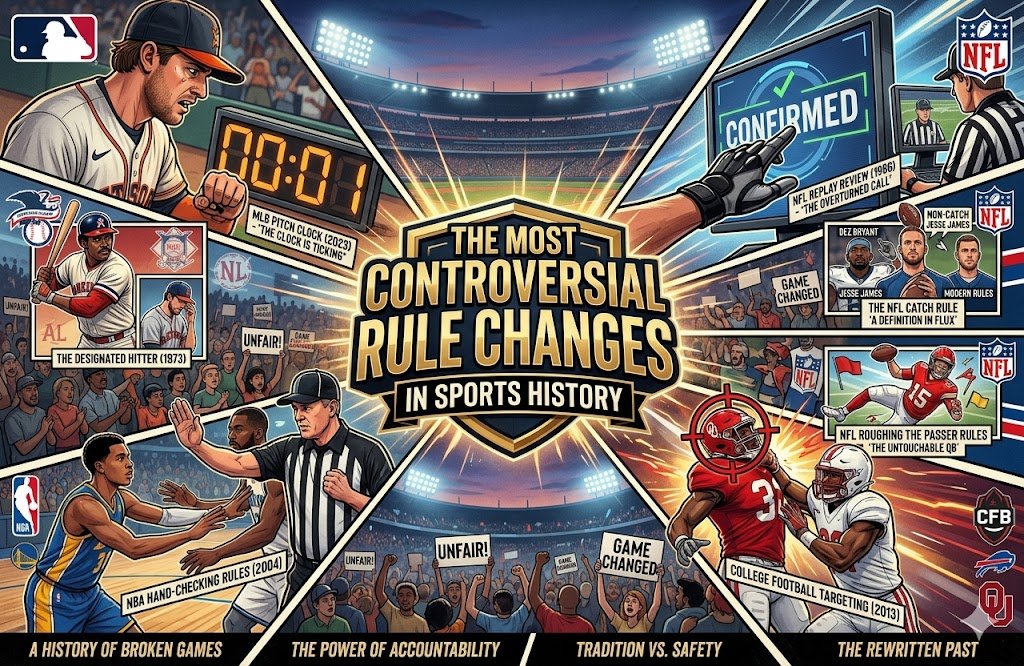
Sports fans love tradition until tradition starts making the game worse.
Then everybody argues.
That’s why controversial rule changes in sports always hit a nerve. A league changes one rule, adjusts one clock, adds one review system, protects one type of player, bans one kind of contact, or changes one scoring format, and suddenly fans act like someone broke into their childhood home and rearranged the furniture.
Sometimes they’re right to be angry. Some rule changes make games uglier, slower, softer, stranger, or more confusing. Others seem terrible at first but eventually become normal. A few completely change how a sport is played, watched, coached, and remembered.
That’s the tricky thing about sports rules. They’re supposed to protect the game, but they also reshape the game. A small change can alter strategy, statistics, records, player value, fan experience, and even the meaning of greatness.
The most controversial rule changes in sports aren’t just technical adjustments. They’re arguments about identity. What should football be? How fast should baseball move? How physical should basketball get? Should replay fix mistakes or ruin emotion? Should player safety matter more than old-school toughness?
Sports fans don’t agree on those answers.
That’s why the arguments never really end.
Why Controversial Rule Changes in Sports Matter
The reason controversial rule changes in sports is such a hot topic is that rules decide what kind of game fans are watching.
Fans often talk about players, coaches, dynasties, and rivalries, but rules sit underneath all of it. Change the rules, and you change the incentives. Change the incentives, and you change behavior. Change behavior, and the sport starts looking different.
That’s why fans panic when leagues start tinkering. They don’t just fear one new rule. They fear a slow drift away from the version of the sport they fell in love with.
At the same time, sports can’t survive by refusing to change. Games evolve. Athletes get faster. Injuries become better understood. Technology improves. Television demands shift. Attention spans change. Younger fans watch differently. Leagues have to adapt, even when adaptation makes older fans furious.
That tension creates the drama.
Tradition says, “Leave it alone.”
The future says, “Fix it before people stop watching.”
The MLB Pitch Clock
Few recent rule changes transformed a sport’s rhythm as quickly as the MLB pitch clock.
Baseball had spent years dealing with complaints about slow games, dead time, endless mound visits, stepping out, stepping off, adjusting gloves, and pitchers turning every at-bat into a small hostage situation. Purists argued that baseball’s lack of a clock was part of its beauty. Critics argued that the game had become too slow for modern audiences.
Then the pitch clock arrived.
Suddenly, pitchers had to work faster. Hitters had to be ready. The pace tightened. Games got shorter. Dead time disappeared. For many fans, baseball felt alive again. For others, something sacred got lost. They missed the old tension, the slow burn, the feeling that a big ninth-inning at-bat could breathe.
That’s why the pitch clock belongs among the most controversial rule changes in sports. It didn’t just change timing. It changed the emotional texture of baseball.
Baseball used to drift. Now it moves.
Some fans call that progress.
Others call it vandalism with a stopwatch.
NFL Replay Review
Replay review sounds like an easy win.
Get the call right. Fix obvious mistakes. Use technology. Give teams a chance to challenge bad officiating. In theory, replay should make sports feel fairer.
In practice, replay changed the way fans experience games.
The NFL’s replay system has created some of football’s most exhausting modern rituals: waiting for the booth, watching frame-by-frame slow motion, debating what “control” means, arguing about whether a knee was down, whether the ball moved, whether the receiver survived the ground, whether a camera angle showed enough, or whether common sense still exists somewhere inside league headquarters.
Replay solved some problems and created others.
Before replay, bad calls were infuriating but immediate. Fans yelled, moved on, and lived with the injustice. With replay, fans get a new kind of pain: the belief that even with technology, the league still somehow got it wrong.
That’s why replay review remains one of the most controversial rule changes in sports. It promised certainty. Instead, it gave fans slow-motion confusion.
The game became more accurate.
It also became less spontaneous.
The NFL Catch Rule
The NFL catch rule became controversial because nobody seemed to know what a catch was anymore.
For generations, fans thought they understood catching a football. You grab the ball. You get two feet down. You hold on. Simple enough.
Then replay, slow motion, and increasingly technical language turned the catch into a legal document.
Calvin Johnson’s overturned touchdown against the Bears in 2010 became one of the defining moments. Dez Bryant’s famous non-catch against the Packers in the 2014 playoffs made things worse. Fans saw players make what looked like catches, only for officials to explain that, actually, according to the rulebook, reality wasn’t reality.
That kind of controversy cuts deep because football is supposed to be physical and immediate. When fans need a rules analyst to explain why a spectacular play didn’t count, something feels broken.
The catch rule changed over time, but the damage lingered. It became a symbol of the NFL’s problem with over-officiating its own drama.
The league tried to define a catch perfectly.
Instead, it made everyone doubt their own eyes.
NBA Hand-Checking Rules
The NBA’s hand-checking changes helped reshape modern basketball.
In earlier eras, perimeter defenders could use their hands more aggressively to guide, bump, and control offensive players. That made life harder for guards and wings. Games could be more physical, slower, and rougher. Defenders had more tools. Scorers had to fight through contact.
When the NBA cracked down on hand-checking, the game opened up.
Guards got more freedom. Drives became cleaner. Spacing mattered more. Skill and speed became more valuable. The modern NBA, with its high-scoring guards, spread pick-and-rolls, and explosive perimeter play, owes a lot to that shift.
Fans still argue about it constantly.
Old-school fans say the league got soft and made defense too hard. Modern fans say the rule change let skill shine and made the game more watchable. Both sides have a point. The NBA became more open, more dynamic, and more offensive. It also lost some of the physical edge older fans loved.
That’s why hand-checking belongs in any conversation about controversial rule changes in sports. It didn’t just change how defenders used their hands.
It helped change who could dominate the league.
The Designated Hitter
The designated hitter may be baseball’s longest-running rule argument.
For decades, the American League used the DH while the National League made pitchers hit. That difference became part of baseball’s identity. AL fans got more offense. NL fans got strategy: double switches, pinch hitters, managers deciding whether to pull a pitcher in a tight game.
Then the universal DH arrived, and a whole style of National League baseball disappeared.
Supporters said it made sense. Pitchers mostly couldn’t hit. Nobody wanted to watch automatic outs. The DH protected pitchers from batting and baserunning injuries while adding more real offense to the lineup.
Critics hated it. They argued that baseball lost strategy, texture, and weirdness. A pitcher batting might’ve been ugly, but it was part of the game’s odd charm. It forced managers to think differently. It made the National League feel distinct.
The DH debate is really a debate over what baseball should value: cleaner entertainment or tactical inconvenience.
The universal DH made the game more consistent.
It also made it less strange.
For some fans, that’s a loss.
College Football Targeting
College football’s targeting rule is one of the most controversial player-safety rules ever introduced.
The intention is obvious: protect players from dangerous hits to the head and neck. Football has had to confront concussions, long-term brain trauma, and the reality that old-school violence came with real costs. Targeting rules are part of that reckoning.
But the enforcement has driven fans crazy.
A player can be ejected from a major game for a hit that looks accidental. Replay can slow a violent sport down to the frame and assign intent where there may only have been speed, instinct, and bad timing. Defenders are asked to make split-second decisions while offensive players lower their bodies, slide late, or change angles.
Fans often agree with the goal but hate the result.
That’s what makes targeting so controversial. Very few people want more head injuries. But plenty of fans hate seeing a playoff game, rivalry game, or bowl game altered by an ejection that feels too harsh.
Player safety matters.
So does competitive fairness.
The targeting rule sits right in the fight between them.
NFL Roughing the Passer Rules
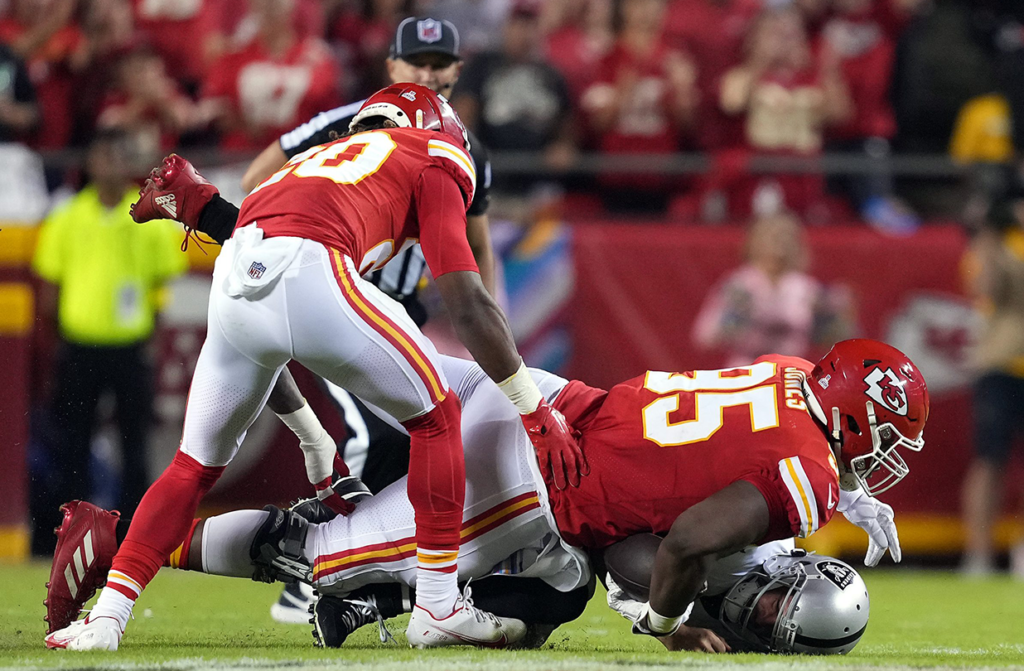
NFL roughing the passer rules may create more weekly rage than almost any modern football rule.
Protecting quarterbacks makes sense. They’re valuable. They’re often vulnerable. The league wants offense, star power, and fewer injuries. Nobody wants to watch backup quarterbacks every week because defenders are allowed to turn starters into folding chairs.
But fans hate when routine hits become penalties.
The controversy usually comes from the feeling that defenders have no clear way to play. They can’t hit too high. They can’t hit too low. They can’t land with too much body weight. They can’t arrive late, but football happens fast. Sometimes a pass rusher beats a tackle, reaches the quarterback, makes what looks like a normal hit, and still sees a flag.
That makes fans feel like the sport is being softened beyond recognition.
The NFL is trapped here. It needs quarterbacks healthy, but it also sells violence. The league wants pass rushers to be terrifying, just not too terrifying. It wants defense, but not at the expense of marketable stars.
That contradiction is why roughing the passer remains one of the most controversial rule changes in sports.
Football wants danger.
The league wants controlled danger.
Fans can feel the difference.
The NHL Shootout
The NHL shootout was introduced to avoid ties and give regular-season games a clear winner.
On paper, it made sense. Fans like winners. Television likes clean endings. Shootouts are dramatic, easy to understand, and full of star-player moments. A goalie. A shooter. A spotlight. Simple.
But many hockey fans hated it.
Their argument was also simple: hockey is a team sport, and shootouts are a skills competition. Deciding a game through breakaway attempts can feel disconnected from the 60 minutes that came before it. A team can play better hockey and lose because of a few one-on-one attempts.
Supporters say shootouts are exciting. Critics say they’re artificial.
That’s the core tension. The shootout created drama, but not always the kind traditional fans respected. It turned regular-season endings into something more digestible, more highlight-friendly, and more casual-fan friendly.
It also made some diehards roll their eyes.
The NHL shootout is one of those controversial rule changes in sports that shows how leagues often choose entertainment value over purity.
And honestly, they usually know exactly what they’re doing.
The NFL Overtime Rules
NFL overtime rules have been controversial for years because fans hate seeing huge games end with one offense never touching the ball.
The old sudden-death structure made sense in a rough, simple way: first score wins. But as passing offenses became more explosive and quarterbacks became more important, the format started feeling unfair. A coin toss could carry too much power.
Playoff heartbreak made the debate louder. Fans watched elite quarterbacks lose without getting a chance to answer. That never sat right. Football is a team sport, yes, and defense matters, yes, but modern fans want both offenses to get a shot when the stakes are massive.
The league has adjusted overtime rules over time, especially for the postseason, but the debate hasn’t vanished. Some fans want college-style overtime. Others hate that idea. Some want fairness. Others want games to end before players are exhausted and injured.
NFL overtime is controversial because there’s no perfect answer.
Every format has a flaw.
The coin toss just makes the flaw feel personal.
The Three-Point Line
The three-point line is now so central to basketball that it’s hard to imagine the sport without it.
But when it entered the game, it was controversial. Traditionalists saw it as a gimmick. Why should one shot be worth more just because it came from farther away? Would it distort the game? Would it reward specialists too much? Would it turn basketball into a circus?
In hindsight, the three-point line became one of the most important rule changes in sports history.
It changed spacing. It changed roster construction. It changed strategy. It changed player development. It created new kinds of stars. Eventually, it helped produce the modern NBA, where shooting range bends defenses and players like Stephen Curry can reshape the geometry of the sport.
But even now, some fans think the three-point revolution went too far. They miss post play, midrange variety, bruising frontcourts, and basketball that didn’t feel like a math equation.
That’s what great rule changes do. They solve one version of a sport and create another.
The three-point line didn’t ruin basketball.
It transformed it so completely that fans still argue about what was lost.
Why Fans Resist Rule Changes
Fans resist rule changes because sports are emotional memory.
A rulebook might seem technical, but fans connect rules to eras. The rules are part of how their favorite athletes played, how their childhood teams won, how their parents explained the game, and how old highlights look in their minds.
When rules change, fans feel time moving. That can be uncomfortable.
A younger fan may see the pitch clock and think baseball finally woke up. An older fan may see it and think baseball lost patience. A modern NBA fan may love spacing and scoring. An old-school fan may miss hand-checking and post battles. A safety advocate may support targeting. A linebacker may feel like the sport is asking him to defy physics.
Nobody is completely wrong.
They’re just protecting different versions of the game.
The Legacy of Controversial Rule Changes in Sports
The legacy of controversial rule changes in sports is that they reveal what fans value most.
The pitch clock showed how badly baseball needed pace, and how deeply some fans loved the sport’s old rhythm. Replay review proved technology can fix mistakes while creating new frustration. The NFL catch rule showed that too much precision can make common sense disappear. NBA hand-checking changes helped create a faster, freer game. The DH simplified baseball while erasing some National League strategy. Targeting and roughing the passer forced football to confront player safety. The shootout made hockey endings more dramatic but less pure. The three-point line changed basketball forever.
Some rules make sports better.
Some make them worse.
Some only feel wrong until a new generation grows up with them.
That’s the strange truth about rule changes. The controversy fades when the changed version becomes someone else’s childhood. What feels like an attack on tradition today may feel normal tomorrow.
Sports never stay frozen.
Fans hate that.
Fans also keep watching.