
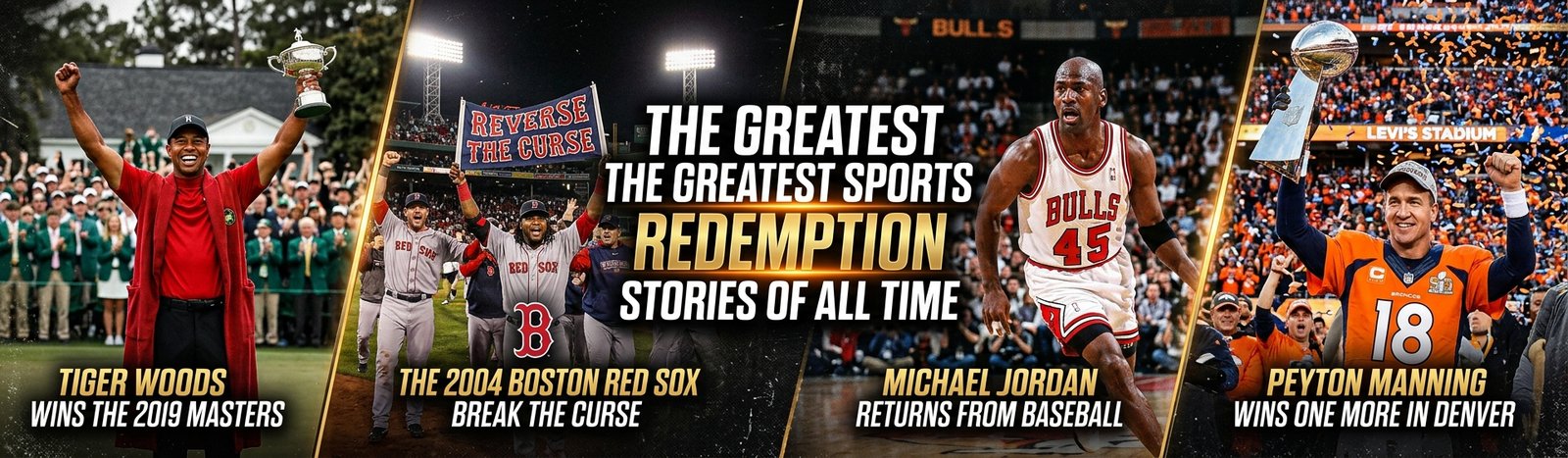
Sports redemption stories hit differently because they don’t begin with glory.
They begin with failure.
A blown lead. A missed shot. A public collapse. A career-ending injury that somehow didn’t end the career. A superstar humbled on the biggest stage. A team carrying decades of pain. A player written off, laughed at, traded, benched, doubted, or left behind by the sport that once celebrated them.
Then something changes.
Not all at once. Not cleanly. Redemption is rarely that polite. It usually comes through rehab, humiliation, repetition, stubbornness, therapy, training, apology, reinvention, patience, and a refusal to let the worst chapter become the final one.
That’s why sports redemption stories last.
Fans love greatness, but they connect with recovery. Perfect athletes can feel distant. Redeemed athletes feel human. They fell. They lost. They broke. They were embarrassed. They made mistakes. They had to climb back under lights bright enough to expose every scar.
A championship is impressive.
A championship after heartbreak is mythology.
That’s the emotional power of redemption in sports. It turns winning into something more than winning. It makes the final whistle feel like an answer to years of doubt.
Why Sports Redemption Stories Matter
Sports redemption stories matter because fans understand failure better than perfection.
Most people don’t know what it feels like to win a Super Bowl, hit a walk-off home run, make a Finals shot, or stand on an Olympic podium. But everyone knows what it feels like to fail. Everyone knows embarrassment, regret, injury, loss, doubt, and the fear that a bad moment might define them.
Sports just makes those feelings public.
That’s why redemption stories become so powerful. They let fans watch someone survive a label. Choker. Bust. Washed. Broken. Selfish. Finished. Cursed. Overrated. Too old. Too fragile. Not clutch. Not the same.
Then the athlete or team comes back and makes the label look small.
Sports redemption stories don’t erase the past.
They transform it.
The failure becomes part of the climb.
Tiger Woods Wins the 2019 Masters
Tiger Woods winning the 2019 Masters is one of the greatest sports redemption stories ever.
For years, Tiger looked too far removed from his old dominance. Injuries, surgeries, personal scandal, public humiliation, and physical breakdowns had changed the aura around him. The player who once felt inevitable suddenly seemed fragile, human, and maybe permanently separated from major championship glory.
Then Augusta happened.
Tiger’s 2019 Masters win wasn’t just another major. It was a resurrection. The red shirt on Sunday looked familiar, but the emotion was different. This wasn’t the cold destroyer of the early 2000s. This was an older Tiger, scarred by time, holding off younger stars and letting the world see what the victory cost him.
The image of him embracing his son after winning carried enormous weight because it echoed the image of Tiger embracing his father after his first Masters win in 1997.
Among sports redemption stories, this one stands near the top because the comeback felt impossible until it happened. Tiger didn’t return to the exact old version of himself.
He became a new version who could still win.
That may be even more impressive.
The 2004 Boston Red Sox Break the Curse
The 2004 Boston Red Sox didn’t just win a World Series.
They exorcised a century of pain.
For generations, Boston fans lived with the Curse of the Bambino, a mythology built from Babe Ruth, Yankees dominance, near-misses, collapses, and heartbreak that seemed almost supernatural. The Red Sox had suffered enough to make losing feel inherited.
Then came the 2004 ALCS.
Down 3-0 to the New York Yankees, the Red Sox were supposed to be finished. No Major League Baseball team had ever come back from that deficit in a postseason series. Against the Yankees, of all teams, it felt especially impossible.
Then Dave Roberts stole second. David Ortiz became a late-night monster. Curt Schilling pitched through injury. Boston won four straight and completed the greatest rivalry reversal in baseball history.
Then they swept the St. Louis Cardinals in the World Series.
Among sports redemption stories, the 2004 Red Sox are essential because the redemption belonged to players, fans, families, and ghosts. It wasn’t only about one team. It was about grandparents, old heartbreaks, cursed language, and generations who had been taught to expect the worst.
Boston didn’t just win.
Boston got released.
LeBron James Wins for Cleveland

LeBron James’ 2016 championship with the Cleveland Cavaliers is one of basketball’s defining sports redemption stories.
LeBron had left Cleveland in 2010 in one of the most criticized athlete decisions ever. “The Decision” turned him from beloved hometown savior into a national villain almost overnight. He won titles in Miami, repaired much of the basketball argument, and returned to Cleveland with a promise to bring a championship home.
Still, the burden remained.
Cleveland hadn’t won a major professional sports title in decades. The Cavaliers faced the 73-win Golden State Warriors in the 2016 NBA Finals and fell behind 3-1. The Warriors looked like the future. The series looked over.
Then LeBron delivered.
Game 5. Game 6. The block in Game 7. Kyrie Irving’s shot. Kevin Love’s stop. Cleveland’s drought ended.
Among sports redemption stories, LeBron’s Cleveland title matters because it answered multiple wounds at once. It redeemed the decision to return. It redeemed Cleveland’s faith. It reshaped LeBron’s legacy. It gave the city the one thing he had been expected to deliver since he was a teenager.
The line was simple.
Cleveland, this is for you.
And for once, sports gave the perfect ending.
Michael Jordan Returns From Baseball
Michael Jordan’s return from baseball became one of the great sports redemption stories because it started with doubt people now forget.
Jordan retired from basketball after winning three straight championships with the Chicago Bulls. He left the sport at the height of his power, played minor league baseball, then returned to the NBA late in the 1994-95 season.
But the comeback didn’t immediately end in triumph.
The Orlando Magic beat the Bulls in the 1995 playoffs. Nick Anderson famously said Jordan didn’t look like the old Michael Jordan. That comment became fuel, because Jordan treated almost everything as fuel.
The next season, Jordan returned fully.
The Bulls went 72-10, won the 1996 NBA championship, and Jordan cried on the locker room floor on Father’s Day, his first title since the death of his father.
Among sports redemption stories, Jordan’s second three-peat is powerful because it turned a failed comeback season into the start of another dynasty. He didn’t just prove he could return.
He proved he could still rule.
For most athletes, one dynasty is enough.
Jordan needed a sequel.
Then he made the sequel legendary.
Alex Smith Returns to the NFL
Alex Smith’s comeback from his 2018 leg injury is one of the most astonishing sports redemption stories because survival came before football.
Smith suffered a devastating broken leg while playing quarterback for Washington. Complications followed, including infection and serious concern about his long-term health. For a long time, the question wasn’t whether he’d play again. It was whether he’d keep his leg and recover a normal life.
Then he came back.
Smith returned to an NFL field in 2020, an outcome that felt almost impossible given everything he had endured. He wasn’t chasing a fairy-tale MVP season. The redemption was simply being there, under center again, after a medical ordeal that would’ve ended almost anyone’s career.
Among sports redemption stories, Smith’s stands out because it strips sports down to courage. The comeback wasn’t about proving critics wrong in the usual loud way. It was about proving that the body, mind, and will could survive something terrifying.
Some redemption stories end with trophies.
This one ended with a snap.
That was enough.
Drew Brees Rebuilds His Career in New Orleans
Drew Brees’ redemption story began with a damaged shoulder and uncertainty.
After suffering a serious injury with the San Diego Chargers, Brees entered free agency with real questions about whether he’d ever return to elite form. The Miami Dolphins passed. The New Orleans Saints believed.
That changed everything.
Brees arrived in New Orleans after Hurricane Katrina, joining a city that needed more than football but found emotional release through the Saints. His partnership with Sean Payton transformed the franchise. The Superdome became alive again. The Saints became contenders. Then, after the 2009 season, Brees led New Orleans to its first Super Bowl title.
Among sports redemption stories, Brees’ is powerful because it tied personal recovery to civic healing. A quarterback with a rebuilt shoulder helped lift a franchise and city through one of the most emotional eras in NFL history.
The Saints had long been a symbol of losing.
Brees helped make them champions.
That’s redemption on multiple levels.
Peyton Manning Wins One More in Denver
Peyton Manning’s final championship with the Denver Broncos was not the prettiest version of greatness.
That’s what made it redemption.
Manning had already built one of the greatest quarterback careers ever, but neck surgeries and age changed him. By the 2015 season, he was no longer the surgical passer who once controlled games with terrifying precision. His body was limited. His arm was diminished. The Broncos leaned heavily on defense.
Still, Manning returned from being benched and helped guide Denver through the playoffs.
The Broncos won Super Bowl 50, and Manning retired as a champion.
Among sports redemption stories, this one matters because it wasn’t about returning to peak form. It was about accepting a different role. Manning couldn’t be the old Peyton anymore. He had to become a veteran survivor on a team carried by defense.
That kind of redemption can be humbling.
Fans often want legends to finish as superheroes.
Manning finished as something more human: diminished, stubborn, grateful, and still holding the trophy.
Niki Lauda Returns From the Fire
Niki Lauda’s comeback after his 1976 crash is one of the most courageous sports redemption stories in racing history.
Lauda suffered severe burns and life-threatening injuries in a fiery crash at the Nürburgring. The images and aftermath were horrific. Most people would’ve been praised simply for surviving.
Lauda returned to racing just weeks later.
That fact still feels almost unreal.
His rivalry with James Hunt defined the 1976 Formula One season, but Lauda’s return transcended the championship fight. It became a story about pain, fear, calculation, and a competitor’s relationship with mortality. Lauda was not reckless in the cartoon sense. He was analytical and brutally honest, which made his courage feel even sharper.
Among sports redemption stories, Lauda’s stands out because the comeback happened in a sport where the danger was immediate and obvious. He returned not to a court or field, but to a machine at high speed.
That’s a different kind of nerve.
Lauda didn’t just face competition again.
He faced fire’s memory.
Bethany Hamilton Returns to Surfing
Bethany Hamilton’s story is one of the most inspiring sports redemption stories because it involved a life-changing trauma and a return to the ocean that had nearly taken everything.
Hamilton lost her left arm in a shark attack as a teenager. For many people, that would’ve ended competitive surfing. Surfing depends on balance, paddling, timing, strength, and instinct. Losing an arm changed every part of the physical relationship with the board.
But Hamilton returned.
She competed again, surfed at a high level, and became a symbol of resilience far beyond her sport. Her comeback reached people who didn’t follow surfing because the emotional story was universal: a young athlete refusing to let trauma define the boundaries of her life.
Among sports redemption stories, Hamilton’s stands out because the comeback wasn’t built around revenge or ego. It was built around love for the sport and the refusal to surrender identity.
The ocean remained dangerous.
She went back anyway.
That’s courage in its purest form.
Monica Seles Returns After the Attack
Monica Seles’ return to tennis after being stabbed during a match is one of the most painful sports redemption stories.
Seles was one of the best players in the world, a dominant force with power, intensity, and multiple Grand Slam titles already secured at a young age. Then, in 1993, she was attacked on court by a spectator. The physical wound was serious. The psychological trauma was enormous.
She missed years of her prime.
Seles eventually returned and won the 1996 Australian Open, a remarkable achievement given what she had endured. But the attack permanently altered her career arc and the shape of women’s tennis history.
Among sports redemption stories, Seles’ comeback is powerful because the obstacle was not a normal sports injury or competitive failure. It was violence. Her return required not only physical healing, but the courage to step back into public competition after the sport’s basic sense of safety had been shattered.
She deserved a career untouched by that horror.
Her comeback deserves deep respect because it wasn’t.
Andre Agassi Rebuilds Himself
Andre Agassi’s career is one of tennis’ great sports redemption stories.
Early Agassi was flashy, rebellious, famous, talented, and sometimes criticized for style over substance. He had enormous gifts but also periods of inconsistency and disillusionment. At one point, his ranking fell dramatically, and it looked like his best days might be gone.
Then Agassi rebuilt himself.
He trained harder, refocused, returned to the top of tennis, won more Grand Slam titles, and completed the career Grand Slam. His second act gave his career a depth it wouldn’t have had if he’d simply burned bright early and faded.
Among sports redemption stories, Agassi’s matters because it was about maturity. He didn’t only recover from an injury or one public failure. He changed his relationship with the sport, with work, and with himself.
That kind of redemption is quieter than one dramatic comeback game.
But it may be harder.
Agassi had to become a different person while everyone still remembered the old one.
George Foreman Becomes Champion Again
George Foreman’s late-career heavyweight championship is one of boxing’s greatest sports redemption stories.
Foreman had been a terrifying young champion before losing to Muhammad Ali in the famous Rumble in the Jungle. For years, his career seemed defined by power, intimidation, and that historic defeat. Then he left boxing, became a preacher, changed his public image, and eventually returned to the ring.
Older, heavier, calmer, and almost fatherly, Foreman became champion again at age 45 by knocking out Michael Moorer in 1994.
It was astonishing.
Among sports redemption stories, Foreman’s is unique because he redeemed not only his boxing career, but his entire public identity. The young destroyer became the smiling elder. The feared puncher became beloved. The comeback made him more than a former champion chasing relevance.
It made him timeless.
Foreman proved that second acts don’t have to look like first acts.
Sometimes redemption arrives wearing a different body and a different smile.
The 2011 Dallas Mavericks
The 2011 Dallas Mavericks delivered one of the great team sports redemption stories.
Dirk Nowitzki and the Mavericks had carried years of playoff disappointment, especially after losing the 2006 NBA Finals to the Miami Heat and then suffering a stunning first-round upset as a 67-win team in 2007. Dirk’s greatness was respected, but critics still questioned whether he could lead a team all the way.
Then came 2011.
Dallas beat the Portland Trail Blazers, swept the defending champion Lakers, survived the Oklahoma City Thunder, and defeated the Miami Heat’s new superteam of LeBron James, Dwyane Wade, and Chris Bosh in the NBA Finals.
Dirk was brilliant.
The Mavericks were tough, smart, veteran, and fearless.
Among sports redemption stories, this one is powerful because it answered years of slander in one postseason. Dirk’s label changed. The Mavericks’ failures became the road to the championship instead of evidence against them.
Sometimes redemption is not about becoming someone new.
It’s about making everyone admit they were wrong about who you already were.
The 2016 Chicago Cubs
The 2016 Chicago Cubs are one of baseball’s most emotional sports redemption stories.
For 108 years, the Cubs had been tied to losing, curses, goats, heartbreak, and “maybe next year.” Wrigley Field was beloved, but the franchise’s pain had become part of its identity. Generations of fans lived and died without seeing a championship.
Then the Cubs built a powerhouse.
Kris Bryant, Anthony Rizzo, Javier Báez, Jon Lester, Jake Arrieta, and a deep roster carried Chicago to the World Series against Cleveland. Even then, the story nearly turned cruel. The Cubs blew a lead in Game 7, endured Rajai Davis’ stunning home run, and needed a rain delay before extra innings helped reset the moment.
Then they won.
Among sports redemption stories, the 2016 Cubs matter because the redemption belonged to time itself. It wasn’t only about a roster. It was about families, old radios, bleacher seats, cemetery flags, and fans thinking about people who didn’t live long enough to see it.
That’s when sports becomes more than sports.
Chicago didn’t just celebrate.
It remembered.
Andy Murray Wins Wimbledon
Andy Murray’s Wimbledon victory in 2013 was a national sports redemption story.
British tennis had waited decades for a men’s singles champion at Wimbledon. Murray carried that pressure year after year, and every loss at the tournament seemed to deepen the burden. He was talented enough, disciplined enough, and close enough to make the waiting hurt more.
Then he beat Novak Djokovic in the 2013 final.
Murray had already won the U.S. Open and Olympic gold, but Wimbledon meant something different. It was home pressure, national expectation, Centre Court history, and the weight of becoming the player Britain had been waiting for.
Among sports redemption stories, Murray’s Wimbledon win is powerful because it answered a country’s impatience. He had been criticized for not being warm enough, not breaking through fast enough, not satisfying an impossible national hunger quickly enough.
Then he did.
The victory wasn’t just relief.
It was release.
Simone Biles Returns to Win Again
Simone Biles’ return to the top of gymnastics is one of the most important modern sports redemption stories because it redefined strength.
At the Tokyo Olympics, Biles withdrew from several events while dealing with the twisties, a dangerous mental block in gymnastics where spatial awareness fails. The decision sparked enormous debate, but it also forced a broader conversation about mental health, athlete safety, and the pressure placed on dominant performers.
Biles later returned to elite competition and won again, reminding everyone that stepping back was not weakness.
It was survival.
Among sports redemption stories, Biles’ comeback matters because it challenged the old sports script. Redemption didn’t mean pretending nothing happened. It meant listening to her body and mind, protecting herself, then returning on her own terms.
That’s a different kind of heroism than the old “play through anything” mythology.
Gymnastics leaves no room for fake toughness when the body is flipping through the air.
Biles understood that.
Then she came back and kept building her legacy.
Michael Vick’s Return
Michael Vick’s return to the NFL is one of the most complicated sports redemption stories.
Vick’s conviction related to dogfighting made him one of the most condemned athletes in America. His actions were serious, cruel, and impossible to minimize. After serving prison time, he returned to the NFL and eventually had a remarkable on-field comeback with the Philadelphia Eagles, including one of the best seasons of his career.
This redemption story is not simple.
It shouldn’t be.
Athletic redemption and moral redemption are not automatically the same thing. Playing well again doesn’t erase harm. Public remorse, consequences, changed behavior, advocacy, and time all matter when discussing a story like Vick’s.
Among sports redemption stories, Vick’s belongs because it forces a harder question than most comebacks do: what does redemption require when the failure wasn’t a missed shot or injury, but real wrongdoing?
Fans still answer that differently.
That discomfort is part of the story.
Redemption can be powerful.
It can also be contested.
Why Redemption Needs the Fall
The strongest sports redemption stories need the fall because the fall gives the comeback meaning.
Without the scandal, Tiger’s 2019 Masters is another major. Without the curse, the 2004 Red Sox are another champion. Without Cleveland’s heartbreak, LeBron’s 2016 title is another ring. Without the leg injury, Alex Smith’s return is another veteran appearance. Without the years of doubt, Dirk’s 2011 title is just a great postseason.
Redemption changes the emotional math.
It makes fans count not only the win, but the distance traveled to reach it. The comeback becomes heavier because the athlete or team had to carry the past into the present and still perform.
That’s why fans cry at redemption stories.
They’re not only watching victory.
They’re watching someone escape a version of themselves.
The Legacy of Sports Redemption Stories
The legacy of sports redemption stories is that they make failure feel survivable.
Tiger Woods won the Masters after years of injury and humiliation. The 2004 Red Sox broke a curse that had haunted generations. LeBron James brought a championship to Cleveland after leaving and returning under impossible pressure. Michael Jordan turned a failed comeback season into a second dynasty. Alex Smith returned from a life-threatening leg injury. Drew Brees rebuilt his career and helped transform New Orleans football. Peyton Manning accepted a diminished role and still left as a champion. Niki Lauda returned after fire. Bethany Hamilton returned to the ocean. Monica Seles came back after violence. Andre Agassi rebuilt his career through maturity. George Foreman became heavyweight champion again at 45. Dirk Nowitzki and the Mavericks answered years of doubt. The Cubs ended 108 years of pain. Andy Murray finally conquered Wimbledon. Simone Biles returned on her own terms. Michael Vick’s story remains a difficult example of how complicated redemption can be.
Sports redemption stories matter because nobody gets through sports, or life, untouched.
Everyone falls somehow.
The question is what happens next.
Sports can be cruel, but every so often, it gives fans the ending they wanted.
Not because the past disappeared.
Because the past made the comeback mean more.