
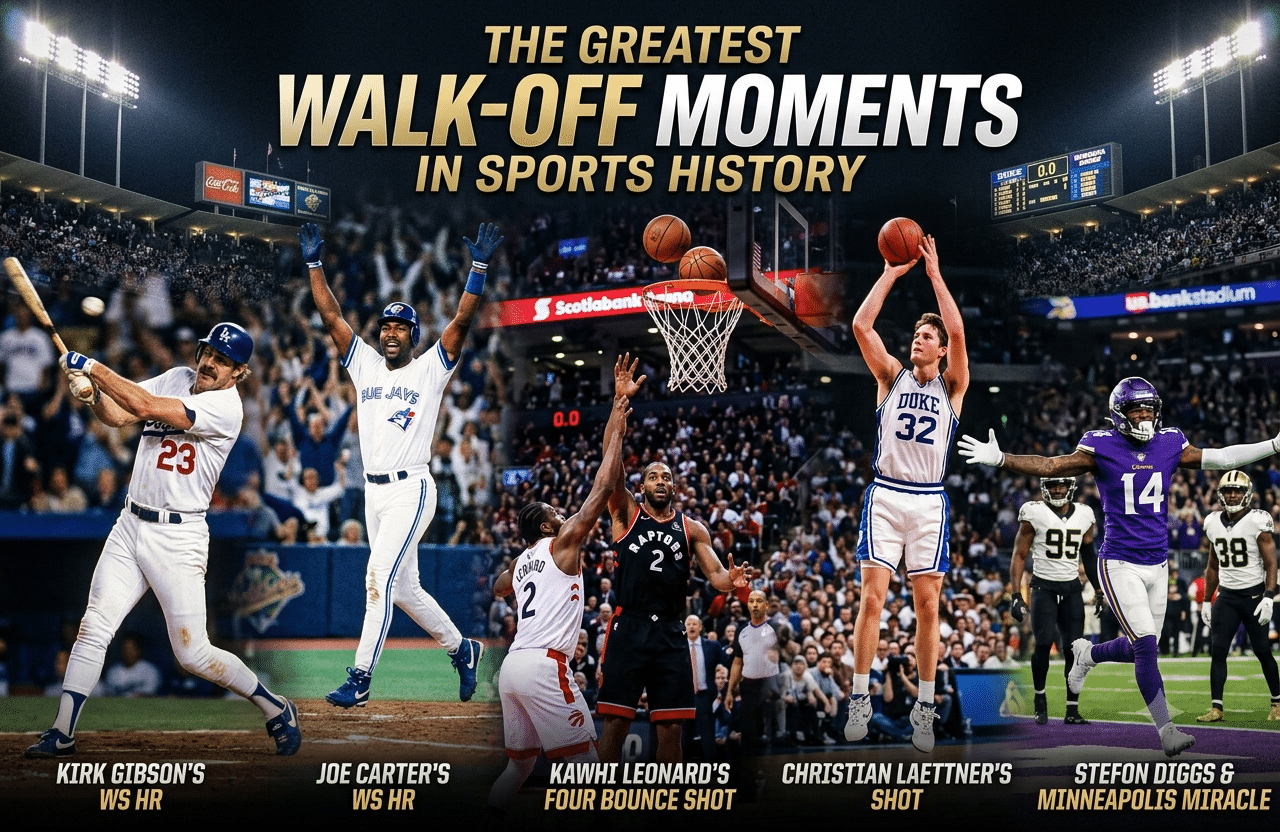
Walk-off moments are sports at their cruelest and most beautiful.
There’s no time to recover. No next possession. No bottom half of the inning. No final drive. No chance to answer. One second, both teams are still alive. The next, one side is celebrating while the other side stands frozen, trying to understand how the whole season just ended.
That’s what makes walk-off moments different from ordinary game-winners.
They don’t just win.
They erase the future.
A walk-off home run sends the defense off the field with nothing left to do. A buzzer-beater drops and turns a packed arena into either heaven or silence. A last-second touchdown return makes coaches, fans, and players look around like someone changed the rules of reality. A sudden-death goal in overtime doesn’t build toward an ending. It detonates one.
The best walk-off moments become instantly historic because they compress everything into one play: pressure, timing, talent, luck, panic, joy, heartbreak, and the strange feeling that sports just wrote the ending itself.
Fans remember championships.
But they replay walk-offs.
Why Walk-Off Moments Matter
Walk-off moments matter because they give sports its cleanest kind of shock.
Most games end gradually. A team builds a lead. The clock runs down. Fans can prepare themselves. Even painful losses often come with warning signs. You can see the defeat approaching.
A walk-off doesn’t work like that.
It arrives suddenly. It turns uncertainty into finality before anyone can fully process the transition. That instant emotional flip is why these plays last so long. The winning side explodes. The losing side collapses. The crowd either erupts or dies. The camera catches faces that look almost too honest.
Walk-off moments also create perfect replay culture. One swing. One shot. One throw. One return. One goal. The highlight doesn’t need much setup because the ending explains itself.
Tie game.
Final seconds.
Season on the line.
Then everything changes.
Kirk Gibson’s World Series Home Run
Kirk Gibson’s home run in Game 1 of the 1988 World Series is one of baseball’s most famous walk-off moments.
Gibson was injured badly enough that he could barely move. He wasn’t expected to play. The Los Angeles Dodgers trailed the Oakland Athletics in the ninth inning, and Dennis Eckersley, one of the best closers in baseball, was on the mound.
Then Gibson limped to the plate.
The at-bat already felt cinematic before the swing. Gibson battled, fought his body, and somehow stayed alive. Then he pulled a backdoor slider into the right-field stands, winning the game for the Dodgers.
His fist pump around the bases became one of the sport’s defining images.
This belongs near the top of all walk-off moments because it felt impossible on several levels. Injured star. Underdog team. Dominant closer. World Series stage. Two outs. Ninth inning. Home run.
Vin Scully’s call made it even more immortal: “In a year that has been so improbable, the impossible has happened.”
That line worked because everyone watching knew it was true.
Joe Carter Wins the World Series
Joe Carter’s walk-off home run in Game 6 of the 1993 World Series gave the Toronto Blue Jays a championship in the loudest possible way.
The Blue Jays led the series against the Philadelphia Phillies, but Game 6 had turned tense. Toronto trailed 6-5 in the bottom of the ninth. Mitch Williams was on the mound. Two runners were on base. Carter stepped in with a chance to end everything.
Then he did.
Carter launched a three-run homer to left field, winning the World Series for Toronto. His leaping celebration around first base became one of baseball’s most joyful images.
Among walk-off moments, this one is elite because it didn’t just win a playoff game.
It won the championship.
A walk-off home run to end the World Series is almost too perfect. Baseball had seen it before with Bill Mazeroski, but Carter’s blast gave modern fans their own version of that ultimate ending.
Some players dream of one big swing.
Carter got the swing everyone else dreams about.
Bill Mazeroski’s 1960 World Series Homer
Before Joe Carter, there was Bill Mazeroski.
Game 7 of the 1960 World Series between the Pittsburgh Pirates and New York Yankees was already wild before the bottom of the ninth. The Yankees had outscored the Pirates across the series and looked like the stronger team in many ways. But Game 7 doesn’t care about total runs.
With the score tied 9-9, Mazeroski led off the bottom of the ninth and hit a home run over the left-field wall.
The Pirates won the World Series.
This remains one of the greatest walk-off moments because it’s the purest baseball ending imaginable: Game 7, tie game, bottom of the ninth, home run, championship over.
There’s no extra explanation needed.
Mazeroski wasn’t known as a legendary power hitter, which makes the moment even better. Sometimes the player who becomes immortal isn’t the obvious superstar. Sometimes history picks the second baseman and tells him to swing.
He did.
Pittsburgh still thanks him for it.
Kawhi Leonard’s Four-Bounce Shot
Kawhi Leonard’s shot against the Philadelphia 76ers in Game 7 of the 2019 Eastern Conference semifinals is one of the most dramatic walk-off moments in basketball history.
The score was tied. The clock was nearly gone. Leonard dribbled toward the right corner, rose over Joel Embiid, and launched a high shot as time expired.
Then the ball bounced.
Once.
Twice.
Three times.
Four.
In.
The Toronto Raptors won 92-90, and the arena exploded while Embiid stood devastated.
This moment belongs among the greatest walk-off moments because of the waiting. Most buzzer-beaters either drop or miss quickly. This one made everyone suffer. The ball sat on the rim long enough for hope and dread to trade places several times.
Toronto went on to win its first NBA championship, which gave the shot even more weight. It became the doorway to the title run.
Every championship needs a moment when destiny starts looking suspiciously real.
For the Raptors, it bounced four times.
Christian Laettner Beats Kentucky
Christian Laettner’s shot against Kentucky in the 1992 NCAA Tournament remains one of college basketball’s most famous endings.
Duke trailed Kentucky by one with 2.1 seconds left in overtime. Grant Hill threw a perfect full-court pass. Laettner caught it near the free throw line, dribbled once, turned, and hit the jumper at the buzzer.
Duke won 104-103.
The play was perfect. The pass, the catch, the footwork, the turn, the shot — everything looked rehearsed by fate. Laettner had already played a flawless game from the field and the free throw line, which only added to the mythology.
This is one of the essential walk-off moments because it ended an all-time great college basketball game with an all-time great shot. It also helped Duke continue toward a national championship, deepening the program’s dynasty identity under Mike Krzyzewski.
Kentucky fans still hate it.
That’s how you know it mattered.
The Music City Miracle
The Music City Miracle remains one of the NFL’s wildest walk-off moments.
In the 1999 AFC Wild Card game, the Buffalo Bills had just taken a late lead over the Tennessee Titans. With only seconds left, Tennessee needed something desperate on the kickoff return.
Then chaos became choreography.
Lorenzo Neal fielded the kick and handed it to Frank Wycheck, who threw a lateral across the field to Kevin Dyson. Dyson took off down the sideline and scored a touchdown, giving the Titans a stunning 22-16 win.
The play was reviewed, debated, and replayed endlessly. Was it a lateral? Was it forward? Titans fans know the answer. Bills fans may never accept it.
This belongs among the greatest walk-off moments because football rarely gets endings this strange. A kickoff return touchdown is dramatic enough. A trick-play lateral return to win a playoff game with seconds left is something else entirely.
For Tennessee, it launched a run to the Super Bowl.
For Buffalo, it became another chapter in a long book of pain.
Stefon Diggs and the Minneapolis Miracle
The Minneapolis Miracle gave Vikings fans one of the most stunning walk-off moments in NFL playoff history.
Minnesota trailed the New Orleans Saints in the final seconds of a 2017 NFC Divisional playoff game. The Vikings needed a miracle from their own territory. Case Keenum dropped back and threw to Stefon Diggs near the sideline.
Saints safety Marcus Williams missed the tackle.
Diggs stayed inbounds, turned upfield, and ran into the end zone as time expired.
The Vikings won 29-24.
The call became part of the moment: “Diggs! Sideline! Touchdown! Unbelievable!”
This was a walk-off moment built on disbelief. Fans in the stadium went from despair to explosion in one missed tackle. Diggs throwing his helmet, arms out, surrounded by noise, became an instant playoff image.
Minnesota’s franchise history has plenty of heartbreak, which made the moment feel even more powerful.
For once, the miracle belonged to the Vikings.
David Freese Saves the Cardinals
David Freese’s walk-off home run in Game 6 of the 2011 World Series finished one of baseball’s wildest postseason games.
The St. Louis Cardinals were down to their final strike twice against the Texas Rangers. Freese first tied the game with a triple in the ninth inning. Then, in the 11th, he hit a walk-off home run to center field.
“We will see you tomorrow night.”
The Cardinals won Game 6, then won Game 7 and the World Series.
This belongs among the greatest walk-off moments because Freese didn’t just end a game. He rescued a season that had already looked dead. The Rangers were one strike away from their first championship twice. Twice, St. Louis survived.
Freese’s homer became the emotional peak of a game that felt too dramatic to be real. Some walk-offs are clean and simple.
This one came after hours of madness.
That made it even better.
Aaron Boone’s 2003 ALCS Home Run
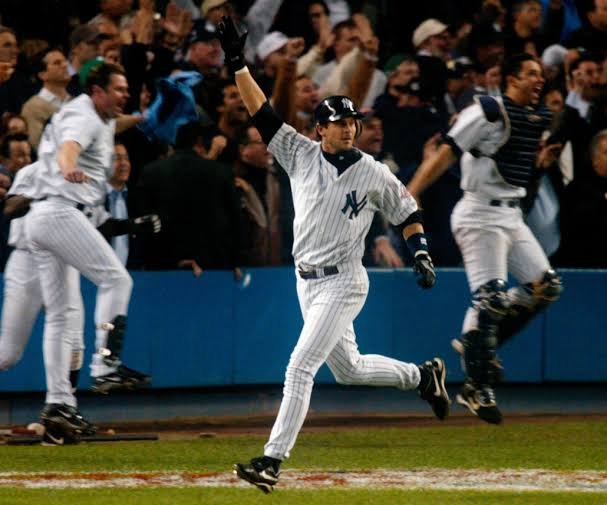
Aaron Boone’s walk-off home run in Game 7 of the 2003 ALCS is one of the most famous Yankees-Red Sox moments ever.
Boston had a chance to beat New York and reach the World Series. The Red Sox led late, but the Yankees tied the game against Pedro Martinez in the eighth. The game went into extra innings, thick with rivalry pressure and old ghosts.
Then Boone led off the 11th inning against Tim Wakefield.
One swing.
Yankees win.
The home run sent New York to the World Series and crushed Boston fans yet again, adding another painful chapter to the Curse of the Bambino. Boone became a Yankees postseason hero forever.
This belongs among walk-off moments because rivalry pressure gave the swing extra violence. A walk-off in Game 7 is already enormous. A walk-off in Game 7 against your most tortured rival becomes something closer to psychological warfare.
The Red Sox got revenge in 2004.
But Boone’s swing still echoes.
Derek Fisher’s 0.4 Shot
Derek Fisher’s buzzer-beater against the San Antonio Spurs in the 2004 NBA playoffs remains one of the most shocking walk-off moments in league history.
The Spurs had just taken the lead on a ridiculous Tim Duncan shot. With only 0.4 seconds left, the Los Angeles Lakers appeared to have almost no chance. There was barely enough time to catch and shoot.
Fisher caught the inbound pass, turned, and released.
The shot went in.
The Lakers won.
The disbelief came from the timing. Fans were still processing Duncan’s miracle shot when Fisher answered with something even more absurd. The entire emotional arc of the game flipped twice in less than a second of game time.
Among walk-off moments, Fisher’s shot stands out because it tested the limits of what fans think can happen in 0.4 seconds.
Apparently, heartbreak can happen very quickly.
Franco Harris and the Immaculate Reception
The Immaculate Reception is one of football’s most famous and debated endings.
In a 1972 playoff game between the Pittsburgh Steelers and Oakland Raiders, the Steelers trailed late and faced fourth down. Terry Bradshaw threw a desperate pass. The ball ricocheted after contact involving Jack Tatum and Frenchy Fuqua, then Franco Harris scooped it before it hit the ground and ran for the winning touchdown.
Pittsburgh won 13-7.
The play remains controversial, argued over, and mythologized. Did the ball hit the right player? Was it legal? Did it touch the ground? Raiders fans have opinions. Steelers fans have a statue.
This belongs among the greatest walk-off moments because it did more than win a playoff game. It helped launch the Steelers’ rise into one of the NFL’s great dynasties.
Some plays become famous because they’re beautiful.
The Immaculate Reception became famous because it looked like football had briefly lost its mind.
Bobby Thomson’s Shot Heard ’Round the World
Bobby Thomson’s home run in 1951 remains one of baseball’s defining walk-off moments.
The New York Giants and Brooklyn Dodgers met in a three-game playoff to decide the National League pennant. The Dodgers led late in the deciding game. Then Thomson hit a three-run walk-off home run off Ralph Branca.
“The Giants win the pennant!”
The call became as famous as the swing.
This is one of the most important walk-off moments because it ended a fierce rivalry battle with one of baseball’s most dramatic home runs. The Giants didn’t just win a game. They stole a pennant from the Dodgers in the most painful possible way.
The phrase “Shot Heard ’Round the World” still carries the weight of that moment.
Some walk-offs win games.
This one named itself.
Mario Lemieux’s Final-Second Magic
Hockey has plenty of sudden-death overtime goals, but some of its most dramatic walk-off moments come when a superstar turns the final seconds into theater.
Mario Lemieux had that kind of gift. His combination of size, skill, patience, and creativity made him one of hockey’s greatest offensive forces. When a game came down to one chance, Lemieux could make defenders look like they were standing inside his imagination.
The best hockey walk-offs usually share a feeling: the puck is loose, the crowd rises, the goalie reacts, and then the red light turns everything into chaos.
Lemieux’s legacy includes many clutch moments because he had the rare ability to slow the game down while everyone else panicked.
That’s what walk-off moments reward.
Not only talent.
Calm inside the explosion.
Why Walk-Off Moments Become Myth
Walk-off moments become myth because they offer the one thing sports rarely gives cleanly: a perfect ending.
No debate about clock management after the fact. No slow kneel-down. No gradual closing. The moment itself ends the story. The hero swings, shoots, throws, catches, returns, scores, or saves, and the game immediately belongs to the past.
That suddenness creates emotional clarity.
For the winners, pure release.
For the losers, pure shock.
Walk-offs also produce unforgettable body language. Players sprinting out of dugouts. Teammates piling on each other. Fans jumping in disbelief. Opponents dropping to a knee. Coaches staring blankly. Goalies face-down on the ice. Pitchers refusing to turn around.
The camera loves walk-offs because nobody has time to pretend.
That honesty is part of the magic.
The Legacy of Walk-Off Moments
The legacy of walk-off moments is that they turn pressure into permanent memory.
Kirk Gibson limped into World Series mythology. Joe Carter jumped into championship history. Bill Mazeroski gave Pittsburgh the ultimate Game 7 ending. Kawhi Leonard let the ball bounce Toronto toward a title. Christian Laettner broke Kentucky’s heart. The Music City Miracle turned a kickoff return into playoff folklore. Stefon Diggs gave Minnesota a miracle of its own. David Freese saved the Cardinals from elimination. Aaron Boone deepened the Yankees-Red Sox wound. Derek Fisher proved 0.4 seconds was enough. Franco Harris caught football chaos before it hit the ground. Bobby Thomson gave baseball a phrase that still lives.
Walk-offs matter because they don’t ask fans to wait for meaning.
They deliver it immediately.
One swing.
One shot.
One catch.
One bounce.
One final impossible second when sports stops being a game and becomes a memory nobody gets to revise.