Sports announcers are the voices inside memory.
A great game can happen without a great call, but it rarely lives the same way afterward. The play happens once. The voice carries it forever. A home run, a miracle, a knockout, a buzzer-beater, a touchdown, a perfect game, a final out, a gold medal, a championship moment — all of it becomes easier to remember when the right announcer finds the right words at the exact second history needs them.
That’s the strange power of sports announcers.
They don’t play the game. They don’t score. They don’t coach. They don’t decide who wins. But when the moment arrives, they become part of it. Their voice gets attached to the highlight, replayed in documentaries, tribute videos, old broadcasts, stadium montages, and family memories.
Fans may forget what inning it was, what quarter it was, or what the exact score had been five minutes earlier.
They remember the call.
“Do you believe in miracles?”
“The Giants win the pennant!”
“Havlicek stole the ball!”
“Down goes Frazier!”
That’s not just commentary.
That’s sports history learning how to echo.
Why Sports Announcers Matter
Sports announcers matter because they guide how fans feel while history is happening.
A bad announcer talks over the moment. A great one understands the rhythm. When to explain. When to rise. When to pause. When to let the crowd speak. When to add context. When to sharpen the drama. When to say the line that turns a play into a memory.
The best sports announcers also become trusted companions. Fans invite them into living rooms for years. Their voices mark seasons, holidays, playoff runs, childhood weekends, summer nights, and family traditions. A broadcaster can become so familiar that hearing them feels like returning to an old stadium.
Great announcers don’t simply report sports.
They preserve the feeling of watching them.
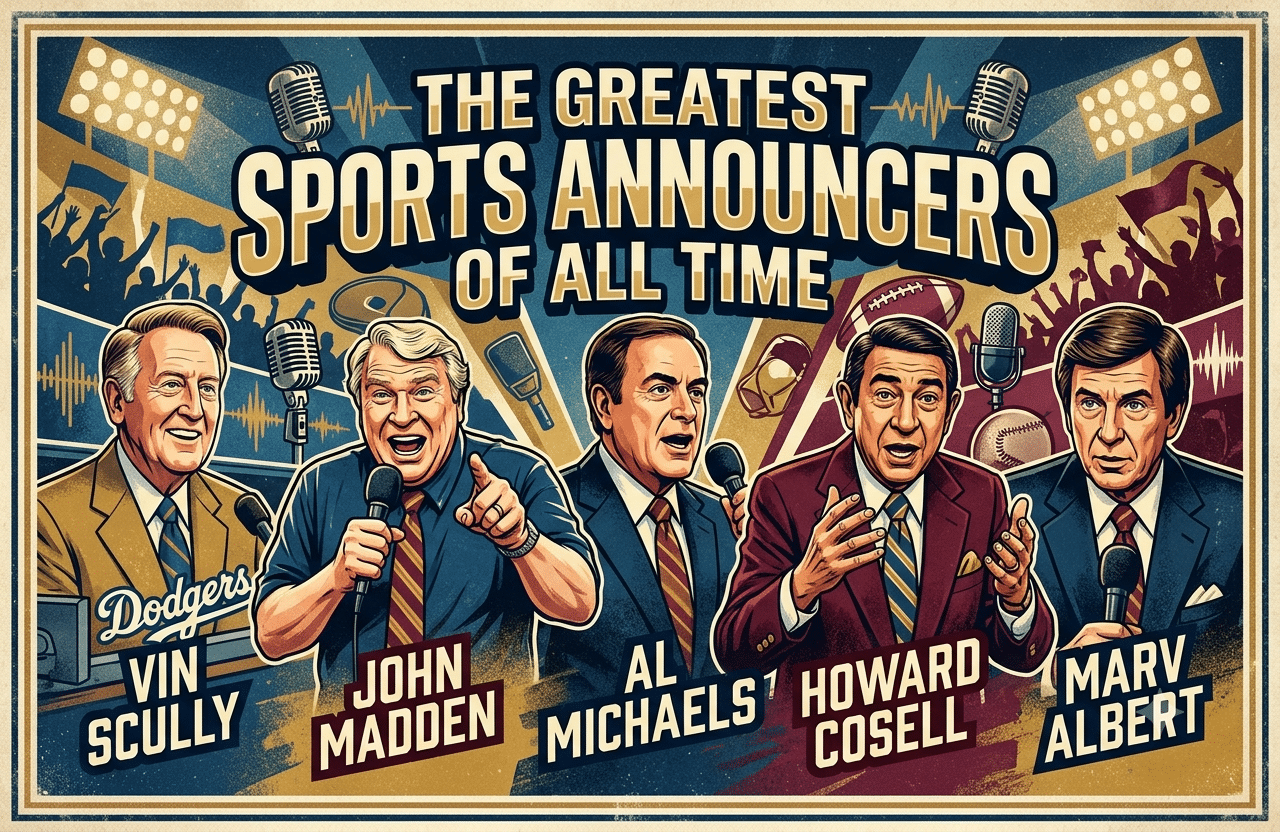
Vin Scully
Vin Scully may be the greatest sports announcer ever.
His voice was warm, graceful, intelligent, and unhurried. He didn’t sound like someone trying to dominate the broadcast. He sounded like someone inviting fans to sit beside him and watch baseball breathe.
Scully called Dodgers games for decades, beginning in Brooklyn and continuing through the franchise’s Los Angeles era. That alone is remarkable. But the length of his career isn’t what made him legendary. It was how beautifully he filled the time.
Baseball is a sport of space. There are pauses between pitches, quiet stretches, and long summer evenings where the game needs a storyteller, not a shouter. Scully understood that better than anyone. He could explain history, describe a pitch, tell a story, and then disappear into silence at the exact right moment.
His call of Kirk Gibson’s 1988 World Series home run remains one of the greatest in sports broadcasting. After Gibson’s dramatic homer, Scully let the crowd roar before delivering the perfect line: “In a year that has been so improbable, the impossible has happened.”
Among sports announcers, Scully stands alone because he made broadcasting feel like literature without making it feel fancy.
He didn’t just call baseball.
He made baseball sound eternal.
John Madden
John Madden changed football broadcasting because he sounded like football itself.
He was loud, funny, enthusiastic, physical, and deeply knowledgeable without becoming stiff. Madden could explain line play, blocking schemes, defensive reads, and quarterback decisions in a way casual fans could understand. He loved the sport so openly that his joy became contagious.
The telestrator became part of his magic. Madden would draw circles, arrows, lines, and chaotic marks across the screen, turning football into something visual and teachable. He made fans understand that a play wasn’t just a pass or a run. It was bodies moving with purpose, leverage, angles, and collisions.
He also had personality for days.
Boom.
Bam.
Turkey legs.
Big guys sweating in the trenches.
Madden didn’t sound polished in the traditional sense. That was the charm. He sounded alive. He made the game feel fun without making it feel unserious.
Among sports announcers, Madden belongs near the top because he taught millions of fans how to watch football more carefully while making them laugh at the same time.
That’s a rare gift.
Al Michaels
Al Michaels has one of the most famous calls in sports history, and he earned it by knowing exactly how to handle the moment.
The 1980 Miracle on Ice could’ve swallowed a broadcaster whole. The United States hockey team was seconds away from beating the Soviet Union in one of the greatest upsets ever. The emotional weight was enormous. The game was chaotic. The national tension was real.
Then Michaels asked the perfect question:
“Do you believe in miracles?”
Yes.
That line became immortal because it was simple, emotional, and exactly right. It didn’t overexplain. It didn’t try to be clever. It gave the moment the one word it needed: miracles.
But Michaels’ career is far more than one call. He became one of the most reliable big-game voices in American sports, especially in football. Calm, sharp, professional, and dramatic without sounding desperate, Michaels had a way of letting the stakes rise naturally.
Among sports announcers, Michaels matters because he could handle enormous moments without losing control of the broadcast.
Some announcers chase drama.
Michaels lets drama come to him.
Howard Cosell
Howard Cosell was less an announcer than a force of nature.
He was opinionated, theatrical, intellectual, confrontational, and impossible to ignore. Fans either loved him, hated him, or loved hating him. That made him perfect for the changing world of televised sports, where personality became part of the show.
Cosell became famous through boxing, especially his relationship with Muhammad Ali, and later through Monday Night Football. His style was unlike almost anyone else’s. He didn’t sound like the friendly voice next door. He sounded like a courtroom argument in a broadcast booth.
That could be exhausting.
It could also be thrilling.
Cosell belongs among legendary sports announcers because he helped expand what a broadcaster could be. He wasn’t merely describing action. He was interpreting, judging, provoking, and turning the broadcast into public theater.
His call of George Foreman knocking down Joe Frazier — “Down goes Frazier!” — remains one of boxing’s most famous calls because it captured shock with blunt repetition.
Cosell made sports sound important, dramatic, and sometimes uncomfortable.
That was the point.
Marv Albert
Marv Albert’s voice became the sound of NBA basketball for generations.
His signature “Yes!” after a made basket was short, sharp, and instantly recognizable. He didn’t need to overdecorate the call. He had rhythm, timing, and a voice that fit basketball’s speed. When the NBA rose into a national and global entertainment force, Albert’s voice was there for many of its biggest moments.
He called playoff battles, Finals moments, Michael Jordan highlights, Knicks wars, and countless regular-season games. His delivery could match the pace of basketball without stepping on it. He knew when a dunk needed energy and when a jumper needed snap.
Basketball is difficult to call well because the game moves constantly. Too much talking can crowd the broadcast. Too little can flatten the energy. Albert found a style that felt natural: quick, expressive, and tuned to the sport’s momentum.
Among sports announcers, Albert’s place is tied to sound. Fans can hear that “Yes!” even without a clip playing.
That’s how a voice becomes iconic.
Keith Jackson
Keith Jackson sounded like college football.
His voice had warmth, authority, and a regional texture that made Saturday afternoons feel bigger. When he said “Whoa, Nellie,” it didn’t sound like a catchphrase forced into the broadcast. It sounded like part of the sport’s weather.
Jackson called countless college football classics and became closely associated with the pageantry of the sport: marching bands, rivalries, campuses, traditions, bowl games, and the feeling that Saturday football was a national ritual made of local passions.
He had a gift for making a game feel important without sounding artificial. His voice carried weight, but not arrogance. He respected the sport’s history and understood that college football is often as much about place as performance.
Among sports announcers, Jackson matters because he gave college football a voice that matched its soul.
Not too slick.
Not too corporate.
Just big, warm, and unmistakable.
Pat Summerall
Pat Summerall was the master of restraint.
In an era when many broadcasters filled space with noise, Summerall understood the power of saying less. His voice was deep, calm, and economical. He didn’t need to scream to make a moment feel important. He trusted the game.
That restraint made his partnership with John Madden work beautifully. Madden brought energy, explanation, humor, and chaos. Summerall brought clarity, timing, and composure. Together, they became one of the greatest broadcasting teams in sports history.
Summerall’s calls often had a quiet finality. A touchdown, a field goal, a Super Bowl moment — he could deliver the essential information in a few words and let the crowd do the rest.
That’s harder than it sounds.
Among sports announcers, Summerall deserves respect because he proved minimalism can be powerful. Not every big moment needs a broadcaster trying to become the story.
Sometimes the best call is the one that steps aside at the right time.
Bob Costas
Bob Costas became one of the most versatile sports broadcasters ever.
He could host, interview, call games, narrate essays, handle Olympic coverage, and move between sports with unusual ease. Costas brought intelligence, polish, memory, and a sense of historical context to the broadcast. He often sounded like someone who understood not just the game, but its place in a larger story.
That made him especially valuable during events like the Olympics and major baseball broadcasts. Costas could frame a moment without drowning it in sentiment. He could be sharp, witty, reflective, or serious depending on what the moment required.
Some sports announcers are tied tightly to one sport. Costas became tied to sports broadcasting itself.
His gift was not raw excitement in the Madden sense or poetic patience in the Scully sense. It was control. He knew how to guide viewers through an event, explain why it mattered, and add just enough perspective to make the moment feel connected to history.
That kind of versatility deserves its own category of greatness.
Ernie Harwell
Ernie Harwell was the voice of Detroit Tigers baseball for generations.
Like Vin Scully, Harwell understood that baseball broadcasting is built on companionship. Fans didn’t just tune in for the score. They tuned in for the voice. Harwell’s style was gentle, clear, and deeply familiar to Tigers fans who heard him through radios, kitchens, porches, cars, and summer nights.
Local baseball announcers can become part of a city’s emotional life in a way national voices sometimes can’t. Harwell was that kind of broadcaster. He belonged to Detroit’s baseball memory.
His calls had warmth without weakness. He knew the game, respected the audience, and made listeners feel included. That matters in baseball, where a team’s announcer often becomes the thread connecting one generation of fans to the next.
Among sports announcers, Harwell represents the beauty of the local voice.
Not every legend needs the biggest national stage.
Some become legendary by being there every night.
Chick Hearn

Chick Hearn gave the Los Angeles Lakers their basketball language.
He was fast, colorful, inventive, and responsible for phrases that became part of basketball vocabulary: “slam dunk,” “air ball,” “no harm, no foul,” and more. Hearn didn’t just call Lakers games. He helped shape how fans talked about basketball.
His rapid-fire style fit the Lakers perfectly, especially as the franchise became associated with glamour, stars, and Showtime. Hearn could keep up with the pace and personality of the team. His voice became part of the Lakers’ identity as much as the uniforms and the Forum.
A great local announcer doesn’t simply describe a franchise.
He becomes part of how the franchise understands itself.
Hearn belongs among the greatest sports announcers because his influence escaped the local broadcast. The language he popularized still lives in basketball today. That’s an enormous legacy.
Some broadcasters call the sport.
Hearn added words to it.
Brent Musburger
Brent Musburger had a gift for making big events feel even bigger.
His famous opening, “You are looking live,” became one of sports television’s great scene-setters. Musburger understood the theatrical side of broadcasting. He knew that before the play-by-play even began, the viewer needed to feel the scale: the stadium, the crowd, the lights, the stakes.
He called college football, basketball, NFL games, and major events across decades. His voice carried excitement and polish, with a style that often made the broadcast feel like a national occasion.
Musburger belongs among notable sports announcers because he mastered anticipation. Some broadcasters are best during the final play. Musburger was great at making the audience feel the importance before the game even started.
That matters.
Sports are not only action.
They’re buildup.
Musburger knew how to open the curtain.
Jim Nantz
Jim Nantz became one of modern sports’ most familiar voices through the NFL, NCAA Tournament, golf, and especially the Masters.
His style is smooth, polished, and calm, often built more around elegance than explosion. That fits certain events perfectly. At Augusta National, where golf already carries a hushed, almost ceremonial atmosphere, Nantz’s voice became part of the setting.
“Hello, friends” is simple, but it works because it matches the relationship he built with viewers over time. Nantz sounds like a host as much as a play-by-play voice. He welcomes fans into the event, especially during major American sports traditions.
Among sports announcers, Nantz’s greatness comes from consistency and tone. He doesn’t overwhelm the broadcast. He gives it shape. Whether calling a Final Four, a Super Bowl, or a Masters Sunday, he usually understands the emotional temperature.
That’s why fans associate him with big-event comfort.
Not every announcer needs to sound dangerous.
Some need to sound like tradition.
Verne Lundquist
Verne Lundquist’s voice carried warmth, surprise, and joy.
He called many sports, but college football and golf fans especially remember him with affection. Lundquist had a way of reacting to huge moments that felt honest. Not forced. Not rehearsed. Just a broadcaster delighted, stunned, or moved by what he was seeing.
His call of Tiger Woods’ chip-in at the 2005 Masters — “In your life, have you seen anything like that?” — became one of golf’s great modern calls. It worked because it sounded like a real question from someone who knew the sport and still couldn’t quite believe the moment.
Lundquist also became beloved through SEC football broadcasts, where his voice became part of Saturday tradition.
Among sports announcers, Lundquist matters because his joy felt genuine. Fans trusted that he loved the moment with them.
That can’t be faked for long.
Mike Breen
Mike Breen gave modern NBA fans one of the best single-word calls in sports.
“Bang!”
That’s it. One word. Perfectly timed.
Breen’s “Bang!” works because he doesn’t use it carelessly. When it arrives, fans know something big just happened. A clutch three. A playoff dagger. A shot that changes the game. The word hits like punctuation.
His call of Ray Allen’s three-pointer in Game 6 of the 2013 NBA Finals remains one of the most famous modern basketball calls: “Bang! Tie game!”
Breen belongs among sports announcers who understand rhythm. Basketball moves fast, and he handles that pace with clarity, excitement, and restraint. He knows when to rise, when to let analysts work, and when to mark a moment with one sharp word.
That’s the modern broadcasting challenge.
Be energetic without becoming noise.
Breen does it.
What Makes a Great Sports Announcer?
Great sports announcers understand that the game comes first.
That sounds obvious, but not every broadcaster follows it. The best announcers add to the moment without stealing it. They know the rules, history, players, stakes, and rhythm of the sport. They prepare deeply, but don’t dump every note on the audience. They have signature style, but don’t turn every call into self-parody.
A great announcer also has emotional intelligence. Not every touchdown needs screaming. Not every sad moment needs poetry. Not every historic moment needs a catchphrase. The best voices know what the moment is asking for.
Sometimes it asks for words.
Sometimes it asks for silence.
The silence may be the hardest part.
The Legacy of Sports Announcers
The legacy of sports announcers is that they give sports history its soundtrack.
Vin Scully made baseball sound graceful and timeless. John Madden made football smarter, funnier, and more alive. Al Michaels gave the Miracle on Ice its eternal question. Howard Cosell made broadcasting argumentative and theatrical. Marv Albert became the voice of NBA excitement. Keith Jackson gave college football warmth and grandeur. Pat Summerall proved restraint can be powerful. Bob Costas brought intelligence and versatility. Ernie Harwell gave Detroit baseball a trusted companion. Chick Hearn helped create basketball language. Jim Nantz made big events feel polished and familiar. Mike Breen gave modern NBA fans their sharpest punctuation.
Games create the moments.
Announcers help those moments survive.
That’s why the great voices stay with fans long after the broadcast ends. They become attached to childhood, family, cities, teams, champions, heartbreaks, and the exact second when something impossible happened.
A great call doesn’t make the moment great.
But once the right voice finds the right words, the moment never sounds the same without it.