Biggest draft mistakes hurt because they don’t look like disasters right away.
On draft night, every team sounds confident. The general manager praises the process. The coach talks about fit. The owner smiles for the camera. The player puts on the hat, shakes hands, and says he’s ready to work. Everybody pretends the future has been carefully chosen.
Then time starts telling the truth.
A player gets hurt. A prospect never develops. A team drafts for need instead of greatness. A front office ignores warning signs. A future superstar gets picked one spot later. A franchise tries to be clever and ends up creating a scar fans talk about for decades.
That’s why the biggest draft mistakes in sports history are so painful. They aren’t just bad picks. They’re alternate timelines. They make fans wonder what their team could’ve become if one name, one scouting report, one medical evaluation, or one owner’s opinion had gone differently.
Draft mistakes are cruel because they mix hope with hindsight.
And hindsight is undefeated.
Why the Biggest Draft Mistakes Still Matter
The biggest draft mistakes matter because drafts are supposed to build the future.
Free agency can fix a roster. Trades can change a team quickly. Coaching can cover flaws for a while. But the draft is where franchises are supposed to find pillars: quarterbacks, franchise players, stars, cornerstones, faces of the team.
When a team misses badly, the damage can last for years.
A bad pick wastes money, time, development reps, roster spots, fan patience, and sometimes the career of a coach or executive. But the worst part is who gets missed. Fans can forgive a bust more easily when nobody great was available. What they can’t forgive is watching the next player become a legend.
That’s when a mistake becomes history.
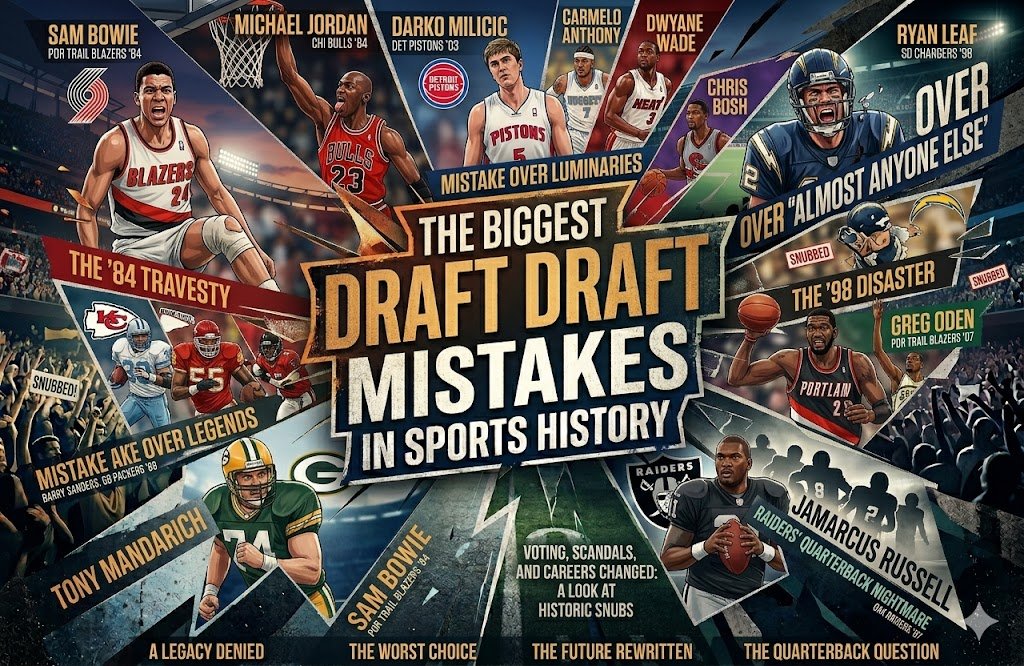
Sam Bowie Over Michael Jordan
No draft mistake is more famous than the Portland Trail Blazers taking Sam Bowie over Michael Jordan in the 1984 NBA Draft.
Portland selected Bowie second overall. Jordan went third to the Chicago Bulls.
That sentence became one of the most painful pieces of NBA history.
To be fair, the choice wasn’t as stupid in the moment as it looks now. Portland already had Clyde Drexler and needed a big man. Bowie had talent. Teams often built around size, and centers were still treated like gold. The logic existed.
The problem is that Jordan became Michael Jordan.
Six championships. Five MVPs. Global icon. Basketball’s defining modern figure. The athlete who turned the NBA into a worldwide machine. Once Jordan became that, every explanation for the Bowie pick started sounding like paperwork at a crime scene.
Bowie’s career was damaged by injuries, which makes the story more complicated and more human. He wasn’t a bad person or a talentless player. He was a promising big man whose body betrayed him.
But sports memory is ruthless.
Portland didn’t just miss a star.
Portland missed the player who changed basketball forever.
That’s why this remains the king of the biggest draft mistakes.
Ryan Leaf Over Almost Anyone Else
The 1998 NFL Draft was supposed to have two franchise quarterbacks at the top: Peyton Manning and Ryan Leaf.
The Indianapolis Colts took Manning first. The San Diego Chargers took Leaf second.
The gap between those two careers became one of the widest in NFL history.
Manning became one of the greatest quarterbacks ever: MVPs, Super Bowls, records, and a career built on preparation, accuracy, control, and football intelligence. Leaf became one of the NFL’s most infamous busts, struggling with performance, maturity, pressure, and everything that comes with being drafted to save a franchise.
What makes the Leaf pick so fascinating is that plenty of people believed the debate was real. Some scouts loved Leaf’s physical tools. He had size, arm strength, and confidence. In the wrong light, confidence can look like leadership.
Then the NFL exposed everything.
The Chargers didn’t just miss on a quarterback. They missed while the better answer was sitting right there at number one. That’s not fully their fault — Indianapolis had the first pick — but Leaf’s collapse still became a symbol of how badly quarterback evaluation can go.
Every NFL team wants traits.
Ryan Leaf became the warning that traits without stability can burn a franchise down.
Darko Milicic Over Carmelo Anthony, Dwyane Wade, and Chris Bosh
The Detroit Pistons won the 2004 NBA championship, so this mistake didn’t destroy them.
That almost makes it stranger.
In the 2003 NBA Draft, Detroit selected Darko Milicic second overall. The next three picks were Carmelo Anthony, Chris Bosh, and Dwyane Wade.
That’s brutal.
Darko barely played for the Pistons and never became close to the star Detroit hoped for. Meanwhile, Carmelo became one of the great scorers of his era. Bosh became a Hall of Fame big man and key piece of Miami’s championships. Wade became a franchise legend, Finals MVP, and one of the best shooting guards ever.
The Pistons were good enough to survive the mistake, but fans still wonder what could’ve happened if they’d taken one of the stars behind Darko. Could Detroit have extended its title window? Could Carmelo have become the offensive weapon those defense-first teams needed? Could Wade have changed everything?
That’s what makes this one of the biggest draft mistakes in NBA history.
It didn’t stop Detroit from winning.
It may have stopped Detroit from becoming a dynasty.
Greg Oden Over Kevin Durant
The Portland Trail Blazers appear again, and that alone feels unfair.
In 2007, Portland took Greg Oden first overall. Kevin Durant went second to the Seattle SuperSonics.
At the time, Oden looked like a classic franchise center. He was huge, dominant, defensive, and exactly the kind of big man teams had been trained to value for decades. Durant was brilliant, but Oden felt like the safer old-school championship blueprint.
Then injuries destroyed Oden’s career.
Durant became one of the greatest scorers in basketball history.
This mistake is painful because it wasn’t ridiculous when it happened. Many teams would’ve taken Oden. That’s what separates this from a purely dumb pick. It was a reasonable choice that aged into tragedy.
For Portland fans, the emotional weight is unbearable because they’d already lived through Bowie over Jordan. Oden over Durant felt like history repeating itself with a different body and the same cruel punchline.
Sometimes draft mistakes come from bad scouting.
Sometimes they come from bad luck.
Fans suffer either way.
JaMarcus Russell and the Raiders’ Quarterback Nightmare
JaMarcus Russell had the arm.
That was the problem. Everyone saw the arm.
The Oakland Raiders selected Russell first overall in the 2007 NFL Draft, betting on size, power, and raw talent. He looked like a quarterback built in a lab: massive frame, huge arm, highlight throws that made scouts dream.
But the NFL demands more than throwing a ball through a wall.
Russell struggled with conditioning, preparation, accuracy, leadership, and consistency. His career fell apart quickly, and his name became shorthand for quarterback bust. For the Raiders, the damage was massive. A number one overall quarterback is supposed to reset a franchise. Russell became another chapter in a long stretch of chaos.
The pick remains one of the biggest draft mistakes because it shows how seductive physical tools can be. Teams can convince themselves they can teach everything else if the raw ability is rare enough.
Sometimes they can.
Sometimes they draft JaMarcus Russell.
Tony Mandarich Over Barry Sanders, Derrick Thomas, and Deion Sanders
The Green Bay Packers selected offensive lineman Tony Mandarich second overall in the 1989 NFL Draft.
The next three picks were Barry Sanders, Derrick Thomas, and Deion Sanders.
That’s almost impossible to read without wincing.
Mandarich was hyped as one of the greatest offensive line prospects ever. He was huge, powerful, and surrounded by almost cartoonish expectations. But he flopped badly in Green Bay, while the players chosen right after him became legends.
Barry Sanders became one of the greatest running backs ever. Derrick Thomas became a terrifying pass rusher. Deion Sanders became one of the most electric athletes in football history.
The Packers eventually recovered as a franchise, but that pick still stands as one of the biggest draft mistakes in NFL history because of the names surrounding it.
Missing on a prospect hurts.
Missing on three Hall of Fame-level talents in a row is historic pain.
Kwame Brown First Overall
Kwame Brown becoming the first high school player drafted number one overall came with enormous pressure.
The Washington Wizards selected him first in 2001, with Michael Jordan heavily involved in the franchise’s basketball decisions. Brown had size, athleticism, and potential. What he didn’t have was the development path, confidence, or support needed to become the player Washington imagined.
Brown had a long NBA career, which often gets forgotten. He wasn’t useless. But number one overall picks are judged differently. Washington didn’t draft him to become a serviceable big man. They drafted him to become a franchise-changing star.
That never happened.
The pick became even more infamous because of Jordan’s connection to it. The greatest player ever wasn’t automatically a great talent evaluator, and Brown became one of the clearest examples.
This is one of the biggest draft mistakes because it shows the danger of potential without patience. Teams love young talent because they can imagine anything.
Reality is less generous.
Hasheem Thabeet Over James Harden and Stephen Curry
The Memphis Grizzlies took Hasheem Thabeet second overall in the 2009 NBA Draft.
James Harden went third. Stephen Curry went seventh.
That’s the nightmare.
Thabeet had size and shot-blocking potential, but he never became a major NBA player. Harden became an MVP and one of the defining offensive players of his generation. Curry became a two-time MVP, four-time champion, and the player who changed modern basketball with his shooting.
To be fair, Curry wasn’t viewed then the way he’s viewed now. His size, position, and translation to the NBA were debated. Harden was highly regarded, but not yet the bearded offensive system he became later.
Still, Thabeet at number two became a painful symbol of drafting for size over skill.
The NBA was changing. Shooting, spacing, creation, and guard play were about to take over. Memphis picked a traditional big man who couldn’t keep up with the future.
That’s one of the worst ways to make a draft mistake.
You don’t just miss a player.
You misread where the sport is going.
Sam Darnold, Josh Rosen, and the 2018 Quarterback Draft Lessons

The 2018 NFL Draft is a little different because it produced multiple quarterback lessons at once.
Baker Mayfield went first. Sam Darnold went third to the Jets. Josh Allen went seventh to the Bills. Josh Rosen went tenth to the Cardinals. Lamar Jackson went thirty-second to the Ravens.
The biggest mistakes here weren’t only about who got picked. They were about evaluation, development, and fit.
Darnold was supposed to be the clean quarterback prospect with franchise potential. Rosen was praised by some as polished and pro-ready. Allen was criticized for accuracy concerns. Jackson faced lazy questions about whether his style could work at quarterback.
Years later, Allen and Jackson became stars. Darnold and Rosen didn’t become franchise saviors for the teams that drafted them.
This draft class shows how the biggest draft mistakes aren’t always obvious on draft night. Sometimes teams miss because they value the wrong traits. Sometimes they fail to build around the player. Sometimes they draft a quarterback into a broken situation and act surprised when he breaks too.
Quarterback mistakes hurt more than any other NFL draft mistakes because the position controls the entire franchise mood.
A bad quarterback pick doesn’t just lose games.
It steals years.
Mark Appel and the Risk of “Safe” Baseball Picks
In baseball, draft mistakes can be harder to dramatize because prospects take longer to develop and even top picks fail often.
But Mark Appel stands out.
The Houston Astros selected Appel first overall in 2013. He was considered polished, advanced, and safer than many high school prospects. The logic made sense. College ace. Strong resume. Good stuff. Clear path.
Then his professional career stalled.
Appel struggled in the minors, stepped away from baseball, and didn’t become the franchise arm Houston expected. The pain grew because Kris Bryant was selected second and became a star, winning Rookie of the Year, MVP, and a World Series with the Cubs.
Baseball drafts are brutal because even smart picks fail. That’s why Appel’s story deserves more sympathy than mockery. Still, from a franchise-building standpoint, it remains one of the biggest draft mistakes because Houston had a chance at a cornerstone bat and took a pitcher who never became that guy.
Safe picks aren’t always safe.
Sometimes they’re just easier to explain.
Why Teams Make Huge Draft Mistakes
Teams make huge draft mistakes because projecting young athletes is hard.
Fans love acting like every bad pick was obvious, but that’s hindsight talking. Scouts are trying to predict bodies, minds, work habits, injuries, coaching fit, pressure response, league evolution, and development curves. That’s a lot.
Still, patterns appear.
Teams fall in love with size. They overrate athletic testing. They ignore injuries. They draft for need instead of best player available. They chase old models while the sport changes around them. They trust personality too much or not enough. They assume they can fix flaws nobody else could fix.
The biggest draft mistakes usually come from a mix of bad evaluation and bad imagination.
A team sees what a player is.
Another team sees what the sport is becoming.
That difference can change everything.
The Legacy of the Biggest Draft Mistakes
The legacy of the biggest draft mistakes is that they turn draft night into permanent evidence.
Sam Bowie over Michael Jordan became the ultimate warning about drafting for need. Ryan Leaf showed how quarterback traits can fool everyone. Darko Milicic over Carmelo, Bosh, and Wade may have cost Detroit a longer dynasty. Greg Oden over Kevin Durant became another painful Portland what-if. JaMarcus Russell showed the danger of raw talent without the right foundation. Tony Mandarich over three legends remains almost unbelievable. Hasheem Thabeet over Harden and Curry showed what happens when a team misses the future.
Every draft mistake hurts, but the biggest ones become part of sports language.
Fans bring them up whenever their team is on the clock. Analysts use them as warnings. Front offices pretend they’ve learned from them. Then, every few years, somebody makes another one.
That’s the beauty and horror of the draft.
It sells hope in real time.
It delivers judgment years later.