
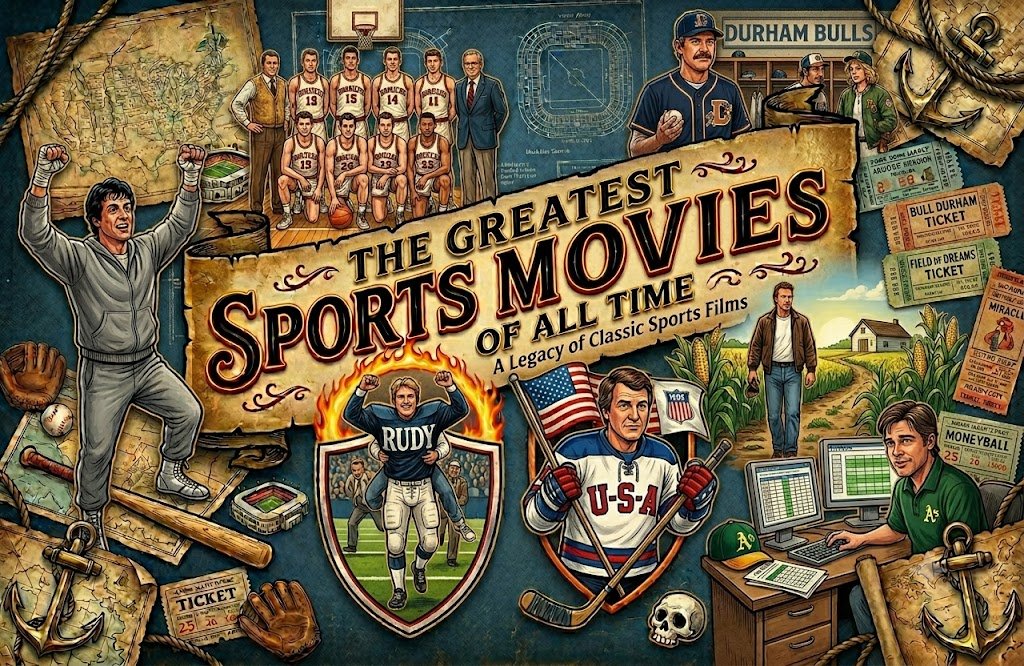
Sports movies work because sports already understand drama.
There’s a clock. There’s a score. There’s pressure. There’s a favorite, an underdog, a coach with a speech, a player with a wound, a team that doesn’t believe yet, a crowd waiting to erupt, and one final moment where everything has to mean something.
That’s why the best sports movies don’t really need to explain why the game matters. Fans already know. The field, court, ring, track, rink, or diamond becomes a stage where fear, pride, regret, ambition, family, race, class, grief, ego, and hope all show up wearing uniforms.
The greatest sports movies aren’t always about winning. Some are about losing well. Some are about getting one more chance. Some are about friendship. Some are about fathers and sons. Some are about a town needing something to believe in. Some are about an athlete fighting the world, the system, or themselves.
The game gives the story shape.
The people give it weight.
That’s why sports movies keep lasting. They take the emotional language of competition and turn it into something bigger than the scoreboard. A great sports movie makes fans feel like a championship, a final shot, or one impossible punch can stand in for everything a person has ever wanted.
Why Sports Movies Matter
Sports movies matter because they turn competition into memory.
A real game ends. A movie keeps replaying the feeling. It lets fans revisit the locker room speech, the training montage, the last play, the walk to the mound, the slow-motion run, the impossible comeback, and the moment someone finally believes in themselves.
Sports movies also help explain why people care so much about games. To outsiders, sports can look simple: win or lose. But fans know that sports are rarely just about winning. They’re about identity, loyalty, community, childhood, family, pride, and the strange belief that one game can repair something broken.
A good sports movie understands that.
A great one makes even non-fans understand it too.
Rocky
Rocky is the sports movie by which almost every underdog story gets measured.
The film works because it isn’t really about whether Rocky Balboa beats Apollo Creed. It’s about whether he can prove he belongs in the ring at all. Rocky is a small-time boxer, a bruised romantic, a lonely man with a soft heart and a hard life. He gets a shot he didn’t expect, then has to decide whether he’s worthy of it.
That’s what makes Rocky different.
The final fight is thrilling, but the emotional victory comes before the decision. Rocky doesn’t need to win the belt to win the story. He needs to go the distance. He needs to stand up to the life that kept telling him he was nothing special.
The training montage became one of the most famous sequences in movie history. The steps. The music. The gray Philadelphia streets. The raw feeling that effort itself can become beautiful if someone has enough reason to keep going.
Among sports movies, Rocky remains essential because it understands the underdog better than almost anything else.
Winning is nice.
Dignity is bigger.
Hoosiers
Hoosiers is small-town basketball mythology.
Set in Indiana, the film follows a tiny high school basketball team chasing an impossible championship under a complicated coach. On paper, it’s a classic underdog story. But the reason Hoosiers lasts is atmosphere. The gyms. The towns. The old cars. The nervous faces in the crowd. The feeling that basketball isn’t just a sport there. It’s a shared religion.
The movie understands how a team can become the emotional center of a place.
That’s why the final game works so well. It’s not only about a school trying to win. It’s about every person in that town seeing something of themselves in the boys on the court. Every pass matters because everybody has invested their pride into the same fragile hope.
Hoosiers belongs among the greatest sports movies because it captures the romance of local sports better than almost anything else. Not pro contracts. Not national fame. Not celebrity.
Just a team, a town, a gym, and the belief that for one night, little can beat big.
Remember the Titans
Remember the Titans became one of the most beloved football movies because it uses sports as a way into a much larger story.
The film follows a newly integrated high school football team in Virginia during a period of racial tension. Football becomes the space where young men who’ve been taught to distrust each other are forced to become teammates. That doesn’t happen magically. The film works because the conflict doesn’t vanish just because someone puts on pads.
The team has to earn unity.
Coach Herman Boone, played by Denzel Washington, gives the movie its center: tough, commanding, impossible to ignore. But the heart of the film is the players learning that brotherhood can’t be performed. It has to be practiced.
Among sports movies, Remember the Titans stands out because it understands that teams are built under pressure. Not just athletic pressure. Social pressure. Personal pressure. The pressure of becoming better than the world around you expects.
The football scenes are memorable.
The real victory is the change inside the locker room.
Field of Dreams

Field of Dreams is barely a sports movie in the traditional sense.
That’s why it works.
There’s baseball, yes. A field. Ghost players. Shoeless Joe Jackson. A catch. A line that became part of American pop culture: “If you build it, he will come.”
But Field of Dreams is really about longing. Fathers and sons. Regret. Memory. The ache of wanting one more conversation with someone who’s gone. Baseball is the language the movie uses because baseball is uniquely good at carrying nostalgia.
The film understands that sports can become an emotional inheritance. A game played in a backyard can hold decades of silence. A catch can say what a family never figured out how to say out loud.
That’s why Field of Dreams belongs among the greatest sports movies. It doesn’t treat baseball like entertainment. It treats it like a portal.
Some sports movies make fans want to cheer.
This one makes them want to call their father.
Rudy
Rudy is one of the most famous sports movies about wanting something almost too badly.
The story follows Rudy Ruettiger, an undersized dreamer desperate to play football at Notre Dame. He doesn’t have the body, the talent, or the easy path. What he has is obsession, belief, and a refusal to accept the version of himself everyone else sees.
The movie is sentimental, absolutely. It knows exactly which emotional buttons it’s pressing. But it works because the dream is so simple. Rudy doesn’t want to become a superstar. He doesn’t want riches or fame. He wants to run onto that field in a Notre Dame uniform and prove that the dream wasn’t stupid.
That’s why the ending still hits.
When Rudy finally gets into the game and records a sack, the moment is tiny by normal football standards. But emotionally, it feels enormous because the movie has made the audience understand the cost of that one play.
Among sports movies, Rudy endures because it turns a small victory into a life’s proof.
Not every dream has to be big to matter.
The Sandlot
The Sandlot is one of the great childhood sports movies because it understands that kids don’t need organized leagues for sports to become sacred.
They need a field.
They need friends.
They need a ball, a rumor, a summer, and a monster dog beyond the fence.
The movie follows a group of boys playing baseball during one unforgettable summer. But the real subject is childhood itself: nicknames, dares, crushes, legends, bad decisions, friendship, and the way one summer can feel like it lasts forever until suddenly it’s gone.
The Sandlot works because the baseball feels casual and mythic at the same time. To adults, it’s kids playing a game. To the kids, it’s everything. The Beast is real. The ball matters. The team matters. The stories matter.
Among sports movies, The Sandlot stands out because it isn’t about elite competition. It’s about falling in love with a sport before stats, pressure, scholarships, and money get involved.
It’s about play.
That’s easy to forget.
A League of Their Own
A League of Their Own is one of the best baseball movies ever made because it combines humor, history, and emotional force.
The film tells the story of women playing professional baseball during World War II, when men were away fighting and the sport needed to survive. The players are treated at first like novelty acts, expected to entertain more than compete. Then the film shows what should’ve been obvious all along: they could play.
The movie works because it balances comedy with respect. The characters are funny, messy, competitive, tired, angry, proud, and human. Tom Hanks’ Jimmy Dugan gives the film one of its most famous lines, but the women carry the emotional core.
A League of Their Own belongs among the greatest sports movies because it remembers athletes who were too often treated like a footnote. It shows how women fought for space inside a sport that didn’t quite know what to do with them.
There’s no crying in baseball, sure.
But there’s plenty of history that deserves to be remembered.
Bull Durham
Bull Durham is one of the great sports movies because it understands the romance and absurdity of minor league baseball.
The film follows Crash Davis, a veteran catcher, Ebby Calvin “Nuke” LaLoosh, a wild young pitcher, and Annie Savoy, the woman who understands the game, the players, and the strange rituals of baseball better than almost anyone around her.
What makes Bull Durham special is tone. It’s funny, sexy, poetic, and deeply aware that baseball is ridiculous and beautiful at the same time. The movie doesn’t treat the minor leagues as a lesser world. It treats them as a place where dreams survive in cramped buses, bad paychecks, cheap motels, and one more chance.
Crash Davis is one of the best characters in sports movie history because he knows exactly what the game gives and what it takes. He’s close enough to the majors to taste them and far enough away to know taste isn’t the same as a meal.
Among sports movies, Bull Durham is for anyone who understands that sports aren’t only about stars.
They’re also about lifers.
Moneyball
Moneyball is a baseball movie about numbers, but its heart is frustration.
The Oakland A’s can’t spend like the Yankees. They can’t keep stars. They can’t win by copying richer teams. So Billy Beane and the front office try to rethink how value works. On-base percentage, inefficiencies, overlooked players, ugly wins — the movie turns baseball economics into drama.
That sounds impossible.
It works.
Moneyball belongs among the greatest sports movies because it understands that sports change when someone challenges the old language. Scouts, executives, fans, and media all have assumptions about what a good player looks like. The A’s had to ask whether those assumptions were costing teams wins.
The film isn’t really saying spreadsheets are magic. It’s saying survival requires imagination when the system is stacked against you.
That’s why Moneyball connects beyond baseball. It’s about trying to win a rigged game without pretending the game is fair.
Sometimes the underdog doesn’t need a miracle.
Sometimes it needs a better model.
The Natural
The Natural is baseball as myth.
Roy Hobbs isn’t treated like a normal player. He’s a wounded legend, a man with a magical bat, a lost future, and one last chance under stadium lights. The movie is lush, dramatic, and completely uninterested in making baseball feel ordinary.
That’s the appeal.
Some sports movies chase realism. The Natural chases feeling. It turns a home run into a thunderstorm of light. It treats baseball like an American fable about talent, regret, temptation, and redemption.
The final home run, with sparks raining from the lights, is one of the most famous images in sports movie history. It’s not subtle. It doesn’t need to be. It’s the kind of movie moment that understands why people romanticize baseball in the first place.
Among sports movies, The Natural stands out because it doesn’t show baseball as it is.
It shows baseball as fans sometimes imagine it in their dreams.
Friday Night Lights
Friday Night Lights is one of the most powerful football stories because it refuses to make high school sports purely inspirational.
The film version, based on the book, shows football in Odessa, Texas as something bigger and more troubling than a game. The players carry the expectations of a whole town. The pressure is intense, sometimes unfair, and often heartbreaking. Football gives them identity, but it also traps them inside other people’s dreams.
That’s what makes the story hit.
The movie understands that sports can lift communities, but they can also consume young athletes before they know who they are. The stadium lights look beautiful. They also expose everything.
Among sports movies, Friday Night Lights matters because it doesn’t romanticize the cost of caring too much. It shows the glory and the damage together.
That honesty gives it weight.
Not every sports dream is gentle.
Some come with bruises nobody sees.
Miracle
Miracle tells one of the most famous sports stories in American history: the 1980 U.S. Olympic hockey team beating the Soviet Union.
The challenge for any movie about that game is obvious. Everyone knows the ending. The film still has to make the journey feel tense. Miracle does that by focusing on preparation, team-building, conditioning, doubt, and coach Herb Brooks’ relentless belief that beating the Soviets required more than talent.
It required a different kind of team.
Kurt Russell’s performance as Brooks gives the movie its spine. The famous “Great moments are born from great opportunity” speech works because the film earns it. By the time the team reaches the Soviet game, fans understand the work behind the miracle.
Among sports movies, Miracle stands out because it captures both national mythology and locker-room grind. It doesn’t treat the upset as magic alone.
It shows the labor required to make magic possible.
He Got Game
He Got Game is one of the most complicated basketball movies ever made.
Spike Lee’s film follows Jesus Shuttlesworth, one of the top high school basketball prospects in the country, as he’s pressured by family, coaches, agents, programs, and institutions that all want a piece of his future. His father, played by Denzel Washington, is temporarily released from prison and told he can reduce his sentence if he convinces Jesus to attend the governor’s preferred college.
That setup turns recruiting into moral pressure.
The basketball matters, but the movie is really about exploitation, family wounds, ambition, and the machinery surrounding young talent. Jesus isn’t just a player. He’s an asset before he’s even grown.
He Got Game belongs among the greatest sports movies because it looks at the parts of basketball culture that inspirational films often avoid. Talent can be a gift, but it can also make a young athlete valuable to people who don’t actually love him.
That’s a darker truth.
The movie doesn’t blink at it.
Why Sports Movies Last
Sports movies last because they give fans more than a game.
They give fans a reason to feel the game again.
A great sports movie can make a viewer care about a fictional team within minutes. That’s hard to do. But sports have built-in emotional architecture. Training means sacrifice. A scoreboard means urgency. A rival means conflict. A final play means release.
The best movies use that structure without becoming predictable. They understand that the game only matters if the people matter first.
That’s why Rocky, Hoosiers, Field of Dreams, The Sandlot, Moneyball, Remember the Titans, and A League of Their Own all feel different. They use sports to talk about different kinds of longing.
Respect.
Belonging.
Memory.
Justice.
Joy.
Redemption.
That’s why people keep watching.
The Legacy of Sports Movies
The legacy of sports movies is that they turn games into stories fans can carry.
Rocky made going the distance feel bigger than winning. Hoosiers turned small-town basketball into legend. Remember the Titans used football to show what unity costs. Field of Dreams made baseball a language for grief and family. Rudy made one play feel like a lifetime. The Sandlot preserved childhood. A League of Their Own honored women who kept baseball alive. Bull Durham found poetry in the minors. Moneyball made strategy dramatic. Miracle turned preparation into belief.
The best sports movies don’t only make fans cheer.
They make fans remember why sports matter in the first place.
Not because every game changes the world.
Because sometimes a game gives people a way to understand the world they’re already living in.