Sports injuries are the cruelest plot twists in athletics.
A team can prepare for everything else. It can scout opponents, build depth, study film, manage rotations, hire trainers, improve equipment, design game plans, and convince itself that the season has a shape. Then one step lands wrong. One knee bends. One tendon snaps. One hit arrives half a second late. One body reaches a limit the mind wasn’t ready to accept.
And suddenly history changes.
That’s what makes sports injuries so devastating. They don’t care about timing, legacy, fairness, or narrative. They can interrupt a dynasty before it begins. They can turn an MVP into a comeback story. They can end a career in one replay. They can change a draft, a championship, a franchise, or an entire fanbase’s understanding of what almost happened.
Injuries are part of sports, but some become more than medical events.
They become historical hinges.
Fans remember where the athlete fell. They remember the silence. They remember the broadcast tone changing. They remember teammates waving for help. They remember the replay they wish they hadn’t seen. They remember the comeback attempt. They remember the version of the athlete that existed before the injury and the different version who returned after it.
The scoreboard can tell you who won that day.
The injury tells you what was lost.
Why Sports Injuries Haunt Fans
Sports injuries haunt fans because they create unfinished stories.
A normal loss hurts, but it at least gives fans an answer. The opponent was better. The shots didn’t fall. The defense broke. The quarterback threw the interception. Fine. Painful, but clear.
An injury doesn’t feel clear.
It feels stolen.
Fans don’t just mourn the game. They mourn the alternate future. Derrick Rose attacking the rim for another decade. Bo Jackson becoming the greatest physical myth in NFL history. Grant Hill leading the post-Jordan NBA. Brandon Roy closing playoff games in Portland. Tiger Woods dominating without years of physical breakdown.
Sports injuries make fans think in ghosts.
The athlete may return. They may even succeed again. But the original timeline is gone, and everyone knows it.
That’s why the most famous sports injuries never fully disappear from memory.
They don’t only change bodies.
They change imagination.
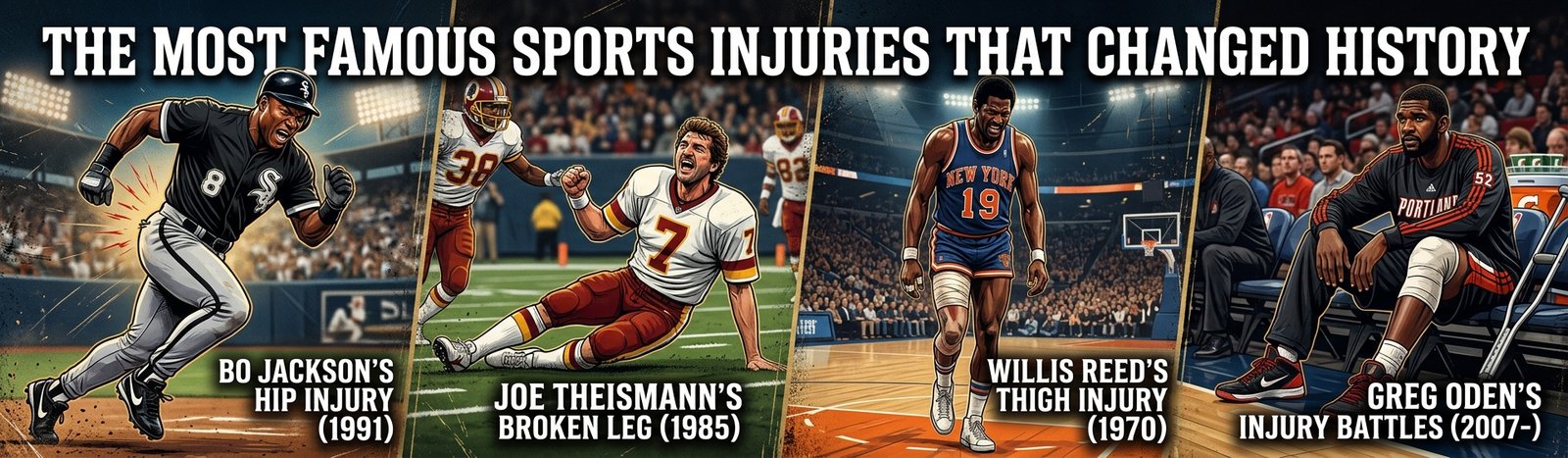
Bo Jackson’s Hip Injury
Bo Jackson’s hip injury is one of the most famous sports injuries ever because it didn’t just derail a career.
It froze a myth.
Bo was already larger than sports. He played Major League Baseball and NFL football with a physical style that made normal athletic categories feel useless. He hit baseballs into orbit, threw runners out with cartoonish force, and ran through football defenses like the field had been tilted in his favor.
Then came the hip injury during an NFL playoff game in January 1991.
Jackson’s football career was effectively over, and though he returned to baseball, he was never the same impossible athlete fans had seen before. The injury turned him from an active superstar into one of sports’ great “what if” figures.
Among sports injuries, Bo’s is especially haunting because fans never got the full career. They got the trailer. They got enough highlights to believe almost anything, then watched the body shut the door before the legend could finish proving itself.
That’s why Bo still feels mythical.
His injury didn’t erase greatness.
It trapped it in possibility.
Derrick Rose’s ACL Tear
Derrick Rose’s ACL tear in the 2012 NBA playoffs changed the Chicago Bulls and reshaped one of basketball’s most emotional careers.
Rose had become the youngest MVP in NBA history. He was explosive, fearless, and deeply connected to Chicago. He attacked the rim with a violence that made every drive feel like both a highlight and a warning sign. The Bulls had defense, toughness, and a real identity. They looked like the team built to challenge LeBron James and the Miami Heat in the East.
Then Rose went down late in a playoff game against the Philadelphia 76ers.
The injury changed everything.
Rose would fight through years of setbacks, returns, reinventions, and flashes of the old brilliance. He remained beloved because the struggle became part of the story. But the MVP version of Rose disappeared far too early.
Among sports injuries, this one hurts because fans saw the future forming. Chicago had its post-Jordan star. The league had a new rivalry brewing. Rose had the city in his hands.
Then one knee changed the decade.
Joe Theismann’s Broken Leg
Joe Theismann’s broken leg in 1985 remains one of the most infamous sports injuries in NFL history.
During a Monday Night Football game, Theismann was sacked by Lawrence Taylor. The injury was immediate, graphic, and horrifying. Taylor reacted instantly, waving for medical help, which told viewers something was terribly wrong before many fully understood what they had seen.
Theismann’s playing career ended that night.
This injury became a permanent part of football memory because of its visibility and brutality. It happened in prime time. It involved one of the NFL’s most famous defenders. It produced a replay many fans still avoid. It also became one of the clearest examples of how violent football can be even within the normal flow of play.
Among sports injuries, Theismann’s stands out because it didn’t need years to reveal its significance. Everyone knew immediately. The career had changed in one hit.
Football often asks fans to enjoy controlled violence.
That night, the control felt thin.
Willis Reed’s Thigh Injury
Willis Reed’s injury during the 1970 NBA Finals became famous not because it ended his moment, but because it set up one of basketball’s greatest entrances.
Reed had suffered a serious thigh injury and was not expected to be a full version of himself for Game 7 against the Los Angeles Lakers. The New York Knicks needed their captain, emotionally if not physically. Then Reed walked out of the tunnel at Madison Square Garden.
The crowd erupted.
He scored the Knicks’ first two baskets, and while Walt Frazier carried the game statistically, Reed’s presence became the symbol of the night. His injury made the entrance matter. Without the injury, it’s just a player starting a game. With the injury, it became mythology.
Among sports injuries, Reed’s is unique because it became part of a championship legend rather than a tragedy. It didn’t steal the story. It deepened it.
Sometimes an injury reveals absence.
Reed’s revealed leadership.
The Knicks didn’t just see their center.
They saw belief walking.
Kevin Durant’s Achilles Injury
Kevin Durant’s Achilles injury in the 2019 NBA Finals became one of the most debated modern sports injuries because of everything around it.
Durant had already missed time with a calf injury. The Golden State Warriors were trying to survive against the Toronto Raptors. Their dynasty was under pressure. Durant returned for Game 5, looked brilliant early, then suffered an Achilles injury that changed the game, the series, and the emotional tone of the Finals.
The moment was awful.
It also sparked immediate questions. Should he have played? Did pressure from the situation matter? Was he cleared properly? Was it simply a terrible risk that became terrible reality?
Durant eventually returned to elite form, which is remarkable. But the injury still marked the end of the Warriors’ first dynasty era. Toronto won the championship. Durant left for Brooklyn. Golden State’s future shifted.
Among sports injuries, Durant’s stands out because it happened at the intersection of medical risk, legacy pressure, free agency, and dynasty fatigue.
One step changed a league’s summer.
Tiger Woods’ Knee and Leg Problems
Tiger Woods’ career is filled with dominance, but it’s also filled with physical damage.
His knee problems, back surgeries, and later severe leg injuries turned his career into a long battle between genius and the body. One of the most famous examples came at the 2008 U.S. Open, where Tiger won while dealing with major knee issues and a leg stress fracture. That victory became one of his defining performances because it looked like willpower dragging a damaged body across the finish line.
But the longer injury story changed golf history.
Years of physical problems interrupted Tiger’s pursuit of major championship records and altered the shape of his prime. His 2019 Masters win became so emotional partly because fans had seen how far away that version of Tiger once seemed.
Among sports injuries, Tiger’s matter because they complicate an already historic career. He achieved enough to be immortal, yet still left fans wondering how much more dominant the record book might’ve looked if his body had cooperated.
That’s a strange kind of greatness.
Even the real career feels like a shortened version of the imagined one.
Grant Hill’s Ankle Injuries
Grant Hill’s ankle injuries changed the NBA’s post-Jordan landscape.
Before the injuries, Hill looked like one of the league’s future faces. He was smooth, skilled, athletic, marketable, and unusually complete. In Detroit, he handled the ball, scored, passed, rebounded, and gave the league a graceful superstar during a transitional era.
Then he signed with Orlando, where he was supposed to form a superstar duo with Tracy McGrady.
Instead, ankle problems wrecked his prime.
Hill eventually reinvented himself and built a long, respected career, which says a lot about his intelligence and professionalism. But the superstar version was stolen during the years when he should’ve been shaping the league.
Among sports injuries, Hill’s are haunting because they changed more than one player’s legacy. They changed McGrady’s path. They changed Orlando’s future. They changed the Eastern Conference’s potential balance.
Grant Hill still had a career many athletes would envy.
But fans know what was missing.
That’s what makes it hurt.
Brandon Roy’s Knees
Brandon Roy’s knee injuries are among the saddest sports injuries for fans who watched his prime closely.
Roy was calm, skilled, clutch, and smooth in a way that made late-game basketball feel slower around him. He gave the Portland Trail Blazers a franchise guard, the kind of player who could control a possession without panic and deliver when everyone knew where the ball was going.
Then his knees betrayed him.
Roy’s decline happened far too early, and Portland’s dream of building around Roy, LaMarcus Aldridge, and Greg Oden never became what it should’ve been. His brief comeback moments only made the story more painful because they reminded fans of what had been lost.
Among sports injuries, Roy’s stand out because they weren’t one dramatic replay that everyone remembers. They were more like a slow theft. The body took pieces away until the star could no longer stay.
Some injuries shock fans in an instant.
Others make them watch a career fade by inches.
Roy’s knees did the crueler one.
Greg Oden’s Injury Battles
Greg Oden’s injury history is one of the defining cautionary tales of NBA draft history.
The Portland Trail Blazers selected Oden No. 1 overall in 2007, ahead of Kevin Durant. At the time, Oden was viewed as a franchise center prospect: huge, defensive, powerful, and potentially dominant. The pick made sense in the basketball logic of the era.
Then injuries destroyed the plan.
Oden barely got a chance to build a career before surgeries and setbacks took over. Durant became one of the greatest scorers ever, making the comparison brutally unfair but unavoidable.
Among sports injuries, Oden’s matter because they changed how a generation remembers an entire draft. He’s often discussed as a bust, but that word can be cruel when injuries are the main villain. Oden didn’t fail because he lacked talent. His body simply never allowed the career to happen.
Portland fans had seen this kind of heartbreak before.
Great talent.
Damaged body.
Endless questions.
Oden became less a player than a painful alternate timeline.
Paul George’s Leg Injury
Paul George’s leg injury during a 2014 Team USA scrimmage was one of the most shocking basketball injuries of the modern era.
It was graphic, sudden, and frightening. George was already an emerging NBA star with the Indiana Pacers, and the injury raised immediate fears about whether he’d ever return to the same level. Seeing a player injured so severely in a national team exhibition also sparked debate about offseason risk and international basketball participation.
George did return and rebuilt himself into an elite player, which made the story less tragic than it first appeared.
But the image remained.
Among sports injuries, George’s stands out because of the shock factor and the comeback. It reminded fans that elite athleticism can be fragile even in settings that don’t seem as intense as playoff competition. One awkward landing, one collision with the stanchion area, and everything changes.
The comeback deserves as much memory as the injury.
George didn’t just return.
He restored his career.
That matters.
Alex Smith’s Leg Injury
Alex Smith’s leg injury in 2018 was one of the most serious NFL injuries of the modern era.
The Washington quarterback suffered a devastating broken leg that later led to life-threatening complications. For a long time, football felt secondary to whether he’d recover physically at all. The fact that Smith eventually returned to play in the NFL was almost unbelievable.
That comeback changed how the injury is remembered.
At first, it was horror. Then it became survival. Then it became one of the most remarkable returns in football history.
Among sports injuries, Smith’s stands out because it went beyond the normal language of sports recovery. This wasn’t simply about getting back on the field after a ligament tear or fracture. It was about saving a leg, fighting infection, enduring rehab, and somehow returning to professional football.
Fans love comeback stories, but sometimes the phrase gets used too casually.
Smith’s comeback earned it.
The injury was terrifying.
The return was astonishing.
Gordon Hayward’s Opening Night Injury
Gordon Hayward’s injury in his first regular-season game with the Boston Celtics in 2017 was one of the most shocking NBA opening-night moments ever.
Hayward had just joined Boston as a major free-agent signing. The Celtics were building around him, Kyrie Irving, young talent, and championship hopes. Then, minutes into the season opener, Hayward suffered a gruesome ankle and leg injury.
The entire atmosphere changed instantly.
A season that began with excitement became about recovery and adjustment before it had even started. Boston still had a strong year, and young players like Jayson Tatum and Jaylen Brown gained larger roles, but Hayward’s Celtics story was never what it was supposed to be.
Among sports injuries, Hayward’s stands out because of timing. Opening night. New team. New expectations. First quarter. National spotlight. Then silence.
Some injuries change a game.
This one changed a season before fans had even settled into it.
Klay Thompson’s ACL and Achilles Injuries
Klay Thompson’s injuries changed the Golden State Warriors’ dynasty timeline.
In the 2019 NBA Finals, Thompson tore his ACL during Game 6 against the Toronto Raptors. He had been playing brilliantly, and the Warriors were already dealing with Kevin Durant’s Achilles injury. Klay’s injury felt like the dynasty’s final physical collapse.
Then, while recovering, Thompson suffered an Achilles injury that cost him even more time.
The Warriors lost one of basketball’s greatest shooters and most beloved stars for more than two full seasons. Golden State eventually returned to championship glory, and Thompson’s comeback became deeply emotional. But the injuries changed years of his prime and reshaped the league’s competitive balance.
Among sports injuries, Klay’s matter because they didn’t happen to a fringe player. They hit a dynasty’s central piece, a player whose shooting could change a playoff series in minutes.
The comeback was beautiful.
The lost time still counts.
That’s the sadness of injuries.
Even when the athlete returns, the missing years don’t.
Penny Hardaway’s Knee Injuries
Penny Hardaway’s knee injuries helped erase one of the NBA’s most exciting possible superstar careers.
In the mid-1990s, Penny looked like a future face of the league. He had size, handle, passing, scoring, style, and charisma. Alongside Shaquille O’Neal in Orlando, he helped make the Magic one of basketball’s most exciting young teams.
Then Shaq left.
Then injuries hit Penny hard.
The version of Hardaway fans had fallen in love with faded too early. He still played for years, but the explosive, creative, superstar-level guard was never fully restored.
Among sports injuries, Penny’s are painful because his prime felt connected to a whole lost NBA timeline. What if Orlando kept Shaq and Penny together? What if Penny stayed healthy? What if the Magic became the next great Eastern Conference power?
Those questions still linger because the early evidence was so exciting.
Penny wasn’t just good.
He felt like the future wearing big shoes and making defenders dizzy.
Then the future changed.
Gale Sayers’ Knee Injuries
Gale Sayers had one of the most brilliant shortened careers in NFL history.
The Chicago Bears running back was electric, graceful, explosive, and nearly impossible to tackle in space. His cuts looked artistic. His acceleration was frightening. He was the kind of player older fans still describe with reverence because the highlights feel too smooth for the era.
Then knee injuries shortened his career.
Sayers still became a Hall of Famer, which says everything about how great he was in limited time. But fans were left wondering what a full career might’ve produced.
Among sports injuries, Sayers’ are important because they shaped the way football remembers short primes. Some athletes build legacy through longevity. Sayers built it through flashes so brilliant that time became almost irrelevant.
Almost.
The injury robbed fans of years, but not memory.
That’s the strange bargain.
Gale Sayers didn’t get the long résumé.
He got the kind of highlight reel that makes people whisper.
Bill Walton’s Feet
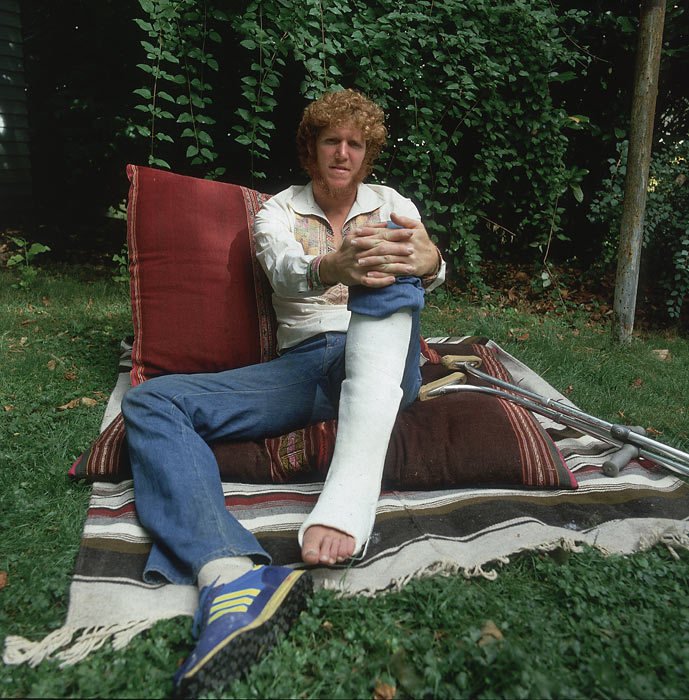
Bill Walton’s foot injuries changed NBA history.
At his peak, Walton was one of the most complete centers basketball has ever seen: passing, defense, rebounding, intelligence, unselfishness, and team impact. He led the Portland Trail Blazers to the 1977 NBA championship and looked capable of anchoring something much larger.
Then his feet betrayed him.
Walton’s injuries limited his prime and turned him into one of basketball’s great what-if superstars. He later had a remarkable chapter as a sixth man with the Boston Celtics, proving his basketball genius remained. But the Portland version was gone too soon.
Among sports injuries, Walton’s matter because they may have prevented a dynasty. The Blazers had something special, and Walton’s style made everyone better. Losing him didn’t just remove a star. It collapsed a whole basketball ecosystem.
Some players score points.
Walton created order.
When his body failed, the order disappeared.
Ken Griffey Jr.’s Injuries
Ken Griffey Jr. still had a Hall of Fame career and remains one of baseball’s most beloved players.
That’s what makes his injury story so interesting.
Griffey’s early years in Seattle were breathtaking. The swing, the smile, the backwards cap, the defense, the home runs, the effortless cool — he looked like baseball’s perfect star. When he went to Cincinnati, injuries began taking chunks out of his seasons and limiting what might’ve been an even greater chase of baseball’s biggest records.
Among sports injuries, Griffey’s matter because they didn’t prevent greatness. They prevented the loudest possible version of greatness.
He still hit 630 home runs.
He still became immortal.
But fans still wonder what the totals would’ve looked like with better health. Could he have chased the all-time home run record more seriously? Could he have reshaped the steroid-era conversation even more strongly as a clean, beloved superstar?
Griffey’s career is already legendary.
The injury-free version might’ve been baseball royalty on another level.
Why Injuries Change More Than Careers
The biggest sports injuries change more than one athlete’s stat line.
They change teammates’ careers. Coaches’ reputations. Front-office decisions. Championship windows. Rivalries. Draft histories. League narratives. Fan psychology. Sometimes they even change rules, medical protocols, equipment standards, or how teams manage player workload.
That’s why an injury can echo for years.
When a superstar gets hurt, everyone around them enters a different timeline. A young player gets more minutes. A coach loses job security. A rival gets an easier path. A franchise delays or accelerates a rebuild. A fanbase learns to distrust hope.
Sports injuries are physical events with emotional aftershocks.
The body heals, maybe.
The timeline doesn’t always.
The Legacy of Sports Injuries
The legacy of sports injuries is that they reveal how fragile sports history really is.
Bo Jackson’s hip injury froze one of the greatest athletic myths ever. Derrick Rose’s ACL tear changed Chicago’s future. Joe Theismann’s broken leg became football’s most unforgettable reminder of violence. Willis Reed’s injury turned his tunnel walk into legend. Kevin Durant’s Achilles injury marked the end of a Warriors era. Tiger Woods’ body changed the shape of golf history. Grant Hill’s ankle injuries altered the post-Jordan NBA. Brandon Roy’s knees stole a beloved star’s prime. Greg Oden’s injuries turned a No. 1 pick into a permanent what if. Paul George and Alex Smith turned horrific injuries into comeback stories. Gordon Hayward’s opening-night injury changed Boston’s plan immediately. Klay Thompson’s injuries interrupted a dynasty. Penny Hardaway’s knees dimmed a future superstar. Gale Sayers’ injuries shortened brilliance. Bill Walton’s feet may have stopped a Portland dynasty. Ken Griffey Jr.’s injuries left fans wondering how high the numbers could’ve gone.
Sports injuries matter because they remind fans that greatness is never guaranteed time.
Talent needs health.
Dynasties need bodies.
Legends need knees, ankles, backs, feet, tendons, bones, and luck.
Every season is built on the hope that the best players will be there when history arrives.
Sometimes they aren’t.
And that absence becomes history too.