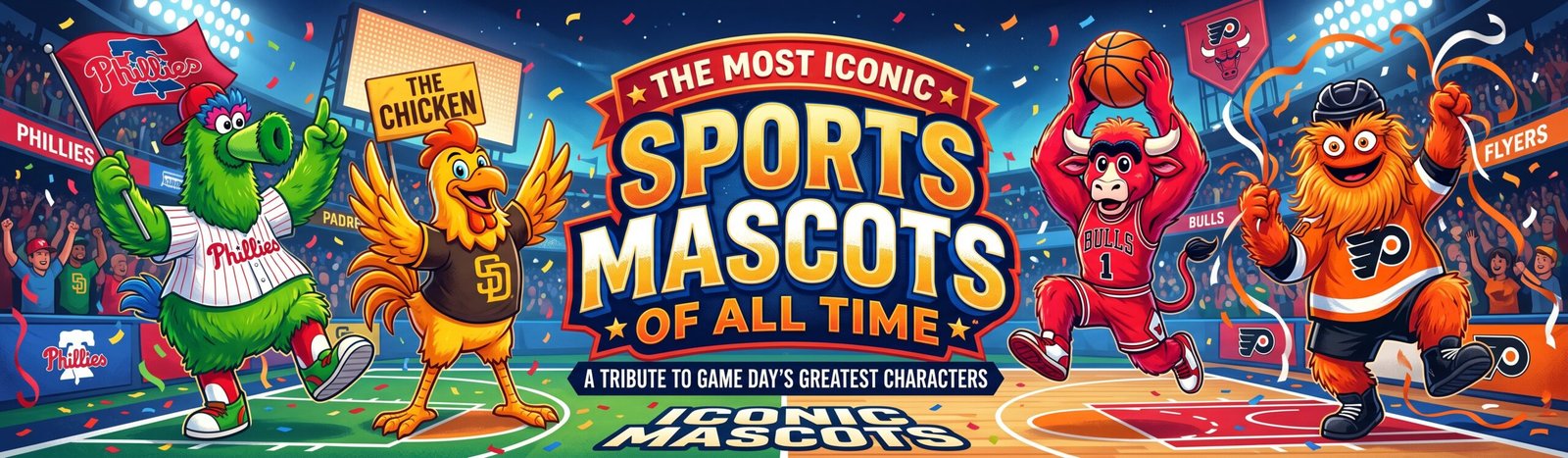
Sports mascots shouldn’t matter as much as they do.
They don’t score. They don’t defend. They don’t hit home runs, stop shots, throw touchdowns, or win championships. Most of them can’t even speak. They’re enormous, silent creatures with fixed smiles, oversized heads, and a suspicious amount of confidence.
Yet the best mascots become part of the team’s soul.
They entertain children during blowouts. They torment visiting players. They fire food into crowds through equipment that probably shouldn’t be trusted. They dance, fall, climb, dunk, mock umpires, crash press conferences, steal hats, and somehow survive situations that would get a normal employee removed from the building.
That’s why the most iconic sports mascots matter.
A great mascot doesn’t feel like a person wearing a costume. The character feels real, even when nobody can explain what kind of animal it’s supposed to be. Fans know the personality. The mascot has grudges, routines, enemies, and a whole fictional life that everyone agrees not to question too closely.
Some mascots represent the team literally.
Others are giant green creatures from nowhere.
The weird ones are usually better.
Why Sports Mascots Become Part of Team Identity
The best sports mascots work because they create emotion without needing the game to cooperate.
A team may be losing by 20. The bullpen may have ruined another lead. The offense may have produced three first downs all afternoon. The crowd still reacts when the mascot steals an opposing fan’s sign, launches into an acrobatic dunk, or starts bothering someone important.
Mascots also connect generations. Children who don’t understand the standings can understand a giant fuzzy character causing trouble. Those children grow up, bring their own families, and discover the mascot is still there while the players, coaches, uniforms, and stadium names have all changed.
That continuity matters.
A mascot can survive rebuilds.
A mascot can’t demand a trade.
A mascot never signs with the rival unless it’s Youppi!, and even that situation required a whole franchise to leave the country.
The Phillie Phanatic
The Phillie Phanatic may be the greatest sports mascot ever created.
He’s large, green, furry, loud without speaking, and completely suited to Philadelphia. The Phanatic doesn’t behave like a polite family-entertainment character. He behaves like an agent of public disorder who happened to receive a credential.
He debuted at Veterans Stadium on April 25, 1978, and became part of the Mascot Hall of Fame’s first class in 2005. His routines have included riding an ATV, taunting opposing players and managers, dancing on dugouts, and generally turning baseball’s quiet stretches into controlled chaos.
The character works because the Phanatic isn’t only cute.
He has edge.
He’ll entertain a child, then spend the next inning mocking the visiting team. He’s friendly, but not harmless. That makes him feel closer to Philadelphia’s actual sports personality than a perfectly polished character ever could.
Plenty of mascots entertain during games.
The Phanatic can become the game.
The Famous San Diego Chicken
The Famous San Diego Chicken helped invent what modern mascot performance looks like.
The character began in 1974 when San Diego State student Ted Giannoulas took a low-paying job wearing a chicken costume for a radio promotion. What started as a marketing appearance grew into a career built around improvisation, parody, physical comedy, and sports performances across the country. The Mascot Hall of Fame credits the Chicken with helping pioneer the modern mascot industry and notes that Giannoulas has performed for decades in thousands of appearances.
The Chicken mattered because he didn’t stand around waving.
He created bits.
He teased officials, players, cheerleaders, coaches, and fans. He treated the ballpark like a comedy stage where the score was only one possible source of entertainment. That approach influenced nearly every mascot who followed.
The Chicken also proved a mascot could become famous independently of one franchise. He performed across different sports and cities while remaining unmistakably tied to San Diego.
Before mascots had carefully managed social accounts, brand partnerships, and full entertainment teams, the Chicken had timing.
Timing is harder to manufacture.
Mr. Met
Mr. Met is the simplest mascot on this list and one of the strongest.
He’s a man with a baseball for a head.
That’s the entire concept.
No complicated creature mythology is needed. No one has to explain where he came from, what species he is, or why his ears disappeared. He’s baseball made into a person, wearing a Mets uniform and smiling through whatever emotional experiment the franchise has designed for its fans that year.
Mr. Met first appeared as an illustrated character in 1963 and became an in-person mascot at Shea Stadium in 1964. The Mets identify him as the first live costumed mascot in Major League Baseball. He later entered the Mascot Hall of Fame and moved with the team to Citi Field.
His oversized baseball head also makes every emotion funnier.
Celebrating looks funnier.
Disappointment looks funnier.
Standing silently after a bullpen collapse looks like performance art.
Mr. Met doesn’t need elaborate stunts to be recognizable. The silhouette does the work. That’s the mark of excellent mascot design.
Sometimes one joke is enough if it’s the right joke.
Benny the Bull
Benny the Bull has outlasted almost every era of Chicago basketball.
The Bulls introduced the original mascot in 1969, long before Michael Jordan turned the franchise into a global sports brand. Benny’s current red-furred form is newer, but the character’s roots go back to the period when the organization was trying to build attention and attendance in Chicago. Sources connect his name to Ben Bentley, an early Bulls public-relations figure and arena personality.
Modern Benny is one of basketball’s most athletic and social-media-friendly mascots.
He dunks from trampolines, dances, throws popcorn, bothers people courtside, and understands the strange mascot rule that almost any situation improves when a giant red bull appears without permission.
His popularity also survived the Bulls’ changing fortunes. That matters. It’s easy for a mascot to feel important when Michael Jordan is winning championships. It’s harder when the team is rebuilding and the fourth quarter requires alternative entertainment.
Benny stayed useful.
Sometimes he was the only Bull guaranteed to put on a show.
Gritty
Gritty entered the world looking like the internet had designed a mascot during a fever.
The Philadelphia Flyers unveiled him on September 24, 2018. He was introduced as a seven-foot-tall orange creature with wild eyes, an enormous beard, and the energy of someone who’d been living unsupervised underneath an arena. Early reactions ranged from confusion to horror, but the character quickly became a Philadelphia phenomenon.
Gritty works because the Flyers didn’t soften him after the public reaction.
They leaned into the weirdness.
He became chaotic, unpredictable, slightly threatening, and extremely online. He falls down. He destroys things. He stares directly into cameras for too long. He has the emotional regulation of a shopping cart rolling downhill.
That made him perfect for Philadelphia.
A safer mascot would’ve disappeared into the background. Gritty became famous because people couldn’t decide whether they wanted to hug him or report him.
The best sports mascots create instant recognition.
Gritty created instant concern.
Close enough.
The Phoenix Suns Gorilla
The Phoenix Suns Gorilla has one of the best mascot origin stories because the character wasn’t originally planned by the team.
A singing-telegram performer arrived at a Suns game wearing a gorilla suit in 1980. The crowd reacted so well that the idea kept growing, eventually turning the Gorilla into the franchise’s official mascot. Later performers developed the acrobatic dunks, comedy routines, and daredevil style that made “Go” one of the NBA’s best-known characters.
The randomness makes it better.
The Suns aren’t named after gorillas.
Phoenix isn’t especially famous for gorillas.
There’s no obvious connection whatsoever.
And yet it works.
That’s a valuable lesson in mascot design. Literal isn’t always memorable. A giant sunflower would make more sense for the Suns, but it probably wouldn’t look as good flying off a trampoline toward the rim.
The Gorilla became iconic because the character had movement and personality.
Logical branding lost.
Dunks won.
Rocky the Mountain Lion
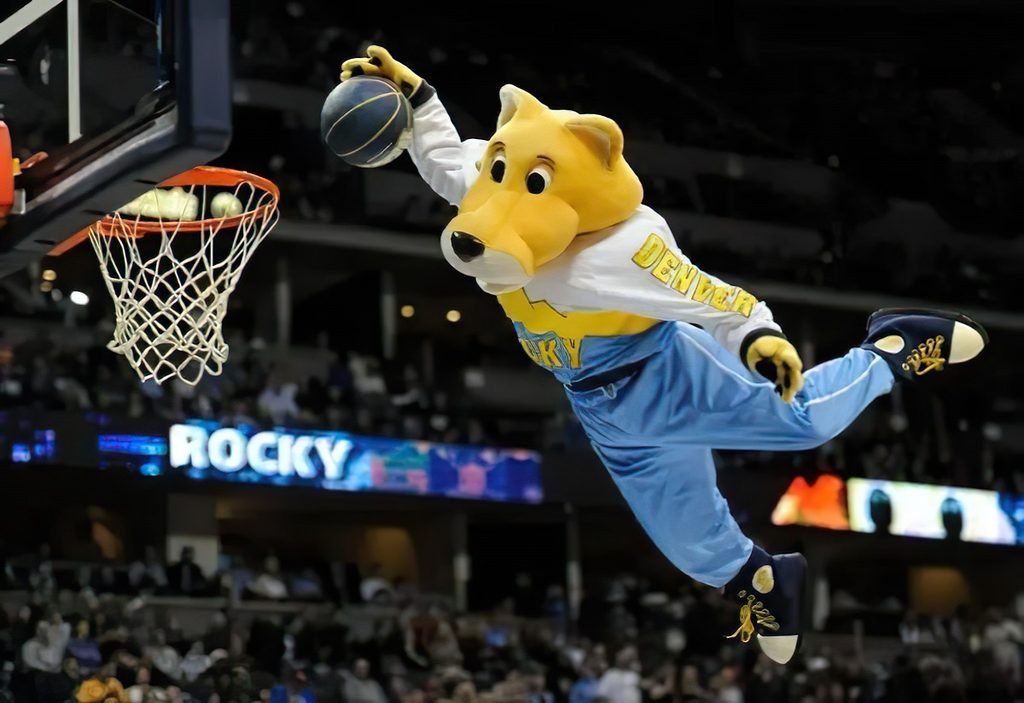
Rocky the Mountain Lion has been one of the NBA’s strongest in-arena performers since his 1990 debut with the Denver Nuggets.
He’s known for acrobatic routines, comedy, crowd interaction, and a signature backward half-court shot that became a regular fourth-quarter feature at Nuggets games. Rocky entered the Mascot Hall of Fame in 2008, and the original performer built the character over more than three decades.
Rocky works because he feels like a complete performer rather than an accessory.
He has timing.
He understands the crowd.
He can turn a timeout into a moment people remember after forgetting half the game’s possessions. That’s the mascot’s real job, especially during a long NBA schedule where not every Tuesday night naturally produces drama.
The design also fits Denver without becoming too obvious. A mountain lion named Rocky is direct enough to make sense, but the character’s skill made him bigger than the concept.
Plenty of teams have mascots.
Rocky has an act.
Youppi!
Youppi! accomplished something almost no other mascot could claim.
He changed professional sports.
Youppi! debuted with the Montreal Expos in 1979 and became one of baseball’s most beloved characters. When the Expos moved to Washington after the 2004 season, Montreal’s orange mascot was left without a team. The Canadiens adopted him in 2005, making Youppi! the first mascot to officially move between two major North American professional sports leagues.
That transition turned Youppi! into more than a mascot.
He became a piece of Montreal sports continuity.
The Expos disappeared, but the city didn’t have to lose every symbol attached to them. Youppi! moved from the baseball diamond to the hockey rink, changed uniforms, and kept representing Montreal.
He’s also remembered for being ejected from an MLB game after bothering Dodgers manager Tommy Lasorda, which may be the highest honor a mascot can receive.
Players dream of making two major leagues.
Youppi! did it without changing species.
Big Red
Big Red is what happens when a university refuses to answer the most basic mascot question.
What is it?
Western Kentucky University’s official position is essentially: red.
Big Red debuted in 1979 and is intentionally described as a large, furry creature of undefined species. The Mascot Hall of Fame inducted the character in 2007 and celebrates the ambiguity as part of his appeal.
That lack of explanation is the whole point.
Big Red isn’t a hill.
He isn’t a human Hilltopper.
He isn’t an animal found in Kentucky or anywhere else with a functioning ecosystem. He’s a giant red mouth with arms, legs, and the confidence of something that knows the mystery is helping.
Among college sports mascots, Big Red stands out because the design shouldn’t work according to normal branding rules.
It isn’t intimidating.
It isn’t graceful.
It doesn’t explain the school nickname.
It’s simply unforgettable.
Sometimes good design answers questions.
Big Red keeps creating them.
Brutus Buckeye
Brutus Buckeye proves a nut can become a national sports figure with the right amount of school pride.
Ohio State introduced Brutus in 1965 after students built the original mascot head from papier-mâché. The character debuted at an Ohio Stadium game against Minnesota and later received his name through a campus contest. Brutus entered the Mascot Hall of Fame in 2007.
The concept is strange when separated from tradition.
A giant anthropomorphic nut walks around wearing scarlet and gray while more than 100,000 people treat him like a dignitary.
Inside Ohio State culture, it feels completely normal.
That’s what decades of repetition can do.
Brutus works because he’s inseparable from the Buckeyes’ identity. The round head, Block O hat, colors, and game-day presence make him recognizable even to people who don’t follow college sports closely.
He’s proof that a mascot doesn’t need to look fierce to represent a powerhouse.
Sometimes being everywhere is enough.
What Makes Sports Mascots Iconic?
The greatest sports mascots usually share several traits.
They’re visually distinct. A mascot has to be recognizable from across a stadium, inside a short video, or printed on something small. A complicated design can disappear. A clear silhouette lasts.
They also have personality. The Phanatic is mischievous. Gritty is chaos. Mr. Met is cheerful endurance. Benny is athletic. Big Red is unexplained. Those personalities remain consistent enough for fans to understand what each character might do, while still leaving room for surprise.
Most importantly, iconic mascots interact rather than decorate.
They don’t stand near the tunnel waiting for photographs. They create moments. They find an opposing player who looks too serious. They interrupt a broadcast. They turn a timeout into comedy. They give fans something worth watching when the game itself isn’t helping.
A mascot becomes iconic when fans would feel the absence immediately.
Why the Weird Sports Mascots Usually Win
The strangest sports mascots are often the most memorable because they can’t be confused with anything else.
There are plenty of lions, tigers, eagles, bears, bulldogs, and wolves. Some are excellent, but the category is crowded. A giant green Galápagos creature, an orange hockey beast, a baseball-headed man, or an unidentified red blob owns its visual territory.
Weirdness also gives performers more freedom.
A realistic animal has expected behavior. A completely invented creature can do almost anything without breaking character. The Phanatic can fire hot dogs. Gritty can fall through furniture. Big Red can consume someone with his stomach-mouth.
Nobody can object that the behavior is biologically inaccurate.
There’s no established biology.
That freedom is where great mascot comedy lives.
The Legacy of Sports Mascots
The legacy of sports mascots is that they give teams personality that survives the scoreboard.
The Phillie Phanatic turned baseball downtime into Philadelphia chaos. The Famous San Diego Chicken helped create the modern mascot industry. Mr. Met made a baseball head into one of sports’ cleanest visual jokes. Benny the Bull survived every Chicago basketball era and became a star of his own. Gritty went from public confusion to instant cult figure. The Suns Gorilla proved an accidental idea can become permanent tradition. Rocky turned mascot performance into a complete arena act. Youppi! survived the loss of one franchise by joining another sport. Big Red became iconic without anyone deciding what he is. Brutus Buckeye turned a papier-mâché nut into Ohio State royalty.
Mascots matter because sports are supposed to contain joy.
Not every game is historic.
Not every season ends well.
Not every team gives fans enough to celebrate.
The mascot still arrives.
Still dances.
Still causes trouble.
Still acts like tonight matters.
That’s more valuable than it sounds.
Players create the result.
The best sports mascots make the whole building feel alive while everyone waits to find out what that result will be.