Sports are full of legends.
But sometimes the most fascinating stories come from the people and teams that caught fire once, burned bright enough to blind everyone, then never quite reached that height again.
That’s why one-season wonders in sports are so addictive. They’re not always the greatest athletes or greatest teams ever. They’re something stranger. They’re flashes. They’re comets. They’re a perfect year, a perfect month, a perfect playoff run, a perfect storm of timing, talent, health, confidence, scheme, and luck.
Some one-season wonders become cult heroes. Some become trivia answers. Some become cautionary tales. Some make fans wonder whether the magic was real or whether everyone just hallucinated the same season together.
The beauty of a one-season wonder is that it refuses to fit neatly into sports history. Greatness usually asks for repetition. Do it again. Prove it wasn’t luck. Build a legacy. But one-season wonders don’t always give us that. They give us one incredible burst, then leave fans arguing over what exactly happened.
Was it talent?
Was it circumstance?
Was it the system?
Was it lightning in a bottle?
That mystery is the whole point.
Why One-Season Wonders in Sports Fascinate Fans
The reason one-season wonders in sports stay memorable is that they feel almost impossible to explain.
A superstar having a great year makes sense. Michael Jordan dominating makes sense. Tom Brady winning makes sense. Serena Williams crushing the field makes sense. But when an athlete or team suddenly becomes far better than anyone expected, fans get pulled into the story fast.
Sports fans love watching someone break the script.
A backup quarterback becomes unstoppable. A running back turns into a video game character. A baseball player suddenly hits home runs like Babe Ruth possessed his bat. A team nobody believed in starts winning every week. A forgotten franchise becomes appointment television.
Then, just as quickly, the magic disappears.
That’s what makes these stories stick. If the success lasted forever, it would become a dynasty. If it never happened, nobody would care. But one brilliant season creates a permanent question mark.
And sports fans love question marks almost as much as championships.
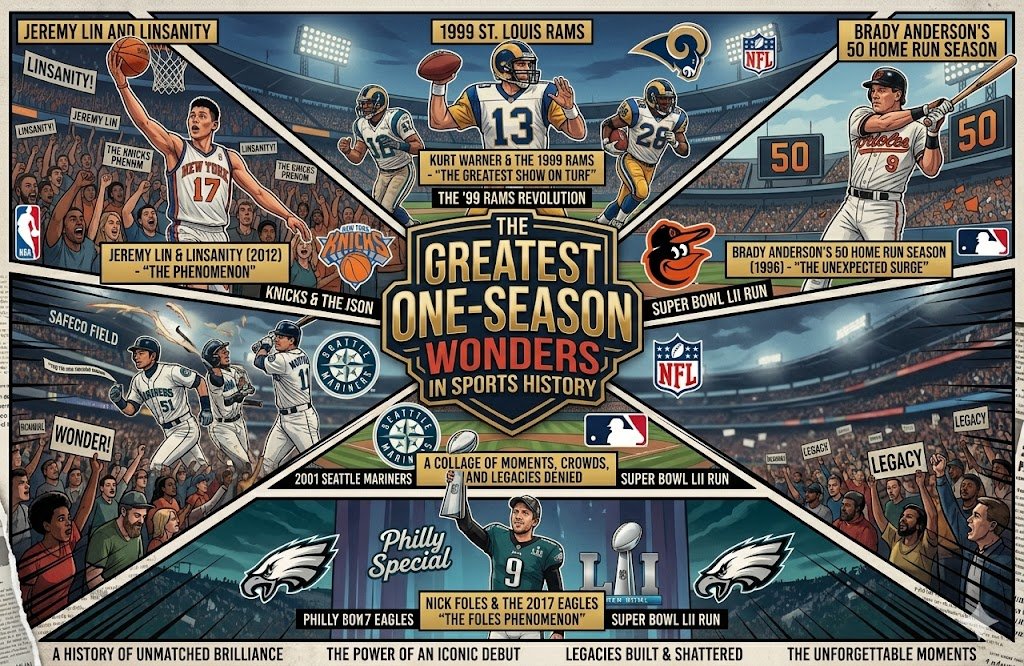
Jeremy Lin and Linsanity
Linsanity wasn’t even a full season.
It didn’t need to be.
For a few weeks in 2012, Jeremy Lin became the center of the basketball universe. He came off the New York Knicks bench, started putting up huge numbers, hit game-winners, shredded defenses, and turned Madison Square Garden into a nightly revival meeting.
The story had everything. An overlooked player. A massive media market. A struggling team. A Harvard background. An Asian American star breaking through in a league where nobody had expected him to become that kind of phenomenon. The Knicks weren’t just winning games. They were living inside a sports fairy tale with better lighting.
Linsanity became bigger than basketball because it felt impossible. Fans who didn’t care about the Knicks suddenly cared. People who didn’t watch regular-season NBA games knew Jeremy Lin’s name. Every game became a test of whether the magic could keep going.
Eventually, injuries, roster changes, defensive adjustments, and the normal cruelty of the league slowed the story down. Lin had a solid NBA career, but he never recreated that stretch.
That’s why Linsanity remains one of the greatest one-season wonders in sports. It was too short to be a traditional legacy, but too powerful to be forgotten.
For a moment, the entire sports world believed.
The 1999 St. Louis Rams
The 1999 St. Louis Rams didn’t just come out of nowhere.
They came out of nowhere at full speed.
Before that season, the Rams weren’t exactly viewed as a sleeping monster. Then Trent Green got hurt, Kurt Warner stepped in, and suddenly the NFL had one of the most explosive offenses it had ever seen. Warner, Marshall Faulk, Isaac Bruce, Torry Holt, and the “Greatest Show on Turf” turned football into track practice with shoulder pads.
The Rams went from afterthought to Super Bowl champion in one of the wildest turnarounds in NFL history.
Now, calling the Rams a pure one-season wonder is tricky because they stayed excellent for a few years. But the 1999 version belongs in this conversation because that first burst of greatness felt unreal. Warner’s rise from grocery-store stocker and arena football quarterback to NFL MVP and Super Bowl champion was almost too perfect for fiction.
That season changed how fans thought about offensive football. It also gave St. Louis one of the great sports memories in city history.
The Rams weren’t a fluke in the simple sense.
But 1999 was lightning.
And lightning counts.
Brady Anderson’s 50-Home Run Season
Brady Anderson’s 1996 season is one of baseball’s strangest power spikes.
Before 1996, Anderson was a good player. Useful. Athletic. Productive. Then he hit 50 home runs for the Baltimore Orioles, a number that looked wildly out of place compared with the rest of his career.
That’s what makes it such a classic one-season wonder. Anderson didn’t become a joke afterward. He remained a good player. But he never came close to that kind of power again. Fifty home runs is superstar slugger territory. For Anderson, it became a statistical island.
Baseball is full of weird seasons because the sport is weird by nature. Ballparks, injuries, swing changes, lineup protection, era context, and plain old randomness can all distort a year. But a 50-homer season from a player who never hit more than 24 in any other year is the kind of thing that makes fans stare at the back of a baseball card like it owes them an explanation.
Anderson’s 1996 season remains one of the great one-season wonders in sports because it feels like a glitch in the record book.
A beautiful, bizarre glitch.
Peyton Hillis and the Madden Cover Season
Peyton Hillis became a folk hero for one strange, bruising year.
In 2010, Hillis ran for over 1,100 yards with the Cleveland Browns and became the kind of physical, downhill back fans love to romanticize. He wasn’t sleek. He wasn’t flashy. He looked like someone built to run through bad weather and worse blocking.
Then something even stranger happened.
He landed on the cover of Madden NFL 12 after a fan vote.
That’s the part that makes his season feel almost mythological. Hillis wasn’t a long-term superstar. He wasn’t the face of the league. But for one year, he became a cult phenomenon. Browns fans had something to rally around. Neutral fans enjoyed the absurdity. The Madden cover turned him from breakout player into sports pop culture oddity.
After that, injuries, contract issues, and inconsistency kept him from repeating the magic.
That doesn’t erase 2010.
If anything, it makes it more memorable. Hillis became one of the great one-season wonders in sports because his rise felt so unlikely and so specific to that moment. It was part football, part internet culture, part underdog story, part Cleveland fever dream.
Not every one-season wonder has to be elegant.
Some just need to run angry.
The 2001 Seattle Mariners
The 2001 Seattle Mariners won 116 games.
Then they didn’t win the World Series.
That’s the whole heartbreak.
The Mariners had lost Ken Griffey Jr. before the 2000 season and Alex Rodriguez before 2001, yet somehow became one of the greatest regular-season teams in baseball history. Ichiro Suzuki arrived from Japan and instantly became a sensation. The lineup was deep. The pitching was strong. The team won constantly.
For six months, Seattle looked like baseball had invented a new machine.
Then October arrived, and the Yankees ended the dream in the ALCS.
The Mariners didn’t collapse into irrelevance immediately, but they never recreated that season. They certainly never turned it into a championship era. That’s why 2001 feels so strange. It was one of the greatest regular seasons any team has ever produced, but without the title, it became a beautiful unfinished sentence.
Teams can be one-season wonders too, and the Mariners are one of the best examples.
They weren’t bad.
They were historically great.
That’s what makes the ending feel even stranger.
Nick Foles and the Eagles Super Bowl Run
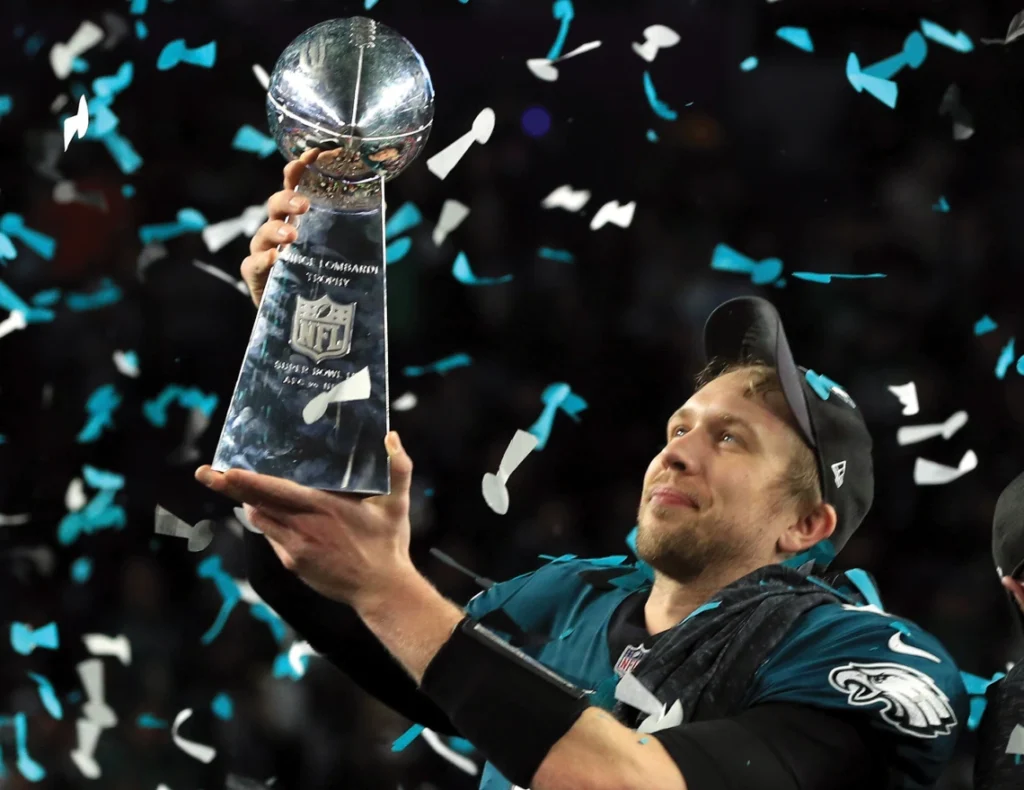
Nick Foles has had a long and interesting football life, but his 2017 playoff run sits in its own category.
Carson Wentz had been playing at an MVP level before tearing his ACL. The Philadelphia Eagles looked like a Super Bowl-caliber team, but plenty of people thought their title hopes died with Wentz’s injury. Then Foles took over.
And somehow, in the biggest moments, he became perfect.
Foles outdueled Tom Brady in Super Bowl LII, won Super Bowl MVP, and delivered Philadelphia its first Super Bowl championship. The “Philly Special” became instant history. Eagles fans got the kind of sports memory that never loses its shine.
Foles had other good moments in his career, including a wild 27-touchdown, 2-interception season earlier with Philadelphia. But the 2017 postseason run is the masterpiece. It’s the thing that turned him from backup quarterback into Philadelphia legend.
That’s what makes one-season wonders in sports so fascinating. They don’t always need Hall of Fame careers. Sometimes they only need to be great when an entire city needs them most.
For Philadelphia, Nick Foles wasn’t a one-season wonder.
He was a miracle with a play sheet.
The 2015 Carolina Panthers
The 2015 Carolina Panthers were a full-season mood.
Cam Newton was MVP. The defense was fast. The team dabbed, danced, smiled, talked, celebrated, and won almost every week. Carolina went 15-1 and looked like the most confident team in football.
For that year, the Panthers weren’t just good.
They had swagger.
Newton’s season was the center of everything. He threw, ran, celebrated, and carried the offense with a kind of physical charisma few quarterbacks have ever had. The Panthers felt fresh, loud, and impossible to ignore.
Then the Super Bowl happened.
Von Miller and the Denver Broncos defense wrecked the ending. Carolina lost, and the magic never fully returned. The Panthers remained competitive in stretches afterward, but the 2015 version feels sealed off from the rest of franchise history.
That’s why they belong in a one-season wonders conversation. They were too dominant to be dismissed, too memorable to be forgotten, and too short-lived to feel like a true era.
Some teams leave behind trophies.
The 2015 Panthers left behind a vibe.
Fernando Valenzuela and Fernandomania
Fernando Valenzuela’s 1981 season was one of baseball’s great cultural explosions.
As a rookie pitcher for the Los Angeles Dodgers, Valenzuela started the season with a run of dominance that turned into “Fernandomania.” He became a sensation, especially among Mexican and Mexican American fans who saw themselves represented in a way baseball hadn’t offered often enough on that stage.
Valenzuela wasn’t just a novelty. He could pitch. His screwball, calm presence, and early dominance made him one of the most compelling athletes in the country. He won Rookie of the Year and the Cy Young Award in the same season, and the Dodgers won the World Series.
Unlike some one-season wonders, Valenzuela had a strong career after that. But 1981 remains the untouchable peak, the year when talent, timing, culture, and Los Angeles all merged into something bigger than normal sports success.
Fernandomania shows that one-season wonders in sports aren’t always about statistical weirdness.
Sometimes they’re about a moment when an athlete becomes a movement.
Tim Tebow’s 2011 Broncos Season
Tim Tebow’s 2011 season with the Denver Broncos was not normal.
It was messy, dramatic, strange, and somehow impossible to stop watching. Tebow wasn’t a polished NFL passer. His mechanics were criticized constantly. The offense often looked stuck for three quarters. Then, late in games, something weird kept happening.
Denver kept winning.
The season became a weekly argument about faith, leadership, quarterback play, media obsession, and whether results mattered more than aesthetics. Tebowmania reached its peak in the playoffs when he threw an overtime touchdown pass to Demaryius Thomas to beat the Pittsburgh Steelers.
That moment became one of the most surreal playoff endings of the decade.
Tebow never became a long-term NFL starting quarterback, but that season still lives because it felt like sports had temporarily abandoned logic. Every game became theater. Every comeback fed the myth. Every criticism made his supporters louder.
Some one-season wonders are clean and statistically dominant.
Tebow’s was chaotic.
That’s why people still remember it.
Jeremy Shockey and the Early 2000s Tight End Moment
Jeremy Shockey burst into the NFL with the New York Giants like he’d been sent to annoy every linebacker and safety in America.
His rookie season in 2002 felt like the arrival of a new kind of tight end personality: loud, emotional, athletic, dangerous after the catch, and impossible to ignore. Shockey went over 800 receiving yards as a rookie and immediately became one of the league’s most visible young players.
He had a productive career, so calling him a pure one-season wonder would be unfair. But that first season had a cultural intensity he never quite matched. For a moment, Shockey felt like the future of the position and the face of a new Giants attitude.
Sometimes one-season wonders in sports are less about disappearing and more about a peak of attention that never returns in the same way.
Shockey stayed good.
The phenomenon was the thing that came and went.
Why One-Season Wonders Usually Fade
One-season wonders fade for different reasons.
Sometimes the league adjusts. Defenses study the film. Pitchers find the hole in the swing. Coaches copy the scheme. Injuries hit. Confidence dips. Supporting casts change. A player loses the perfect role. A team loses chemistry. A front office mistakes magic for a repeatable formula.
Sports are cruel that way.
A great season can look obvious after it happens, but repeating it is much harder. Everything has to line up again: health, timing, opportunity, opponents, pressure, luck, and belief. Most of the time, something changes.
That doesn’t make the original season fake.
It might make it more impressive.
For one year, everything worked.
That’s rare enough.
The Legacy of One-Season Wonders in Sports
The legacy of one-season wonders in sports is that they remind fans greatness doesn’t always arrive in neat career arcs.
Sometimes it shows up for a month, like Linsanity. Sometimes it changes a franchise forever, like Nick Foles in Philadelphia. Sometimes it rewrites a record book, like Brady Anderson’s 50 home runs. Sometimes it turns a forgotten team into a champion, like the 1999 Rams. Sometimes it gives a city one unbelievable summer, like the 2001 Mariners. Sometimes it gives fans a story they still can’t fully explain, like Tebowmania.
Sports culture loves sustained greatness, and it should. Repetition matters. Longevity matters. Proving it again matters.
But there’s a different kind of magic in the brief blaze.
The athlete who caught fire once.
The team that found the perfect year.
The season that shouldn’t have happened but did.
One-season wonders don’t always become legends in the traditional sense.
They become memories fans refuse to stop talking about.