
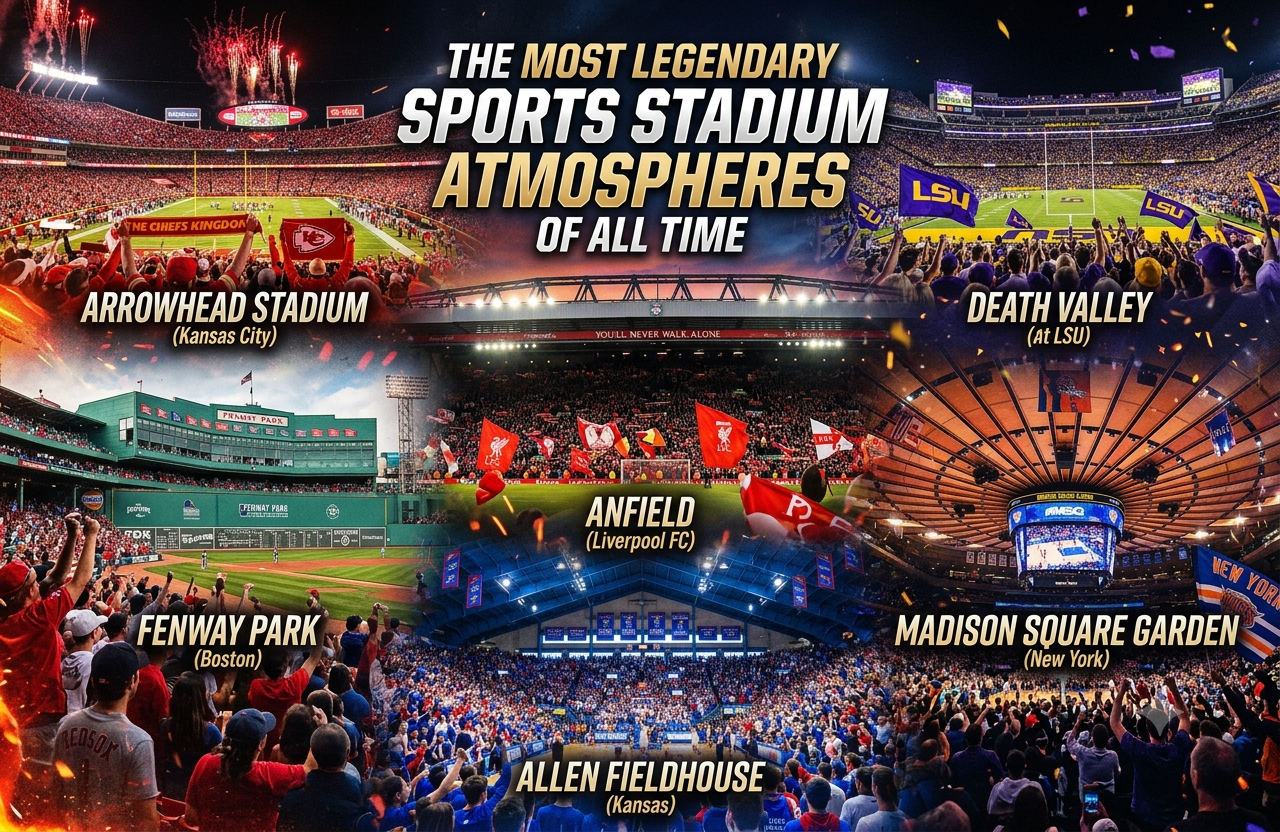
Stadium atmospheres are where sports become physical for the fans.
You can watch a game on television and understand what happened. You can see the touchdown, the goal, the dunk, the save, the home run, the missed kick, the final whistle. But being inside the building is different. The sound hits the body. The seat shakes. The chants blur. The air changes when the home team makes a run. A routine play can feel enormous because 70,000 people reacted at once.
That’s what great stadium atmospheres do.
They make sports feel alive before the scoreboard explains anything.
A legendary stadium atmosphere isn’t only about noise, though noise helps. It’s about identity. The song before kickoff. The student section behind the basket. The cold wind in January. The towels spinning. The old brick walls. The tunnel entrance. The crowd that knows exactly when to rise. The rivalry game that makes the building feel like it’s been waiting all year to become itself again.
Some stadiums are beautiful.
Some are historic.
Some are loud.
The best ones feel dangerous to the visiting team.
They turn home-field advantage from a phrase into a pressure system. Opponents hear it in the huddle, feel it at the free throw line, sense it in the tunnel, and start making mistakes they might not make somewhere quieter.
The greatest stadium atmospheres don’t just host games.
They influence them.
Why Stadium Atmospheres Matter
Stadium atmospheres matter because fans can become part of the competition.
That doesn’t mean fans score points directly. They don’t throw the pass or hit the shot. But they can create conditions that change how the game feels. A deafening crowd can force false starts. A student section can rattle free throws. A soccer terrace can make an away team feel surrounded. A playoff crowd can make every possession feel like a public trial.
Atmosphere is also memory. Fans remember the first time they walked into a stadium and felt the scale of it. They remember the smell, the sound, the entrance, the view from the seats, and the strange little rituals that don’t make sense anywhere else.
The best stadium atmospheres become part of a team’s identity.
The venue stops being a backdrop.
It becomes a character.
Arrowhead Stadium
Arrowhead Stadium is one of the NFL’s great noise machines.
Kansas City Chiefs fans have turned Arrowhead into a place that feels hostile in the best football way: loud, red, cold, intense, and deeply aware of when the opposing offense is trying to communicate. The noise isn’t decorative. It has a job.
Opponents know it.
Arrowhead’s atmosphere has become even more famous during the Patrick Mahomes era, when the Chiefs turned playoff games into events that felt inevitable and terrifying at the same time. But Kansas City’s fanbase was loud long before the recent dynasty. The tailgating, the sea of red, the winter playoff scenes, and the sense of civic ownership all built the foundation.
Among stadium atmospheres, Arrowhead stands out because it feels like the crowd understands football strategy. They don’t just cheer when something good happens. They create chaos before the snap.
That’s a real advantage.
A quarterback can prepare for the Chiefs’ defense.
Preparing for the sound is harder.
Lambeau Field
Lambeau Field has one of the most sacred atmospheres in American sports.
It isn’t the loudest stadium every week. It doesn’t need to be. Lambeau’s power comes from history, weather, simplicity, and the feeling that football has been gathering there forever. The Green Bay Packers are not in a giant glamorous market. They’re in Green Bay, Wisconsin, which is exactly why Lambeau feels so special.
The cold matters.
The bowl matters.
The fans in parkas matter.
The frozen breath, the snow games, the old-school bleachers, the legends, the championships, the Ice Bowl memory — all of it gives Lambeau an atmosphere that feels almost ancestral.
Among stadium atmospheres, Lambeau belongs near the top because it represents football as tradition rather than spectacle. A playoff game there doesn’t need extra theatrics. The building, the weather, and the history already do the work.
Some stadiums impress visitors.
Lambeau makes them feel like they’ve entered a family religion.
Death Valley at LSU
Tiger Stadium at LSU, better known as Death Valley, is one of college football’s most intimidating environments.
A Saturday night game in Baton Rouge can feel less like a sporting event and more like a regional uprising. The crowd is loud, emotional, hostile, and deeply tied to Louisiana football culture. When LSU is good and the opponent is important, the atmosphere can become overwhelming.
The nickname fits.
Death Valley has a reputation for swallowing visiting teams, especially at night. The sound builds differently there. The lights, the humidity, the chants, the student section, the tailgating, and the sense that the whole state has been cooking toward kickoff all day make the place feel wild.
Among stadium atmospheres, LSU stands out because it combines noise with flavor. This isn’t a generic loud building. It feels specific to Louisiana: food, music, heat, pride, and football intensity all mixed together.
Some places host night games.
Death Valley turns night into a weapon.
Cameron Indoor Stadium
Cameron Indoor Stadium is tiny compared with massive football venues, which is exactly why it works.
Duke basketball’s home court is one of the most famous stadium atmospheres in college sports because the crowd sits close, the students are relentless, and the building feels like it’s leaning over the court. The Cameron Crazies don’t need 80,000 people. They need proximity, creativity, timing, and the willingness to make visiting players deeply uncomfortable.
The atmosphere is intimate and hostile.
That combination is rare.
At Cameron, every pass, whistle, free throw, and timeout feels surrounded. The court seems smaller. The noise bounces differently. The students know the opponent, know the pressure points, and know when to turn a regular possession into theater.
Among stadium atmospheres, Cameron matters because it proves size isn’t everything. A smaller venue with total commitment can feel more suffocating than a giant stadium with passive fans.
The building doesn’t overwhelm by scale.
It overwhelms by closeness.
Anfield
Anfield’s atmosphere is one of the most famous in world soccer.
Liverpool’s home ground carries history, emotion, and one of the sport’s most powerful pregame rituals: “You’ll Never Walk Alone.” When the crowd sings, the stadium becomes more than a venue. It becomes a chorus of loyalty, grief, hope, and intimidation.
European nights at Anfield are especially legendary.
The lights, the song, the history of comebacks, the closeness of the stands, and the collective belief of the crowd can make the stadium feel like it’s pulling Liverpool toward something dramatic. Opponents know the reputation. That matters. Atmosphere becomes psychological before the match even starts.
Among stadium atmospheres, Anfield stands out because its power is emotional as much as loud. The crowd doesn’t just roar. It sings memory into the game.
That’s harder to measure.
It’s also harder to escape.
The Big House
Michigan Stadium, known as the Big House, is one of the most iconic settings in college football.
Its atmosphere comes from scale. More than 100,000 fans packed into a giant bowl creates a visual effect unlike almost anything else in American sports. The crowd doesn’t always feel as vertically loud as some smaller stadiums, but the sheer size gives Michigan games a massive, ceremonial quality.
When the Wolverines are rolling, the Big House feels like tradition made concrete.
The winged helmets, the marching band, the fight song, the maize and blue, the rivalry games, the history — all of it gives the stadium a classic college football identity. A big game against Ohio State or Michigan State can turn the building from impressive to thunderous.
Among stadium atmospheres, the Big House matters because it represents college football’s grand scale. Some stadiums intimidate through noise. Michigan intimidates by making the opponent feel like it has walked into a national institution.
That kind of size has its own pressure.
Beaver Stadium
Penn State’s Beaver Stadium is one of college football’s great atmospheres, especially during a White Out.
The White Out turns the stadium into a visual storm. More than 100,000 fans dressed in white create one of the sport’s most striking images, and the sound that comes with it can be overwhelming. It’s not just loud. It looks loud.
That matters.
A White Out game feels choreographed by the crowd itself. The unity, the color, the night setting, the student section, and the emotional intensity make Beaver Stadium one of the hardest environments in the country for visiting teams.
Among stadium atmospheres, Penn State’s White Out belongs because it shows how a fanbase can create an event inside the event. The opponent may be preparing for the football team, but it also has to prepare for the wall of white waiting around the field.
A good crowd cheers.
A great crowd becomes part of the visual identity.
Penn State mastered that.
The Horseshoe
Ohio Stadium, known as the Horseshoe, has one of college football’s most powerful atmospheres.
Ohio State football carries enormous expectations, and the crowd in Columbus knows it. The stadium blends history, size, pageantry, and pressure. Script Ohio, the band, the scarlet and gray, rivalry hatred, and national championship ambition all give the Horseshoe a heavy emotional feel.
When Michigan comes to town, the atmosphere changes from loud to personal.
That’s where great stadium atmospheres are often born: rivalry. The Horseshoe doesn’t just host games. It hosts judgment. Ohio State fans expect greatness, and that expectation can make the building feel intense even when the team is heavily favored.
Among stadium atmospheres, Ohio Stadium matters because it combines tradition with a constant demand to win. Some fanbases hope. Ohio State expects.
That expectation can be suffocating for visitors.
Sometimes for the home team too.
That’s part of the drama.
Allen Fieldhouse
Allen Fieldhouse at Kansas is one of college basketball’s most beloved and intimidating arenas.
The building has history, noise, and a crowd that understands basketball deeply. The “Rock Chalk Jayhawk” chant can feel eerie, especially late in games when Kansas is closing in on a win. The arena has a way of making momentum feel inevitable once the Jayhawks start rolling.
Allen Fieldhouse works because it feels old without feeling dead. The history is alive in the sound. Fans understand they’re participating in something passed down, not just attending entertainment.
Among stadium atmospheres, Allen Fieldhouse belongs because college basketball is at its best when the building feels too emotionally invested to be neutral. Kansas games there can feel like the crowd is helping defend every possession.
A visiting team may lead.
It may even play well.
But at Allen Fieldhouse, the building always seems to believe Kansas has another run coming.
That belief can be exhausting.
Fenway Park
Fenway Park’s atmosphere is built on age, intimacy, and baseball memory.
It doesn’t feel like a modern stadium, which is the whole point. The Green Monster, the strange dimensions, the old seats, the neighborhood around it, the summer nights, the playoff ghosts, and the Red Sox history all make Fenway feel like a living museum that still yells at umpires.
The atmosphere changed after Boston broke the Curse of the Bambino, but it didn’t lose its power. If anything, Fenway became a place where old suffering and modern success live together. Fans remember the heartbreak. They also remember the release.
Among stadium atmospheres, Fenway stands out because baseball usually breathes slowly, and Fenway makes that slowness feel intimate. Every fly ball toward the Monster has a little suspense. Every playoff inning feels crowded by history.
Some stadiums are designed to impress.
Fenway is designed by time, accident, and stubbornness.
That’s why it works.
Wrigley Field
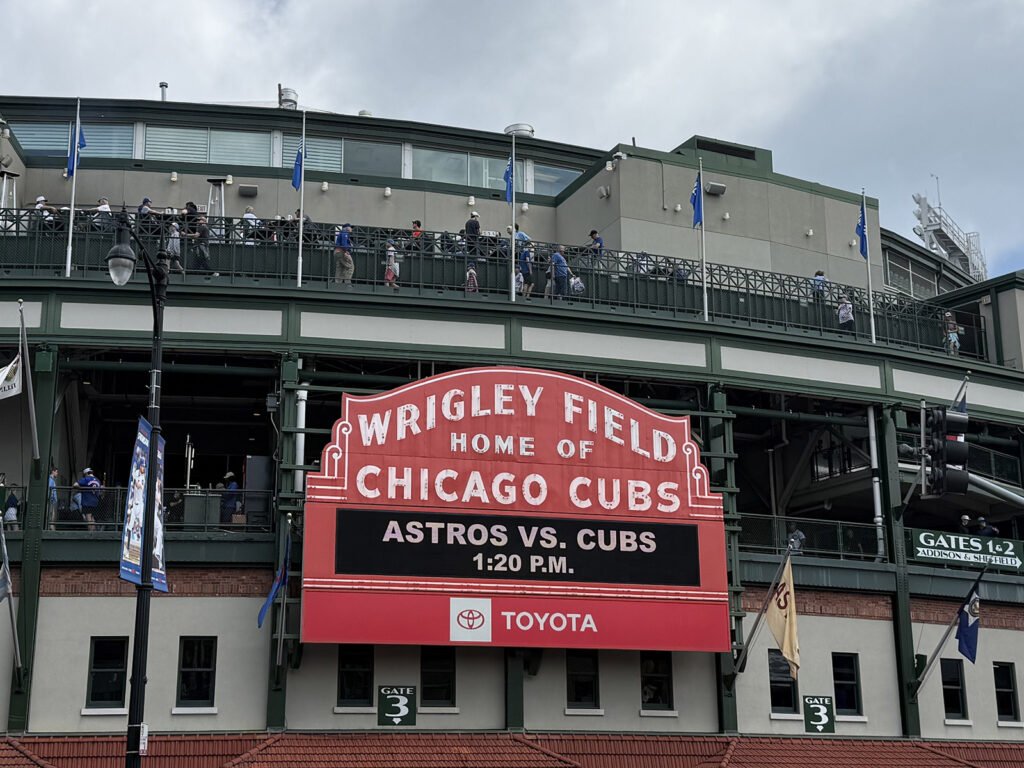
Wrigley Field’s atmosphere is different from Fenway’s, but just as historic.
The ivy. The bleachers. The hand-operated scoreboard. The rooftops. The day games. The neighborhood. The wind. The long curse. The eternal “maybe next year” energy that finally broke in 2016.
Wrigley feels like baseball nostalgia made physical.
For generations, Cubs fans packed the ballpark despite heartbreak, bad teams, and the weight of a championship drought that became part of the franchise’s identity. That loyalty gave Wrigley an emotional softness even when the team was losing. When the Cubs became contenders, that same atmosphere turned desperate and electric.
Among stadium atmospheres, Wrigley matters because it shows how a venue can hold pain beautifully. The ballpark isn’t intimidating in the same way as a deafening football stadium, but it carries a deep emotional charge.
Some places roar.
Wrigley sighs, hopes, panics, sings, and occasionally explodes.
That’s baseball too.
Madison Square Garden
Madison Square Garden calls itself the world’s most famous arena, and the atmosphere can justify the arrogance when the moment is right.
The Garden’s power comes from New York. The crowd is sharp, loud, impatient, knowledgeable, celebrity-filled, and fully capable of turning on the home team if insulted by poor effort. That tension gives big games at MSG a unique feel. The approval means something because it isn’t handed out cheaply.
For Knicks games, the Garden can become one of the loudest and most emotional arenas in basketball when the team gives fans a reason. For Rangers playoff games, it can feel cold, intense, and old-school. For boxing, college basketball, and historic events, the building carries even more layers.
Among stadium atmospheres, Madison Square Garden matters because it has judgment built into it. It doesn’t just cheer. It evaluates. New York makes every great moment louder and every failure sharper.
Some arenas support.
The Garden cross-examines.
The Maracanã
The Maracanã in Rio de Janeiro is one of world soccer’s most legendary stadiums.
Its atmosphere is tied to Brazil’s football soul: noise, color, rhythm, pressure, joy, anxiety, and the weight of a country that treats the sport like a language. The stadium has hosted massive matches, World Cup moments, Olympic scenes, and club rivalries filled with emotion.
The Maracanã’s mythology also includes pain, especially Brazil’s 1950 World Cup loss to Uruguay, one of the most famous national heartbreaks in sports history. That defeat became part of the stadium’s ghost story.
Among stadium atmospheres, the Maracanã stands out because it carries national memory. It isn’t only a place where games happen. It’s a place where Brazil’s relationship with football has been celebrated and wounded in public.
That kind of atmosphere is deeper than noise.
It’s history pressing down from every seat.
La Bombonera
La Bombonera, home of Boca Juniors in Argentina, has one of the most intense atmospheres in soccer.
The stadium is famous for its steep stands, passionate supporters, and the feeling that the building shakes when the crowd gets going. Boca fans create a wall of sound and motion that can make the venue feel alive in a literal sense.
A big match there, especially the Superclásico against River Plate, is one of global soccer’s fiercest environments. The passion is not decorative. It’s overwhelming, tribal, and deeply tied to identity.
Among stadium atmospheres, La Bombonera belongs because it represents soccer as emotional excess. The crowd doesn’t simply watch. It participates with songs, banners, jumping, noise, and pressure that can make the match feel like a civic emergency.
Some stadiums are intimidating because they’re large.
La Bombonera is intimidating because it feels like the walls are moving.
The Palestra
The Palestra in Philadelphia is one of college basketball’s great old gyms.
It doesn’t have the scale of massive arenas, but it has history layered into every corner. Known as the “Cathedral of College Basketball,” the Palestra has hosted countless games, rivalries, and city basketball memories. Its atmosphere comes from intimacy and tradition.
Philadelphia basketball has a particular edge: tough, opinionated, proud, and deeply connected to local identity. The Palestra captures that. A game there can feel like basketball stripped down to its essentials: hardwood, crowd noise, school pride, and history hanging close enough to touch.
Among stadium atmospheres, the Palestra matters because not every legendary venue needs luxury boxes or giant screens. Some buildings are powerful because the game feels closer to its roots inside them.
The Palestra doesn’t overwhelm with size.
It wins with soul.
Oracle Arena
Before the Warriors moved to Chase Center, Oracle Arena had one of the NBA’s best atmospheres.
The “We Believe” Warriors upset of the Dallas Mavericks in 2007 showed the building at its wildest, with fans creating a playoff environment that felt hungry, loud, and slightly unhinged. Later, during the Stephen Curry dynasty years, Oracle became a place where joy and fear mixed together.
The crowd knew a three-point storm could start at any moment.
That anticipation gave Oracle a special energy. A Curry shot, a Klay Thompson heater, a Draymond Green defensive play — one spark could turn the arena into chaos. The building felt connected to the team’s style: fast, loud, emotional, and explosive.
Among stadium atmospheres, Oracle stands out because it bridged underdog desperation and dynasty confidence. Fans had suffered before the winning. That made the rise feel earned.
The Warriors moved into a shinier building.
But Oracle kept the mythology.
The Superdome
The Superdome in New Orleans has one of the most emotionally charged atmospheres in American sports.
It’s loud, enclosed, and perfectly suited for Saints football when the team is good. But the building’s meaning goes far beyond noise. After Hurricane Katrina, the Superdome became a symbol of suffering and survival. When the Saints returned in 2006 and Steve Gleason blocked a punt against the Falcons, the stadium became a place of civic release.
That moment changed how fans understood the building.
Among stadium atmospheres, the Superdome matters because it holds trauma and joy in the same space. A Saints game there can feel like football, party, church, and public therapy all colliding. New Orleans knows how to make sound feel communal, and the dome traps that energy until it becomes overwhelming.
Some venues are loud because fans care.
The Superdome is loud because the city has lived through too much to cheer politely.
Why Some Stadiums Become Mythic
The best stadium atmospheres become mythic when the venue develops a personality separate from the team.
A team can have a good crowd for a few seasons. A mythic stadium has an identity that survives rosters. Lambeau is Lambeau no matter who plays quarterback. Anfield is Anfield before kickoff. Cameron is Cameron even when Duke is rebuilding. Fenway and Wrigley are emotional landmarks even in bad seasons.
That’s the difference.
A great atmosphere needs repetition. Same songs. Same chants. Same colors. Same rituals. Same stories told to new fans until the building feels inherited. Over time, the stadium becomes a memory machine.
Fans don’t only attend games there.
They add themselves to the place.
The Legacy of Stadium Atmospheres
The legacy of stadium atmospheres is that they prove sports are not only played by athletes.
Arrowhead turns noise into strategy. Lambeau Field makes football feel frozen into tradition. Death Valley makes Saturday night in Baton Rouge feel dangerous. Cameron Indoor makes a small building feel suffocating. Anfield turns a song into pressure. The Big House turns scale into ceremony. Beaver Stadium’s White Out becomes a visual storm. The Horseshoe makes expectation feel heavy. Allen Fieldhouse turns basketball history into sound. Fenway and Wrigley make baseball feel haunted and beloved. Madison Square Garden gives every big moment New York judgment. The Maracanã carries national memory. La Bombonera shakes with soccer obsession. The Palestra keeps basketball close to its roots. Oracle Arena turned joy into noise. The Superdome gave New Orleans a place to scream together.
Great stadium atmospheres matter because they make home feel like more than location.
They make it feel like force.
The field is the same size everywhere.
The court has the same lines.
The rink has the same ice.
But some places make opponents feel like the building itself has chosen a side.