
Championship droughts change the way fans experience time.
A normal losing season lasts a few months. A championship drought can last long enough to pass through grandparents, parents, children, and grandchildren. Players arrive, become stars, slow down, retire, and enter the Hall of Fame without bringing home the trophy everyone was waiting for.
The uniforms change.
The stadium gets replaced.
The league expands.
The team finds a new owner, a new coach, a new general manager, and another supposedly can’t-miss prospect.
The drought remains.
That’s when losing stops being a temporary result and becomes part of the franchise’s identity. Fans start expecting the worst before anything has gone wrong. A late lead feels dangerous. A promising postseason run feels less like hope and more like the opening act of a new way to suffer.
The most famous championship droughts also attract mythology. Fans blame curses, ghosts, trades, animals, bad owners, unlucky buildings, and mistakes made decades before the current roster was born. Every collapse becomes evidence that the drought has developed a personality.
Then, sometimes, the team finally wins.
That’s when an ordinary championship becomes something much larger. It becomes a release for people who spent their whole lives wondering whether they’d ever see it.
Why Championship Droughts Become Family History
Championship droughts last in memory because fandom rarely begins with one person.
Teams get inherited. A parent teaches a child which colors to wear, which rival to hate, and which old loss still shouldn’t be mentioned during dinner. The child may never have watched the famous collapse live, but eventually the pain feels borrowed and personal anyway.
That’s why drought-ending championships produce such emotional celebrations. Fans aren’t only reacting to the players on the field. They’re thinking about the people who took them to games, listened on radios, kept old ticket stubs, wore the same fading cap, and didn’t live long enough to see the ending.
A long drought gives the championship a cast of invisible witnesses.
The team lifts the trophy in the present.
The celebration belongs to several generations.
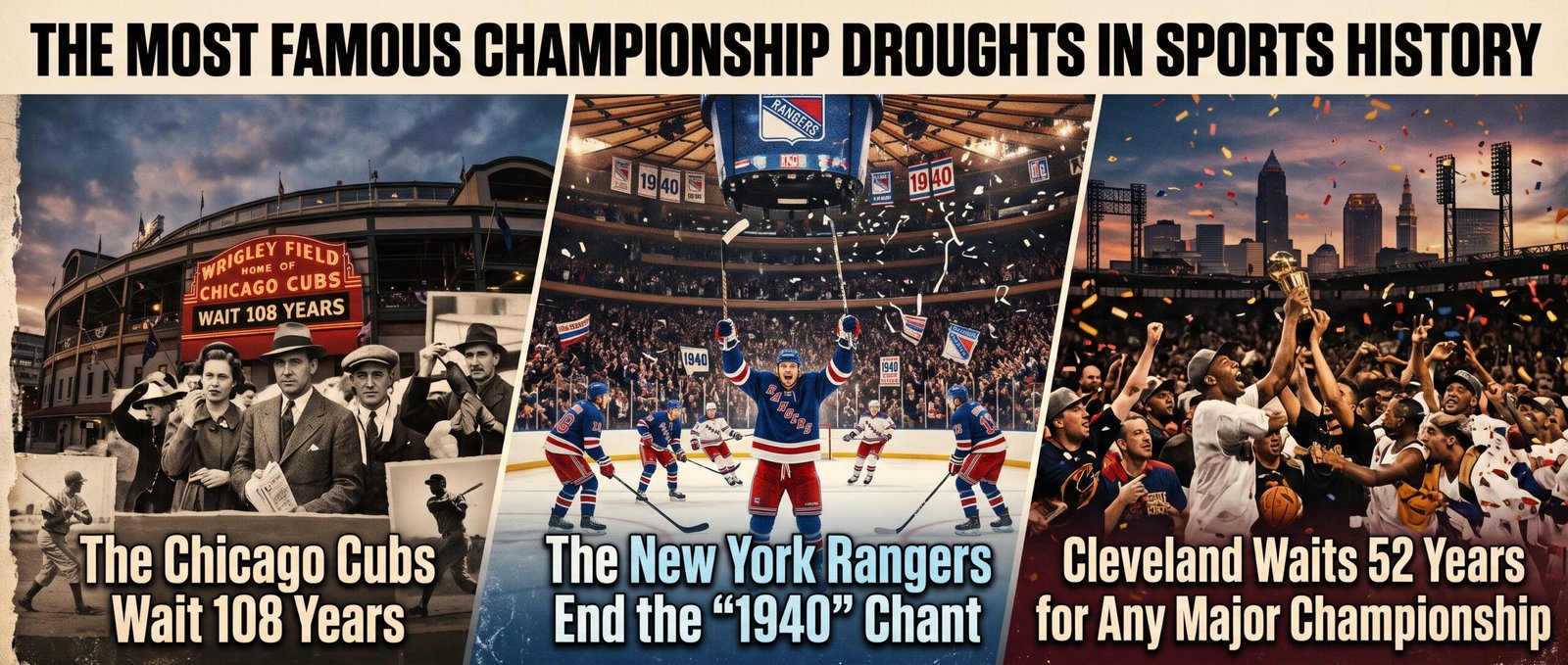
The Chicago Cubs Wait 108 Years
The Chicago Cubs’ 108-year wait remains the defining championship drought in major North American sports.
The Cubs won the World Series in 1907 and 1908, then spent more than a century chasing the next one. During that time, the franchise became associated with the Curse of the Billy Goat, the 1969 collapse, the heartbreak of 1984, the Steve Bartman game in 2003, and the permanent promise that maybe next year would finally be different.
Usually, it wasn’t.
Wrigley Field remained beautiful. The fanbase remained loyal. The drought kept turning Chicago’s North Side into the home of baseball’s lovable losers, a title that sounded affectionate until another promising season ended badly.
Then the 2016 Cubs won 103 regular-season games and reached the World Series against Cleveland, another franchise carrying generations of disappointment. Chicago fell behind three games to one, fought back, and reached a Game 7 that seemed specifically designed to test every old fear.
The Cubs built a lead.
Cleveland came back.
Rajai Davis tied the game with an eighth-inning home run.
Rain delayed extra innings.
Then Ben Zobrist drove in the go-ahead run, Chicago survived the bottom of the 10th, and the 108-year wait finally ended with an 8-7 victory.
The Cubs didn’t simply win a World Series.
They escaped their most famous identity.
For the first time in generations, “wait until next year” stopped being a joke.
The Chicago White Sox End an 88-Year Wait
The other side of Chicago had its own enormous drought.
The White Sox won the World Series in 1917, then became connected to one of baseball’s darkest scandals when several players from the 1919 team were accused of conspiring to throw the World Series. The Black Sox scandal gave the franchise a shadow that lasted far longer than the careers of anyone involved.
By 2005, the White Sox had gone 88 years without another championship.
Then Ozzie Guillén’s team turned October into a sprint.
Chicago swept the defending champion Red Sox in the Division Series, defeated the Angels in five games, and swept the Houston Astros in the World Series. The White Sox finished the postseason 11-1 and won 16 of their final 17 games when the end of the regular season is included.
The championship didn’t receive the same endless national mythology that surrounded Boston in 2004 or the Cubs in 2016. That doesn’t make the release smaller.
South Side fans had waited nearly nine decades.
Their team ended the drought by leaving almost no room for one final collapse.
The Boston Red Sox Break the Curse
The Boston Red Sox spent 86 years carrying the Curse of the Bambino.
Boston had won five of the first 15 World Series, including the 1918 title. Then the Red Sox sold Babe Ruth to the New York Yankees. Ruth became baseball’s greatest early superstar, the Yankees became an empire, and Boston became the rival that always seemed to find a new way to lose.
The drought collected iconic pain.
Bucky Dent’s home run in 1978.
Bill Buckner’s error in 1986.
Aaron Boone’s walk-off homer in 2003.
By 2004, Red Sox fans didn’t need to be taught how to expect disaster. It was part of the culture.
Then Boston fell behind the Yankees 3-0 in the American League Championship Series.
The ending looked familiar until it didn’t.
Dave Roberts stole second in Game 4. Bill Mueller tied the game. David Ortiz won it in extra innings. Ortiz delivered again in Game 5. Curt Schilling pitched the bloody-sock game in New York. Boston won Game 7 at Yankee Stadium, becoming the first MLB team to overcome a 3-0 postseason series deficit.
The Red Sox then swept the St. Louis Cardinals and won their first championship since 1918.
That’s why this remains one of the greatest drought endings in sports history.
Boston didn’t avoid the Yankees on its way to freedom.
It came back from the dead in their house.
The Philadelphia Phillies Finally Win in 1980

The Philadelphia Phillies were founded in 1883 and spent nearly a century without winning a World Series.
There were pennants, stars, promising teams, and repeated failures. By 1980, the organization understood the window around Mike Schmidt, Steve Carlton, Pete Rose, Greg Luzinski, Garry Maddox, Larry Bowa, and Tug McGraw couldn’t remain open forever.
The Phillies survived an exhausting National League Championship Series against Houston, with four of the five games going to extra innings. They then defeated the Kansas City Royals in six games to win the first World Series title in franchise history.
The ending produced one of baseball’s great celebration images. McGraw struck out Willie Wilson, leapt into the air, and Philadelphia finally had the championship its oldest professional franchise had spent generations chasing.
The Phillies’ wait wasn’t surrounded by one famous curse.
It didn’t need one.
Ninety-seven seasons of trying created enough pressure without supernatural help.
The New York Rangers End the “1940” Chant
For decades, rival hockey fans could torment the New York Rangers with one number.
That was the last year the Rangers had won the Stanley Cup. As the drought stretched across five decades, the number became a chant, an insult, and a reminder that one of hockey’s most famous franchises couldn’t finish the job.
The 1993-94 Rangers entered the postseason as the Presidents’ Trophy winner, but the path still became brutal. New York survived a seven-game Eastern Conference Final against the New Jersey Devils, then faced the Vancouver Canucks in another seven-game series.
The Rangers won Game 7 at Madison Square Garden, 3-2, ending a 54-year championship drought. Captain Mark Messier scored what became the Cup-winning goal, Brian Leetch won the Conn Smythe Trophy, and the Garden erupted when the final seconds disappeared.
The emotional word attached to the night was relief.
That makes sense.
When a drought lasts 54 years, winning doesn’t initially feel like ordinary joy.
It feels like putting down something the whole city had been carrying.
Cleveland Waits 52 Years for Any Major Championship
Cleveland’s drought wasn’t limited to one franchise.
The Browns won the 1964 NFL championship. Then the city entered 52 years of shared sports pain across the Browns, Cavaliers, and baseball franchise.
The losses became famous enough to earn names.
The Drive.
The Fumble.
The Shot.
The 1997 World Series collapse.
LeBron James leaving for Miami.
Cleveland wasn’t only waiting for a champion. It was fighting a national image as the city where sports hope eventually turned into humiliation.
Then LeBron returned.
In the 2016 NBA Finals, the Cavaliers fell behind the 73-win Golden State Warriors three games to one. No NBA team had ever recovered from that deficit in the Finals.
Cleveland won Game 5.
Then Game 6.
Then Game 7 in Oakland, behind LeBron’s chase-down block, Kyrie Irving’s three-pointer, and Kevin Love’s final defensive stand against Stephen Curry.
The Cavaliers’ victory ended Cleveland’s 52-year citywide championship drought.
That title meant more than the first championship in Cavaliers history.
It changed the city’s relationship with every old loss.
The wounds still existed.
They no longer controlled the ending.
Some Championship Droughts Are Still Growing
Not every historic wait has found its conclusion.
The Cleveland Guardians haven’t won the World Series since 1948. They’ve returned to the World Series several times, including a seven-game loss to the Cubs in 2016, but the drought remained the longest active wait in Major League Baseball through the 2026 season.
The Sacramento Kings franchise won its only NBA championship in 1951, when it was still known as the Rochester Royals. The organization later moved through Cincinnati and Kansas City before reaching Sacramento, but it hasn’t returned to the NBA Finals since that title.
The Toronto Maple Leafs won their 13th Stanley Cup in 1967, the final season of the NHL’s Original Six era. They haven’t returned to the Stanley Cup Final since, turning every promising Toronto season into another test of one of hockey’s most emotionally exhausted fanbases.
The NFL has its own inherited waits. The Arizona Cardinals’ most recent league championship came in 1947, when the franchise still played in Chicago. The Detroit Lions last won in 1957. Seattle won Super Bowl LX after the 2025 season, so neither of those long waits ended before the 2026 campaign began.
These droughts don’t all feel the same.
Some franchises have reached the final round and fallen inches short.
Others have spent long stretches without even creating a serious championship chance.
But the result is identical every offseason.
The banners still stop at the same year.
Why Ending a Drought Feels Bigger Than Winning
A championship always matters.
Ending a drought changes the meaning of the championship.
The players aren’t only beating the opponent in front of them. They’re confronting every failed team, missed opportunity, joke, curse, collapse, and funeral where somebody said they hoped the franchise would win one eventually.
That pressure can be unfair to the current roster.
A 25-year-old player didn’t cause something that happened in 1967, 1957, or 1948. Yet the athlete still walks into a stadium filled with people carrying those dates.
That’s why drought-ending celebrations can feel less like ordinary sports victories and more like civic events.
Strangers hug.
Families visit graves.
Old footage returns.
People cry over athletes they’ve never met because the title closes a story that began before those players were born.
The Legacy of Championship Droughts
The legacy of championship droughts is that they turn time into part of the competition.
The Cubs waited 108 years and needed one of the wildest Game 7s ever played to escape. The White Sox waited 88 years, then tore through the postseason with an 11-1 record. The Red Sox turned 86 years of curses and Yankees heartbreak into the greatest series comeback in baseball history. The Phillies waited through nearly a century of franchise history before winning in 1980. The Rangers survived 54 years of “1940” chants before lifting the Cup at Madison Square Garden. Cleveland carried 52 years of pain across three franchises before LeBron James brought the city a championship.
Other waits continue.
Cleveland baseball still looks back to 1948.
The Kings still look back to Rochester in 1951.
The Lions still look back to 1957.
The Maple Leafs still look back to 1967.
That’s what championship droughts do.
They make old dates feel present.
They turn each promising season into a negotiation between belief and self-protection. Fans want to imagine the parade, but they’ve learned how much imagination can hurt.
Then one team finally finishes.
The clock stops.
The old year loses its power.
And an entire fanbase gets to replace “maybe someday” with a sentence people may have waited their whole lives to say:
We finally won.