Trades that backfired are some of the most painful mistakes in sports.
A bad draft pick hurts because a team chose wrong. A bad free-agent signing hurts because money got wasted. But a terrible trade has a sharper kind of sting because the team already had something valuable in its hands.
Then it gave it away.
That’s what makes trades that backfired so fascinating. They aren’t always obvious disasters at the time. Sometimes the logic makes sense. A team needs money. A star wants out. A franchise wants draft picks. A front office thinks it’s selling high. An owner wants to cut costs. A roster needs a reset. A contender wants the final piece. A rebuilding team wants the future.
Then history starts laughing.
The player who left becomes a legend. The draft picks turn into a dynasty. The prospect turns into a superstar. The veteran declines. The rebuild collapses. The fanbase watches someone else celebrate with the player it used to cheer for.
The worst trades that backfired don’t just damage one season.
They rewrite whole franchises.
Why Trades That Backfired Hurt So Much
Trades that backfired hurt because they create a permanent comparison.
Every time the traded player succeeds, the old team gets dragged back into the mistake. Every award, playoff run, championship, highlight, and Hall of Fame speech becomes evidence. Fans don’t have to imagine the player in their uniform because they already saw it. That’s the cruelest part.
The regret isn’t abstract.
It has old photos.
A trade can also change how fans trust a front office. One terrible deal can make every future move feel suspicious. Fans start asking if the team knows what it’s doing. They remember the mistake whenever another star gets mentioned in rumors.
A trade that works can build a champion.
A trade that backfires can become a curse with paperwork.
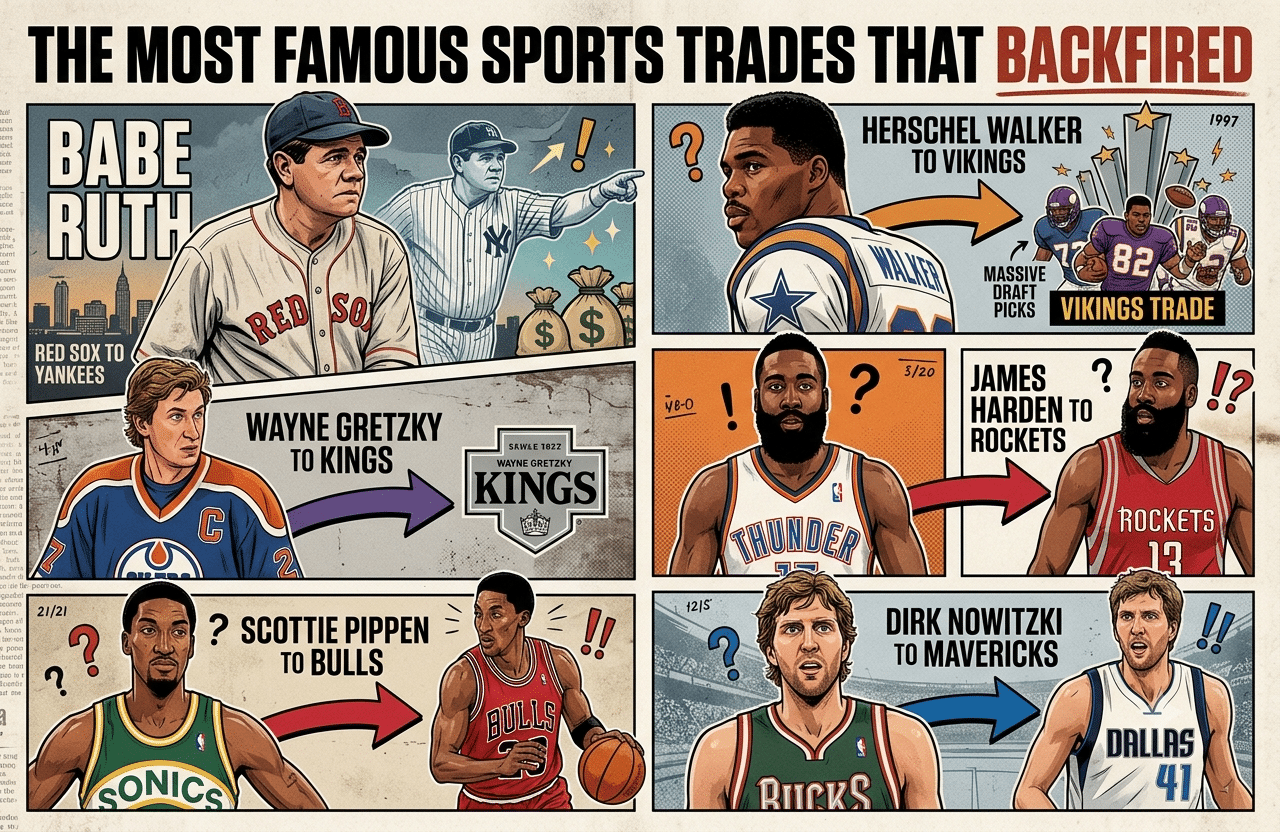
Babe Ruth to the Yankees
The most famous trade that backfired in sports history wasn’t technically a modern trade the way fans think of one now. It was a sale.
But spiritually, Babe Ruth leaving the Boston Red Sox for the New York Yankees belongs on every list of trades that backfired.
The Red Sox sold Ruth to the Yankees after the 1919 season. Ruth had already shown extraordinary talent as both a pitcher and hitter, but nobody fully knew he was about to become the most transformative power hitter baseball had ever seen.
Then he became Babe Ruth.
In New York, Ruth changed the sport. He made home runs glamorous, turned the Yankees into baseball’s most powerful franchise, and became the central figure in one of American sports’ greatest myths. The Yankees won title after title. The Red Sox entered an 86-year championship drought that became known as the Curse of the Bambino.
That’s why this deal stands alone. Boston didn’t just lose a great player. It gave its rival the figure who helped build an empire.
Some mistakes cost games.
This one helped create the Yankees.
Herschel Walker to the Vikings
The Herschel Walker trade is the NFL’s ultimate warning label.
In 1989, the Minnesota Vikings traded a massive package of players and draft picks to the Dallas Cowboys for running back Herschel Walker. Minnesota believed Walker could be the superstar piece that pushed the team toward a championship.
Instead, the trade helped build the Cowboys dynasty.
Dallas used the haul from the deal to acquire and develop key pieces around Troy Aikman, Emmitt Smith, Michael Irvin, and Jimmy Johnson’s rebuilding machine. The Cowboys won three Super Bowls in the 1990s.
The Vikings didn’t get the championship they chased.
This is one of the greatest trades that backfired because the damage was two-sided. Minnesota failed to get enough from Walker, while Dallas turned the assets into the foundation of a dynasty. That’s the worst possible outcome for the team making the all-in move.
The Vikings didn’t just lose a trade.
They helped create someone else’s golden age.
James Harden to the Rockets
The Oklahoma City Thunder trading James Harden to the Houston Rockets in 2012 remains one of the NBA’s great what-if decisions.
The Thunder had Kevin Durant, Russell Westbrook, Serge Ibaka, and Harden. They had just reached the NBA Finals. They were young, explosive, and looked like the future of the league. Harden was coming off the bench, but his talent was obvious.
Then contract negotiations failed, and Oklahoma City traded him.
In Houston, Harden became an MVP, a scoring champion, and one of the most important offensive players of his era. The Thunder remained competitive, but the dynasty many expected never happened. Durant eventually left. Westbrook eventually left. The young core that looked ready to own the West never won a championship together.
This belongs among the biggest trades that backfired because Oklahoma City had three future MVPs on the same roster.
That sounds almost impossible.
Keeping all three would’ve been expensive and complicated, but the basketball regret is enormous. The Thunder didn’t trade a useful player.
They traded a superstar before he fully became one.
That’s the kind of mistake fans never stop replaying.
Wayne Gretzky to the Kings
Wayne Gretzky being traded from the Edmonton Oilers to the Los Angeles Kings in 1988 shocked the hockey world.
Gretzky wasn’t merely a star. He was the greatest hockey player alive, the face of the sport, and the centerpiece of an Oilers dynasty. Edmonton had won four Stanley Cups with him. Trading him felt almost impossible.
The deal had business logic, but emotionally, it was devastating.
For Edmonton fans, it was heartbreak. For Los Angeles, it was a turning point. Gretzky brought credibility, attention, and star power to hockey in Southern California. His arrival helped grow the NHL’s presence in nontraditional markets and changed the league’s future.
So did the trade backfire?
For Edmonton emotionally, yes. The Oilers did win another Stanley Cup in 1990 without Gretzky, which complicates the story. But losing the greatest player ever in his prime remains one of the most painful sports trades imaginable.
Among trades that backfired, Gretzky’s move is different because it wasn’t only about wins and losses.
It was about a franchise selling a piece of its soul.
Dirk Nowitzki to the Mavericks
The Milwaukee Bucks technically drafted Dirk Nowitzki in 1998, then traded him to the Dallas Mavericks in a draft-night deal involving Robert “Tractor” Traylor.
At the time, Dirk was a mystery to many NBA fans. A tall German forward with shooting touch sounded interesting, but not necessarily like a future league-changing superstar. Traylor, meanwhile, was a powerful college player with an NBA body.
History made its choice quickly.
Nowitzki became one of the greatest power forwards ever, an MVP, a Finals MVP, and the face of the Mavericks for more than two decades. His 2011 championship run remains one of the most respected title runs in NBA history.
Traylor never came close to that level.
This is one of the clearest trades that backfired because the gap between what Milwaukee gave up and what it received became enormous. Dirk didn’t just become good. He became a franchise icon and helped redefine what a seven-footer could be offensively.
The Bucks had him.
Then Dallas got forever.
Scottie Pippen to the Bulls
On draft night in 1987, the Seattle SuperSonics selected Scottie Pippen and traded him to the Chicago Bulls.
That decision helped change NBA history.
Pippen became Michael Jordan’s perfect running mate, one of the greatest defenders ever, and an essential piece of six Bulls championships. His versatility, playmaking, length, and basketball intelligence gave Chicago the shape it needed to become a dynasty.
Seattle, meanwhile, had strong teams later with Gary Payton and Shawn Kemp, but never won a championship before the franchise eventually relocated to Oklahoma City.
This belongs among trades that backfired because Pippen wasn’t a minor piece. He became one of the most important players of the 1990s and helped power one of the most famous dynasties in sports history.
Of course, draft-night trades can be complicated, and teams make decisions based on scouting, fit, and information available at the time. But the result is brutal.
Seattle drafted a future Hall of Famer.
Chicago got the dynasty.
Brett Favre to the Packers
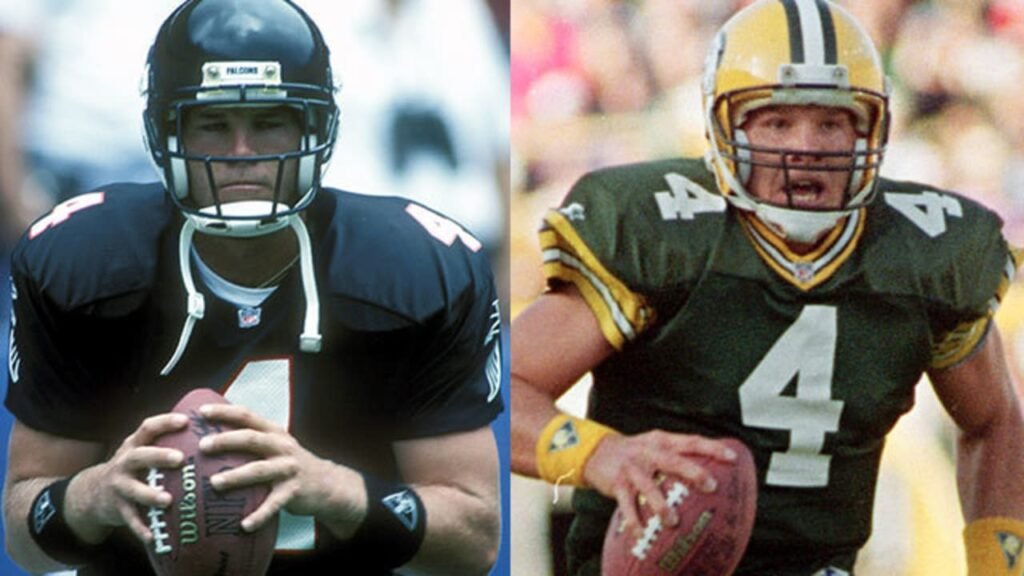
The Atlanta Falcons drafted Brett Favre in 1991, then traded him to the Green Bay Packers after one season.
Favre had talent, but he was raw, wild, and not fully trusted in Atlanta. The Packers saw something more. They traded for him, and the rest became Green Bay football history.
Favre became a three-time MVP, a Super Bowl champion, and one of the most beloved and chaotic quarterbacks in NFL history. His arm, toughness, improvisation, and reckless confidence helped revive the Packers as a national power.
The Falcons later had successful periods, but trading Favre remains one of the franchise’s great what-ifs.
This is one of those trades that backfired because the original team didn’t fully understand what it had. Favre wasn’t polished, and there were valid concerns, but the ceiling was enormous. Green Bay accepted the risk and got a legend.
Atlanta got a reminder that quarterbacks are dangerous to give away too early.
Especially the wild ones.
Sometimes wild is the gift.
Nolan Ryan to the Angels
The New York Mets traded Nolan Ryan to the California Angels after the 1971 season in a deal that brought back Jim Fregosi.
At the time, Ryan was a hard-throwing but erratic pitcher. The Mets had pitching depth, and Ryan hadn’t yet become the legendary strikeout machine fans remember. Fregosi was an established player. The logic wasn’t insane.
The outcome was.
Ryan became one of the most famous pitchers in baseball history, throwing seven no-hitters, piling up strikeouts, and building a career based on velocity, durability, and intimidation. Fregosi struggled with the Mets and never justified the cost.
This belongs among the classic trades that backfired because Ryan’s development exploded after leaving New York. The Mets didn’t trade the fully formed legend, but they traded the arm that became one.
That distinction matters, but it doesn’t soothe fans.
Baseball is full of prospects who never figure it out.
Ryan did.
Just not for the Mets.
Pedro Martinez to the Expos
The Los Angeles Dodgers traded Pedro Martinez to the Montreal Expos after the 1993 season for Delino DeShields.
The Dodgers had concerns about Pedro’s size and whether he could hold up as a starter. That kind of evaluation has haunted teams before. Martinez wasn’t built like the traditional workhorse, but his talent was electric.
In Montreal, then later Boston, Pedro became one of the most dominant pitchers in baseball history. His peak with the Red Sox was outrageous, especially during an offensive era when hitters were putting up huge numbers. Pedro’s combination of command, movement, intelligence, and competitiveness made him almost untouchable at his best.
This is one of the great trades that backfired because the Dodgers gave up a future inner-circle pitching legend before fully trusting what he could become.
DeShields was a useful player.
Pedro was Pedro.
That’s the sentence that decides the trade.
Jeff Bagwell to the Astros
The Boston Red Sox traded Jeff Bagwell to the Houston Astros in 1990 for reliever Larry Andersen.
At the time, Boston was chasing immediate help for a playoff push. Andersen was a veteran reliever who could help right away. Bagwell was a minor league prospect blocked in Boston’s system and not yet seen as a future franchise legend.
Then Bagwell became exactly that.
In Houston, he won Rookie of the Year, MVP, and became one of the best first basemen of his generation. His power, patience, and all-around offensive game made him the face of the Astros for years.
Andersen pitched only briefly for Boston.
This belongs among trades that backfired because it’s the classic short-term rental disaster. The team chasing October gave up a player who could’ve anchored its lineup for a decade.
Every contender understands the temptation.
Win now. Fix the bullpen. Patch the weakness.
But sometimes the rental costs a Hall of Famer.
That’s how regret gets expensive.
Lou Brock to the Cardinals
The Chicago Cubs trading Lou Brock to the St. Louis Cardinals in 1964 became one of baseball’s most famous mistakes.
The Cubs sent Brock to St. Louis in a deal involving pitcher Ernie Broglio. At the time, Brock hadn’t fully become the player he would later be. Broglio had been a strong pitcher, so the trade had some surface logic.
Then Brock became a Cardinals legend.
He helped St. Louis win the World Series in 1964, became one of baseball’s greatest base stealers, and built a Hall of Fame career. Broglio’s career declined quickly after the trade.
This is one of the essential trades that backfired because it immediately punished the Cubs. Brock didn’t just become great someday. He helped the Cardinals win right away.
That’s the worst kind of regret.
A slow-developing mistake hurts over time.
An immediate mistake kicks the door in.
Kawhi Leonard to the Spurs
The Indiana Pacers drafted Kawhi Leonard in 2011, then traded him to the San Antonio Spurs in a deal centered around George Hill.
At the time, Hill was a solid guard and a player the Pacers valued. Leonard was a defensive-minded wing prospect with questions about his shooting and offensive ceiling. The trade didn’t look outrageous in the moment.
Then San Antonio did what San Antonio often did.
The Spurs developed Leonard into a superstar. He became a Finals MVP in 2014, a two-time Defensive Player of the Year, and eventually one of the league’s most dominant playoff performers. His growth helped extend the Spurs’ championship window and changed the trajectory of his career.
This belongs among trades that backfired because Indiana gave up a player who became exactly the kind of two-way wing every modern team desperately wants.
To be fair, many teams underestimated Leonard’s ceiling.
But the Pacers had him.
Then they didn’t.
That’s the painful part.
Steve Young to the 49ers
The Tampa Bay Buccaneers traded Steve Young to the San Francisco 49ers in 1987 after his rough early NFL years.
At the time, Young looked like a talented but uncertain quarterback on a bad team. Tampa Bay wasn’t exactly the ideal environment for development, and his struggles made it easier to move on.
San Francisco became the perfect landing spot.
Young learned behind Joe Montana, developed under one of football’s smartest organizations, and eventually became a Hall of Fame quarterback. He won MVP awards, led the 49ers to a Super Bowl title, and became one of the best dual-threat quarterbacks of his era.
This is one of the trades that backfired because it shows how environment can change everything. Tampa Bay saw a struggling quarterback. San Francisco saw talent that needed time, structure, and a better situation.
The trade looks lopsided now because Young’s best football happened elsewhere.
Sometimes a team doesn’t just trade a player.
It trades away the possibility of what that player could become with competent help.
Chris Paul to the Rockets
Not every trade that backfires looks terrible immediately.
The Houston Rockets trading Chris Paul to the Oklahoma City Thunder for Russell Westbrook in 2019 is a modern example of a move that aged badly fast.
Houston had pushed the Warriors harder than almost anyone with James Harden and Paul. The partnership had tension and injury concerns, but when healthy, it worked at an elite level. The Rockets decided to pivot, pairing Harden with Westbrook in a move built around star power and speed.
The fit was awkward.
Houston eventually collapsed into a rebuild. Paul, meanwhile, revived his reputation in Oklahoma City and later helped lead the Phoenix Suns to the NBA Finals.
This belongs among trades that backfired because Houston moved away from a formula that had nearly worked and chose a louder, less balanced version of star power. The Rockets didn’t trade a young unknown who blossomed later. They traded an aging star they thought was fading.
He wasn’t done.
That misread changed everything.
Why Teams Make Bad Trades
Teams make bad trades because front offices are human, impatient, pressured, and often trapped by circumstances.
Owners want money saved. Coaches want veterans. Stars want help. Fans want action. Windows feel short. Injuries create panic. Contract negotiations get ugly. A player’s personality may frustrate the organization. A prospect may be blocked. A team may convince itself that fit matters more than ceiling.
Sometimes the logic is understandable.
That’s what makes trades that backfired so interesting. Many weren’t cartoonishly stupid in the moment. They became disasters because one side evaluated the future better than the other.
The future is the whole game.
Any team can trade for what a player is.
Great teams understand what a player might become.
The Legacy of Trades That Backfired
The legacy of trades that backfired is that they haunt sports history because they leave receipts.
Babe Ruth built the Yankees after leaving Boston. Herschel Walker’s deal helped Dallas build a dynasty. James Harden became an MVP after Oklahoma City traded him. Dirk Nowitzki became the Mavericks’ greatest player after Milwaukee moved him. Scottie Pippen helped Chicago win six championships after Seattle dealt him. Brett Favre revived Green Bay after Atlanta gave up. Nolan Ryan became a legend after the Mets traded him. Pedro Martinez became one of baseball’s most dominant pitchers after leaving the Dodgers. Jeff Bagwell became an Astros icon after Boston rented bullpen help. Lou Brock punished the Cubs almost immediately. Kawhi Leonard became a Spurs champion after Indiana moved him.
Every trade is a bet on time.
Sometimes the bet wins a championship.
Sometimes it builds one for someone else.
That’s why bad trades live forever. They give fans a villain, a mistake, a turning point, and a question that never dies.
How did they not see it?