

A great trade can change a team.
A shocking trade can change a sport.
The most shocking trades in sports history don’t just move players from one uniform to another.
They rearrange power. They break fanbases. They create curses, dynasties, conspiracy theories, bitter anniversaries, and debates that still make people mad decades later.
Some trades are shocking because the player is too great to imagine leaving, some because the return looks absurd, and some because nobody saw them coming.
Others become that way with time, once everyone realizes one team just gave away a legend and another team just stole the future.
Trades are supposed to be business. Fans know that. But sports never stays business for long.
Slowly but surely, a superstar becomes part of a city’s emotional furniture.
He’s on murals, jerseys, commercials, birthday cakes, bar signs, and childhood walls.
Then suddenly he’s gone, replaced by prospects, draft picks, financial excuses, and a press conference where everyone pretends this was alwats part of the plan.
That’s why the most shocking trades in sports history continue to be talked about.
They remind fans that no player is untouchable, no era is permanent, and no front office decision is too wild to become real.
Why the Most Shocking Trades in Sports History Hit So Hard
The most shocking trades in sports history hit hard because they violate a fan’s sense of order.
Fans know players move. They know aging veterans get dealt. They know bad teams sell. But certain athletes feel different. They feel too important to trade. Too famous. Too tied to the city. Too central to the franchise’s identity.
Then the news breaks.
At first, fans think it’s fake.
Then they check again.
Then the official account posts it.
Then comes the disbelief turns into anger, grief, or numb laughter.
That emotional whiplash is what makes a trade legendary.
Babe Ruth to the New York Yankees
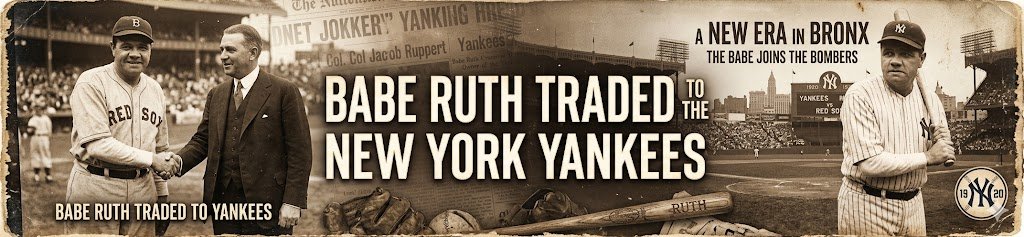
The Babe Ruth sale still might be the most important transaction in American sports history.
The Boston Red Sox sold Ruth’s contract to the New York Yankees in a deal officially announced in January 1920. The actual purchase price was $100,000, according to research cited by the National Baseball Hall of Fame.
At the time, Ruth was already a remarkable talent.
With the Yankees, he became something larger: the face of baseball’s power era, the sport’s first true home run god, and the foundation of the Yankees’ empire.
For Boston, the sale became mythological disaster.
The Red Sox didn’t win another World Series until 2004, creating the famous “Curse of the Bambino” story. Whether you believe in curses or not, the emotional math is brutal. Boston gave away Babe Ruth. New York became New York. The Red Sox spent 86 years hearing about it.
That’s why Ruth to the Yankees belongs at the top of any list of the most shocking trades in sports history, even though it was technically a sale.
It didn’t just shift one player.
It changed baseball’s balance of power for generations.
Wayne Gretzky to the Los Angeles Kings
Wayne Gretzky being traded sounds wrong even now.
In 1988, Gretzky was the centerpiece of the Edmonton Oilers dynasty.
He was the greatest hockey player alive, and maybe the greatest hockey player ever.
Edmonton had just won another Stanley Cup.
Then, on August 9, 1988, Gretzky was sent to the Los Angeles Kings in what the NHL itself calls the biggest trade in league history.
The shock wasn’t just that a superstar moved. It was that Gretzky moved.
Some athletes feel bigger than their contracts.
Gretzky felt like public property in Canada, a national treasure wearing an Oilers sweater. Seeing him in Kings colors was jarring, almost unreal.
But the trade also changed hockey’s future. Los Angeles became relevant.
Hockey gained a brighter spotlight in Southern California. The NHL’s growth into nontraditional markets became easier to imagine because Gretzky gave the sport star power where it hadn’t fully existed.
For Edmonton fans, it was heartbreak. For the NHL, it was expansion of the imagination.
That’s what shocking trades do.
They wound one place and breathe new life into another.
Herschel Walker to the Minnesota Vikings
The Herschel Walker trade is one of the most infamous deals in NFL history because it helped build a dynasty for the team that traded away the star.
In 1989, the Dallas Cowboys sent Herschel Walker to the Minnesota Vikings in a massive deal involving players and draft picks. NFL.com later described the trade as a boon for the Cowboys and a bust for the Vikings.
At the time, Minnesota thought it was landing the missing piece.
Walker was a premier running back, and the Vikings believed he could push them toward a Super Bowl. Dallas, meanwhile, was bad and rebuilding.
Then the deal aged like a crime scene.
The Cowboys used the assets from the trade to help build the foundation of their 1990s dynasty.
Dallas won three Super Bowls in four seasons.
Minnesota never got the championship it was chasing with Walker.
That’s why the Walker trade remains legendary.
It’s not only shocking because of the size of the deal.
It’s shocking because one team thought it was buying a title and accidentally financed someone else’s empire.
Luka Dončić to the Los Angeles Lakers
The Luka Dončić trade still feels fake.
In February 2025, the Dallas Mavericks traded Luka Dončić to the Los Angeles Lakers in a blockbuster three-team deal. NBA.com reported that Dallas sent Dončić to Los Angeles in exchange for Anthony Davis, Max Christie, and a 2029 first-round pick, with additional players and picks involved through Utah.
The shock came from Luka’s age, talent, and timing. He was 25. He’d already led Dallas to the NBA Finals. He looked like the kind of player a franchise keeps for the next decade, builds statues for, and never willingly lets leave.
Then he was gone.
That’s why Luka to the Lakers instantly entered the conversation around the most shocking trades in sports history. It wasn’t a fading star getting moved. It wasn’t a rebuild cash-out.
It was a franchise player, still in his prime, going to the NBA’s glamour franchise in a deal that stunned fans, executives, and players alike.
Some trades become historic slowly.
This one became historic the moment people realized it was real.
Kareem Abdul-Jabbar to the Los Angeles Lakers
Before Shaq, before LeBron, before Luka, the Lakers landed another giant: Kareem Abdul-Jabbar.
In 1975, the Milwaukee Bucks traded Kareem Abdul-Jabbar and Walt Wesley to the Los Angeles Lakers for Elmore Smith, Brian Winters, Junior Bridgeman, and Dave Meyers.
Kareem had already won a championship in Milwaukee.
He was one of the most dominant players in basketball.
Players like that usually define franchises forever. Instead, he became part of the Lakers’ long tradition of acquiring massive stars and turning them into Los Angeles mythology.
The trade changed the Lakers’ future. Kareem became central to the Showtime era with Magic Johnson and helped build one of the NBA’s most iconic dynasties.
For Milwaukee, it was the pain of losing a generational player. For Los Angeles, it was another reminder that some cities seem built to collect legends.
Kareem’s trade belongs here because it helped shape the NBA’s star movement story long before modern player empowerment became part of the language.
Miguel Cabrera to the Detroit Tigers
The Miguel Cabrera trade didn’t have the same public shock as Ruth, Gretzky, or Luka, but in baseball terms, it was enormous.
In December 2007, the Florida Marlins traded Miguel Cabrera and Dontrelle Willis to the Detroit Tigers in a six-for-two deal. MLB later summarized the swap as Cabrera and Willis going to Detroit for Andrew Miller, Cameron Maybin, Burke Badenhop, Mike Rabelo, Dallas Trahern, and Frankie De La Cruz.
Cabrera was only 24 and already one of the best young hitters in baseball.
Players like that almost never become available. Detroit didn’t just get a star. It got a franchise-altering bat who would become one of the greatest hitters of his generation.
For the Marlins, the trade fit a familiar pattern of moving expensive talent. For Tigers fans, it became a gift that kept giving for years.
Not every shocking trade is loud on day one. Some become shocking because time reveals how much one team actually got.
Cabrera to Detroit aged that way.
Why Superstar Trades Feel Like Betrayal
Fans know trades are part of sports, but superstar trades still feel like betrayal.
That’s because fans don’t think like general managers. They think in memories. They remember the playoff run, the jersey purchase, the signature move, the postgame interview, the kid who copied the player in the driveway.
A front office sees contracts and assets. A fan sees identity.
That’s especially true when a team trades a player who still seems central to the future.
Ruth, Gretzky, Kareem, Luka, Cabrera — these weren’t random names. These were players who shaped how fans understood the franchise.
When a team trades someone like that, the message feels cold: nobody belongs to you.
That might be true.
Fans still hate hearing it.
The Legacy of the Most Shocking Trades in Sports History
The most shocking trades in sports history prove that sports can change overnight.
One signature can build a dynasty. One phone call can break a fanbase. One trade can turn a struggling team into a champion, send a superstar into a new mythology, or haunt a franchise for generations.
Babe Ruth made the Yankees into a baseball empire and left Boston with a curse story.
Wayne Gretzky took hockey into Los Angeles and broke Edmonton’s heart.
Herschel Walker gave Dallas the tools to build a dynasty.
Kareem Abdul-Jabbar helped set up the Lakers’ future.
Miguel Cabrera became a Detroit legend.
Luka Dončić to the Lakers reminded everyone that even the most untouchable-looking modern superstar can suddenly be gone.
That’s the strange thrill of trades.
They’re paperwork at first.
Then they become history.